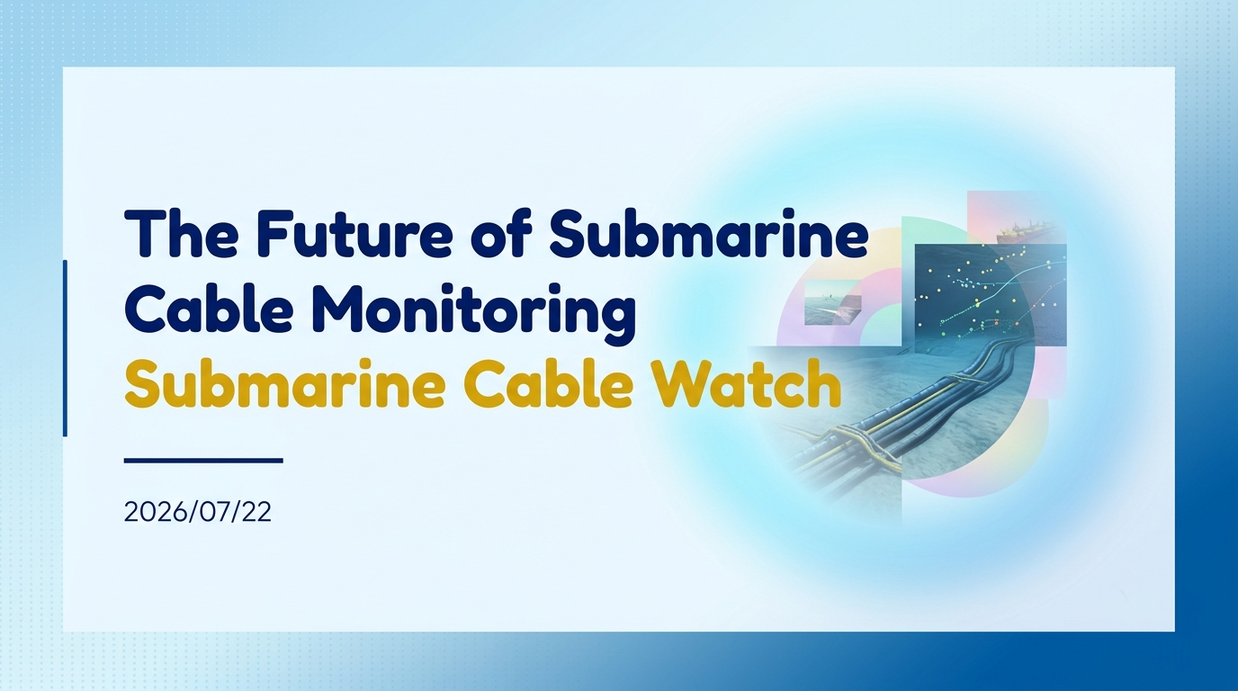
On July 21, 2026, Space Data Inc. released a free prototype version of the “Submarine Cable Watch,” which supports monitoring submarine cables. Although it is a critical infrastructure responsible for about 99% of international communications, this initiative aims to strengthen capabilities in marine situational awareness (MDA) by visualizing damage risks occurring on the unseen seabed using digital twin technology.
- Overview of Submarine Cable Watch
- The Role and Dependence of Submarine Cables
- Current Status of Damage Risks Threatening Marine Infrastructure
- Suspicious Vessel Detection Using AIS and Satellite Data
- Risk Scoring Based on Terrain Data
- Response to Seabed Warfare and Public-Private Partnership
- Analysis of Damage Risks and Legal Challenges
- Near-real-time integration and advanced satellite integration
- Expansion of the surveillance market toward 2032
Overview of Submarine Cable Watch
On July 21, 2026, Space Data Inc., the company behind the space AI platform “SpaceBrain,” publicly released a prototype version of “Submarine Cable Watch,” which supports submarine cable monitoring near Japan, free of charge. This system visualizes approximately 3,270 submarine cable route data in 3D on a digital twin space that reproduces real seabed topography in high definition. Please refer to the diagram below.
The Role and Dependence of Submarine Cables
Submarine cables are an extremely important infrastructure that should be called the main artery of information in today’s digital society. According to a report by the Ministry of Internal Affairs and Communications, about 99% of our country’s international communications are handled by submarine cables, while satellites account for only 1%. This proportion has become even more important with the advent of the AI society, with nearly all of daily $10 trillion in financial transactions and military and diplomatic classified communications passing through this cable network. Since 2015, investments by giant IT companies known as hyperscalers, such as Google and Meta, have also accelerated, and by 2027, it is predicted that these companies will be involved in over 70% of new projects. For Japan, an island nation surrounded by the sea on all sides, the stable operation of submarine cables is not only a key issue for economic activity but also a fundamental issue for national security. However, since most of these are laid down in deep waters, they are extremely vulnerable to threats such as physical damage, cyberattacks, or eavesdropping through espionage.
Current Status of Damage Risks Threatening Marine Infrastructure
Worldwide, there are about 100 to 200 cases of submarine cable failures each year, with causes that vary widely. According to a survey by the International Committee for the Protection of Submarine Cables (ICPC), about 40.8% of damage is due to fishing activities, and about 15.8% is due to the use of anchors by ships, with human factors accounting for just over 60% of the total. In particular, the East China Sea and South China Sea around Japan are not only active in fishing but also have a high concentration of damage incidents due to their topographical characteristics, making them regions with a remarkably high frequency of repairs worldwide. Please refer to the diagram below.
Advanced visualization and vessel monitoring technologies
Suspicious Vessel Detection Using AIS and Satellite Data
One of the innovative features of Submarine Cable Watch is its mechanism to detect vessels—so-called dark vessels—that are not transmitting location information, by matching satellite images with AIS information. Normally, ships larger than a certain size are required to carry AIS and transmit signals, but there are vessels that intentionally stop transmitting and sail. By utilizing the Vessel Watch system provided by Space Data, it automatically detects ships at sea using SAR (Synthetic Aperture Radar) and optical satellites, and matches the detection results with AIS reception data. If AIS information exists despite satellite confirmation, the vessel is highlighted on the map as suspected Dark Vessel. This allows for a visual understanding of where and which ships do not appear in the AIS near Japan. This technology holds the potential not only to reduce the risk of human damage but also to dramatically enhance situational awareness capabilities in maritime security.
Risk Scoring Based on Terrain Data
This system not only calculates the distance between submarine cables and vessels, but also conducts risk analysis based on multifaceted data. Seabed topography data uses tools like GEBCO, which display depth slices from 0m to 8,000m, allowing 3D confirmation of the terrain the cable passes through. Please refer to the diagram below. The
The Importance of MDA in Maritime Security
Response to Seabed Warfare and Public-Private Partnership
The concept of Seabed Warfare, which views the seabed as a new security domain, is rapidly spreading, especially in Europe and the United States. Because submarine infrastructure is physically invisible, it carries the paradox of invisibility, where its importance is only recognized when it is damaged. However, as the cost of deep-sea operations decreases, sabotage using unmanned aerial systems and similar methods has become easier. Since submarine cables are mostly owned and operated by private companies, protection requires broad collaboration not only with military and government agencies but also with private actors. The Submarine Cable Watch uses a lightweight implementation that runs solely through a browser and does not require the installation of dedicated software. This is expected to serve as a communication platform where stakeholders from different positions—such as telecommunications operators, Japan Coast Guard, Ministry of Defense, policymakers, and researchers—can share the ocean situation while viewing the same screen. Having a shared awareness of the situation between the public and private sectors directly leads to strengthening national resilience and protecting critical infrastructure.
Analysis of Damage Risks and Legal Challenges
One of the factors making submarine cable protection difficult is the limitations of the legal system. Article 113 of the United Nations Convention on the Law of the Sea (UNCLOS) requires countries to punish acts of cable damage on the high seas, but in reality, many countries lack established domestic laws, and there are cases where it is difficult to legally punish damage caused by foreign-flagged vessels navigating the Exclusive Economic Zone (EEZ). Especially in areas like the East China Sea, where multiple countries are intertwined, enforcement is restricted by fisheries agreements and other means, making physical monitoring and fact-keeping extremely important. Surveillance systems on digital twins, such as Submarine Cable Watch, visually record evidence of suspicious behavior and provide data that supports future legal development, international rulemaking, and even identifying causes when damage occurs. Currently, discussions on protected zones, which are only designated within territorial waters, should be considered as technical support to extend them to the EEZ. Visualization through technology is the first step toward making legal and diplomatic safeguards effective.
Future developments and growth of the surveillance market
Near-real-time integration and advanced satellite integration
Starting with the release of the prototype, the Submarine Cable Watch is planned to see further feature expansions in the future. Currently, the system combines accumulated real data with hypothetical scenarios, but going forward, we plan to advance near-real-time AIS information through regular data acquisition. Additionally, integration with commercial satellite data will be gradually strengthened, and by increasing the frequency of observations by SAR and optical satellites, monitoring accuracy in the waters around the cable will be improved. Furthermore, we are refining risk assessment algorithms using AI and considering implementing features that automatically predict and notify abnormal movements based on past navigation patterns. We also plan to enhance the robustness of the visualization platform itself, including a multi-stage fallback function to guard against external data distribution disruptions. These efforts are expected to evolve from mere visualization tools into intelligence platforms that directly support situational awareness and decision-making in actual operations.
Expansion of the surveillance market toward 2032
The global market for submarine cable monitoring solutions is expected to experience significant growth in the future. According to market analysis reports, the market is projected to expand from approximately USD 300 million in 2025 to USD 482 million by 2032, with a compound annual growth rate (CAGR) of 7.2%. This growth is driven not only by the installation of new submarine cables due to rising international communication demand, but also by the expansion of energy infrastructure such as offshore wind power. Monitoring technology is essential for the stable operation of submarine power cables, with demand surging in both telecommunications and marine energy. In Japan, major suppliers such as NEC hold a major share of the global market, but along with securing vessels and strengthening maintenance systems, the importance of monitoring solutions on the software side is increasing. The adoption of digital twin technology by startups like Space Data will become a powerful tool for Japanese suppliers and telecommunications operators to maintain and strengthen global competitiveness, greatly contributing to enhancing resilience as a maritime power.
Reference Page
-
[Space Data Inc. Press Release] https://spacedata.jp/news/submarine_cable_watch
-
[Ministry of Internal Affairs and Communications: Report of the Study Group on the Protection of International Submarine Cables, etc.https://www.soumu.go.jp/main_sosiki/joho_tsushin/policyreports/chousa/kokusai_kaitei_cable/index.html
-
[Ministry of Defense: Seabed Warfare as a New Domain]https://www.mod.go.jp/msdf/navcol/SSG/topics-column/index.html
-
【United Nations Convention on the Law of the Sea (UNCLOS)】https://www.un.org/Depts/los/convention_agreements/texts/unclos/unclos_e.pdf
[#海底ケーブル #経済安全保障 #デジタルツイン #海洋状況把握 #宇宙AI #インフラ防護 #MDA #科学技術]


コメント