In a speech delivered in September 2026, Bank of Japan Policy Board Member Kazuyuki Masu stated that negative real interest rates should be resolved as early as possible, signaling a positive stance toward further rate hikes. This comes against the backdrop of underlying inflation approaching the 2% target driven by rising labor and energy costs, aimed at avoiding the risk of abrupt rate increases should inflation accelerate unexpectedly.
- Essential Points on Rate Hikes from Policy Board Statements
- Eliminating Negative Real Rates and Warning Against Accelerating Inflation
- Speculation Over a 1.25% Policy Rate and the Neutral Rate Barrier
- Foreign Exchange Volatility and Risks in the JGB Market
- Corporate Capital Expenditure Intentions and the Wage-Price Virtuous Cycle
- Mortgage Burden Concerns and Key Indicators for Future Rate Decisions
Essential Points on Rate Hikes from Policy Board Statements
Bank of Japan (BOJ) Policy Board Member Kazuyuki Masu expressed his view during speeches and press conferences in September 2026 that current financial conditions—where real interest rates remain negative—should be resolved as early as possible. Although the BOJ raised its policy interest rate target to around 1.0% at its Monetary Policy Meeting in June 2026, real interest rates remain at an extremely low level. Board Member Masu emphasized that achieving the sustainable and stable 2% price stability target is drawing remarkably close, making further rate increases essential to completing monetary policy normalization. He explained that firmly placing the policy rate within the estimated neutral rate range will establish a framework enabling nimble monetary operations tailored to economic conditions. Speculation is rapidly rising that the BOJ will decide to raise the policy rate to around 1.25% at its upcoming Monetary Policy Meeting on September 17–18, 2026, drawing significant market attention as this would mark an additional hike just three months after the June action. Please refer to the diagram below.
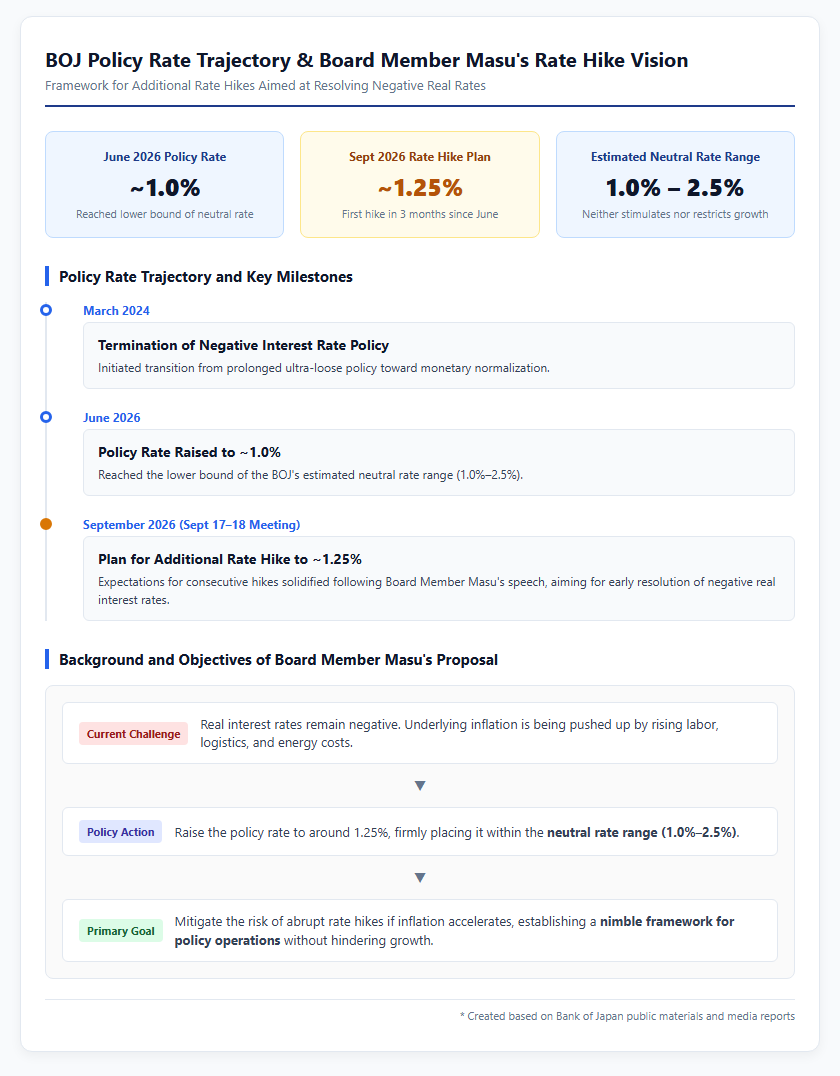
His comments strongly suggest that a shared commitment to steadily advancing monetary normalization is taking firm root within the central bank.
Eliminating Negative Real Rates and Warning Against Accelerating Inflation
The primary driver behind Board Member Masu’s push for timely rate increases is a strong sense of urgency to prevent a scenario where the central bank is forced into rapid, aggressive tightening if inflation accelerates unexpectedly. In the current economic climate, rising labor and logistics costs are increasingly passed through to retail prices for goods and services, clearly pushing up underlying inflation. Furthermore, concerns are rising that fuel and chemical price increases stemming from escalating tensions in the Middle East and Iran could exert persistent upward pressure across the broader economy rather than remaining a temporary shock. Should underlying inflation surge well above the 2% target, the BOJ might be compelled to execute abrupt monetary tightening without due consideration for economic growth, potentially derailing the virtuous cycle of moderate price and wage growth. At the same time, Masu emphasized a “data-dependent” approach, stressing that the BOJ does not adhere to a predetermined schedule and will cautiously evaluate economic and inflation data at every meeting. He outlined a policy path aimed at maintaining both positive real wages and price stability through timely and appropriate policy adjustments, without undermining domestic economic growth through excessive rate hikes.
Acceleration of Monetary Normalization and Financial Market Trends
Speculation Over a 1.25% Policy Rate and the Neutral Rate Barrier
Market participants are rapidly consolidating expectations that the BOJ will raise its policy rate to around 1.25% at its September 2026 meeting. The BOJ estimates Japan’s neutral interest rate—the rate level that neither stimulates nor restricts economic growth—to fall within a broad range of 1.0% to 2.5%. When the policy rate reached 1.0% in June 2026, it touched the lower bound of this neutral range; however, real policy interest rates adjusted for inflation remain deep in negative territory. Nevertheless, the upper limit of the terminal rate faces strong constraints from Japan’s fiscal structure and its capacity to absorb rising debt-servicing costs. Analyst estimates indicate that the ceiling for the policy rate at which the government debt-to-GDP ratio can remain stable without diverging is roughly 1.0% to 1.25%. If rate hikes continue beyond 1.5%, debt-servicing burdens would surge sharply, risking the exhaustion of fiscal flexibility. Consequently, once the BOJ implements an increase to 1.25%, monetary policymakers will need to navigate an exceptionally delicate path, carefully assessing economic growth rates and long-term fiscal sustainability.
Foreign Exchange Volatility and Risks in the JGB Market
Following Board Member Masu’s hawkish comments endorsing additional rate hikes, yen-buying moves intensified in foreign exchange markets amid narrowing U.S.-Japan interest rate differentials, temporarily pushing the dollar-yen pair down to 153.29 yen. Market participants are increasingly focusing not only on nominal rate differentials but also on real interest rate spreads. The BOJ’s stance on rate adjustments is being watched closely as a means to prevent a vicious cycle where a weaker yen pushes up import costs and further inflates domestic prices. Meanwhile, in the Japanese Government Bond (JGB) market, the supply of bonds available to the public is reaching historically high levels as the BOJ executes its phased reduction in bond purchases. The 10-year JGB yield is maintaining an upward trend, and real interest rates in the super-long maturity sector have reached elevated levels even when compared to major overseas markets. To prevent excessive market volatility, the BOJ retains the flexibility to nimbly increase bond purchases if long-term yields surge unexpectedly; however, unrealized losses at financial institutions and shifts in bond supply-demand dynamics remain latent risk factors that could destabilize broader financial markets.
Economic Impacts and Future Outlook
Corporate Capital Expenditure Intentions and the Wage-Price Virtuous Cycle
Despite consecutive interest rate increases, business sentiment and investment appetite among Japanese corporations remain resilient. According to the BOJ’s June 2026 Tankan survey, the business conditions diffusion index (DI) remained strong at +22 for large manufacturers and +37 for non-manufacturers, while capital expenditure plans across all industries and firm sizes for fiscal year 2026 showed solid growth of +6.8% year-on-year. Structural demand for digitalization, labor-saving technology, and AI-related investments continues to support capital spending, with no signs that rising borrowing costs are severely cooling corporate activity. In corporate pricing behavior, price pass-through mechanisms—transferring higher raw material and labor costs to final product prices—have become widely entrenched. Furthermore, the 2026 spring labor-management negotiations achieved high base pay increases, securing a third consecutive year of strong wage growth and pushing real wages back into positive territory. Please refer to the diagram below.
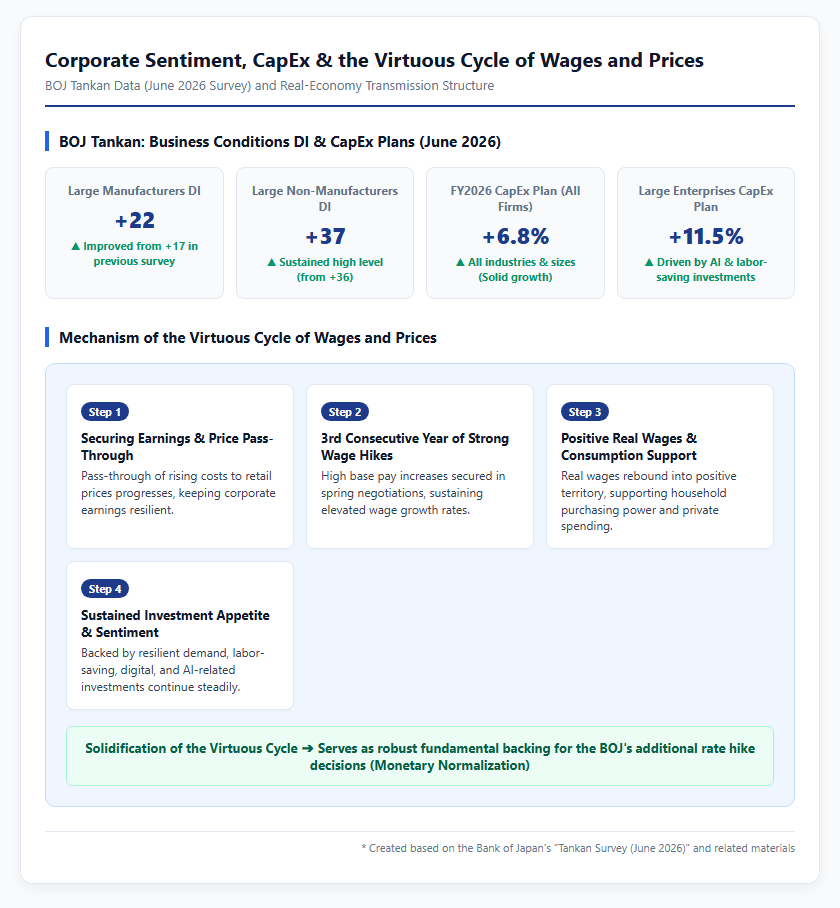
The solidifying “virtuous cycle of wages and prices”—wherein companies maintain profitability while continuing wage hikes, which in turn supports consumer spending—provides robust fundamental backing for further policy rate increases.
Mortgage Burden Concerns and Key Indicators for Future Rate Decisions
As interest rate hikes pick up momentum, rising mortgage interest rates are rapidly emerging as a tangible concern for households. Approximately 75.0% of new mortgage borrowers choose floating-rate loans, but increases in the policy rate translate directly into higher variable loan rates via short-term prime rates. Meanwhile, driven by rising long-term interest rates, the most frequent interest rate for Flat 35 full-term fixed-rate mortgages has reached 3.14%, making household defense measures against increasing repayment burdens an urgent priority. Looking ahead, the paramount point of focus is the pace at which the BOJ will proceed with additional rate hikes while adhering to its “data-dependent” framework beyond September 2026. The BOJ will judge the timing of future hikes by thoroughly examining corporate inflation outlooks in the September Tankan, Consumer Price Index (CPI) trends, and the impact of Middle East-driven energy cost inflation on private consumption. Navigating the dual challenges of guarding against upside inflation risks while avoiding an economic slowdown caused by overly aggressive tightening will determine the trajectory of Japan’s economy.
Reference Pages
- [Bank of Japan] https://www.boj.or.jp/research/brp/rer/rerb260515.htm
【#BankOfJapan #MonetaryPolicy #InterestRateHikes #BoardMemberMasu #RealInterestRates #ForeignExchange #JapaneseEconomy】

コメント