Although the Bank of Japan raised its policy interest rate to 1.25% in September 2026, the foreign exchange market continues to see a weak-yen trend centered around the 157 to 158 yen range per U.S. dollar. The background to this includes an accommodative environment in which Japan’s real interest rates remain deeply negative even after the rate hike, expectations that U.S. high interest rates will persist for a prolonged period, and structural changes in the external balance that rarely involve converting foreign currency into yen.
- Key points of the event: Re-rate hike to 1.25% and continuation of monetary easing
- Continuous rate hikes at 3-month intervals and a shift to a hawkish stance
- Japan-US interest rate differential and expectations of prolonged high interest rates in the United States
- Structural Factors Behind the Weak Yen and the Impact of Trade and Digital Balances
- First US-Japan Joint Intervention in 28 Years and Temporary Recovery to the 155-Yen Level
- Future Outlook and Key Points: Scenarios and Risks for a Reversal to a Stronger Yen
Key points of the event: Re-rate hike to 1.25% and continuation of monetary easing
At its Monetary Policy Meeting on September 18, 2026, the Bank of Japan decided to raise the policy interest rate (the uncollateralized overnight call rate) by 0.25 percentage points, from the previous 1.0% to 1.25%. This rate hike was approved by a majority vote of 7 to 2 and was implemented at an unusually short interval of just three months since the previous hike. This represents a clear acceleration from the traditional pace of “roughly once every six months.” However, even following the rate hike, the foreign exchange market has not shifted significantly toward a stronger yen, with the currency continuing to trade in the 157 to 158 yen range against the US dollar. In a speech on October 6, Governor Kazuo Ueda reiterated his view that current financial conditions remain accommodative even after the policy rate hike and do not suppress economic activity. While the BOJ proceeds with monetary tightening, real interest rates remain in negative territory, resulting in a situation where the effects of monetary easing persist and downward pressure on the yen cannot be fully contained.
The following chart shows the Bank of Japan’s policy interest rate hikes and exchange rate movements.
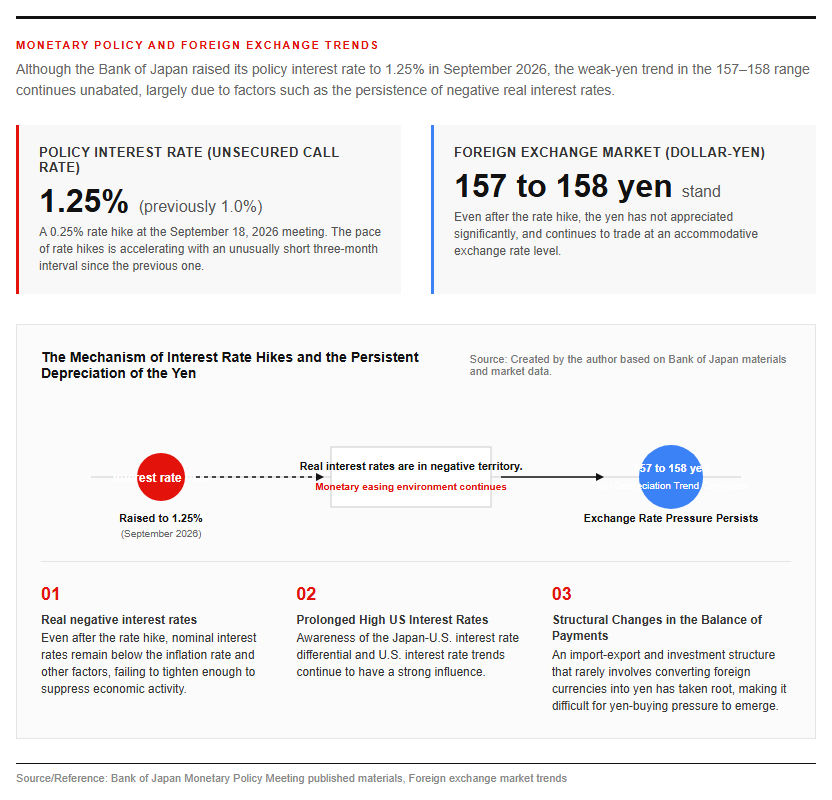
- Policy rate: Raised to 1.25% in September 2026 (accelerating 3 months after the previous rate hike)
- Market reaction: Yen buying remains limited even after the interest rate hike announcement, with the weak yen continuing in the 157–158 yen range against the dollar.
- Financial Environment: Real interest rates are significantly negative and remain in accommodative territory.
Continuous rate hikes at 3-month intervals and a shift to a hawkish stance
Behind the Bank of Japan’s acceleration of its pace of interest rate hikes is caution over the growing risk of further upward pressure on prices, as domestic underlying inflation approaches the 2% target. Governor Ueda pointed out that rising crude oil prices due to escalating tensions in the Middle East, the expansion of artificial intelligence-related investment, and a persistent weak yen are potential concerning factors that could drive up import prices. According to the Shunto wage negotiation results compiled in July 2026, wage hikes exceeded 5% for the third consecutive year, and the trend of companies raising wages and selling prices is becoming firmly entrenched. The BOJ is shifting its policy focus from the “stage of pushing up underlying inflation” to the “stage of aiming for stability at 2%.” Meanwhile, the September meeting exposed divisions in policymaking, as two board members appointed under the Takaichi administration voted against the rate hike. The focus is now on whether the bank will implement a third consecutive rate hike at its upcoming meeting on October 29 and 30, 2026.
- Factors pushing up prices: prolonged depreciation of the yen, escalating tensions in the Middle East, and surging demand for AI investment.
- Wage Trends: 2026 Shunto Wage Increase Rate Records an Average of 5.01%, Maintaining High Levels
- Policy Focus: Whether or not to implement consecutive rate hikes at the Monetary Policy Meeting in late October 2026
Why the Yen Continues to Depreciate Despite Narrowing Interest Rate Differentials
Japan-US interest rate differential and expectations of prolonged high interest rates in the United States
In financial theory, rising interest rates on a domestic currency due to rate hikes are considered a factor for yen appreciation; however, the actual dollar-yen exchange rate is structured in a way that it is heavily influenced by U.S. interest rate trends. Market analysis estimates that about 80% of the force driving the dollar-yen exchange rate comes from U.S. interest rate factors, while Japan’s interest rate impact remains at around 20%. The U.S. Federal Reserve set its policy interest rate at 4.0% at its September 2026 meeting. Under Fed Chair Warsh, the stance placing emphasis on curbing inflation has strengthened, and there is a persistent view in the market that the high-interest-rate environment will be maintained for an extended period. Even as the Bank of Japan steadily proceeds with rate hikes and the policy interest rate differential between the U.S. and Japan formally trends narrower, the incentive for carry trades—buying dollars and selling yen—has not disappeared due to the magnitude of the absolute interest rate gap. As long as expectations of further U.S. rate hikes remain strong, it is extremely difficult to fundamentally reverse the weak-yen trend solely through the BOJ’s unilateral rate hikes.
- U.S. Policy Rate: Maintained at 4.0% as of September 2026
- Market Dominance: Approximately 80% of fluctuations in the USD/JPY exchange rate are driven by US interest rates
- Carry trade: Yen-selling positions continue against the backdrop of the absolute interest rate differential between Japan and the US
Structural Factors Behind the Weak Yen and the Impact of Trade and Digital Balances
Changes in Japan’s external balance structure are also a major factor preventing upward pressure on the yen, despite the ongoing current account surplus. In 2025, Japan’s current account balance posted a record surplus of 32.2 trillion yen. However, the primary income surplus of 41.8 trillion yen—the main driver of this figure—largely consists of reinvested earnings, which are the retained profits of overseas subsidiaries. Because reinvested earnings do not involve the direct conversion of foreign currencies into yen, they do not generate upward pressure on the yen in the actual foreign exchange market. Furthermore, the deficit in the digital-related balance, driven by the use of overseas cloud services and software, reached 6.7 trillion yen in 2025, creating structural foreign currency-selling and yen-buying demand. Moreover, the trade balance has failed to show a dramatic improvement due to rising imports of AI-related equipment and the impact of energy resource prices amid the Middle East situation. These structural changes in both supply and demand form the foundation supporting the ongoing weak-yen trend.
The diagram below shows Japan’s external balance structure and its impact on yen-buying pressure.
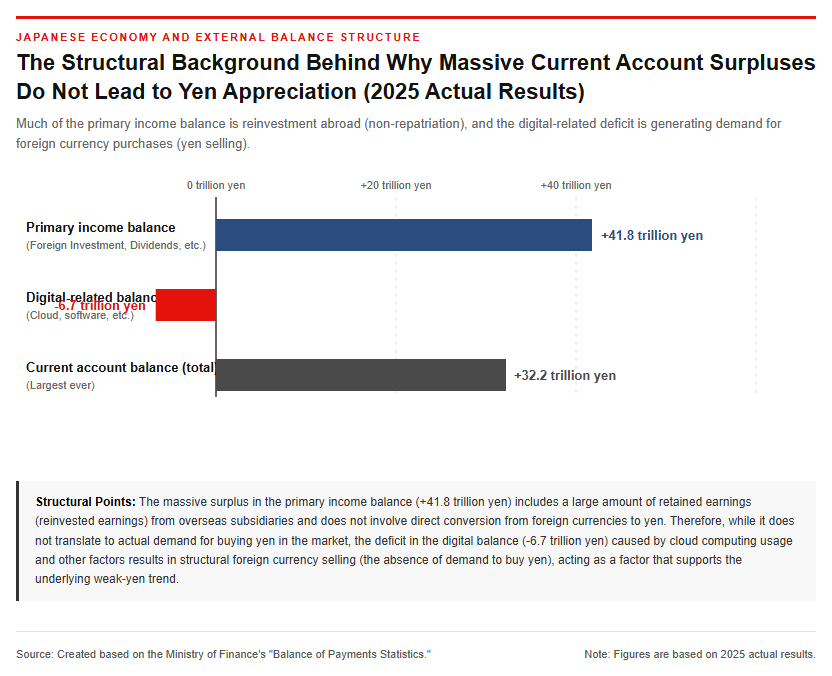
- 2025 Current Account Balance: Record High Surplus of 32.2 Trillion Yen Posted
- Primary Income Balance: A surplus of 41.8 trillion yen, but with large reinvestment earnings, demand to convert to yen is limited.
- Digital Balance of Payments: A persistent annual deficit of around 6.7 trillion yen has taken root, functioning as a structural factor for yen selling.
The Effects of Foreign Exchange Intervention and Future Outlook
First US-Japan Joint Intervention in 28 Years and Temporary Recovery to the 155-Yen Level
In response to the excessive depreciation of the yen, the Japanese and U.S. governments implemented a joint yen-buying, dollar-selling intervention for the first time in 28 years. Under close coordination between Japanese Finance Minister Satsuki Katayama and U.S. Treasury Secretary Bessent, rate checks were conducted in the market, leading to a temporary appreciation of the yen by about 9 yen—moving from just under 164 yen to the 155 yen range against the dollar. The U.S. decision to participate in the intervention was reportedly driven by concerns that Japan’s excessive yen depreciation and rising long-term interest rates would spill over into higher U.S. long-term interest rates, as well as the goal of reducing the U.S. trade deficit. However, the effectiveness of the currency intervention was limited to buying time by temporarily curbing speculative yen-selling positions in the market, falling short of bringing about a sustainable trend reversal in the exchange rate. Even after actual and verbal interventions were executed, the exchange rate was pushed back to the 157 to 158 yen range, and a jittery tug-of-war continues around the 158 yen level, which serves as the authorities’ defense line for intervention.
- Scale of intervention: Joint intervention by the Japanese and U.S. governments for the first time in 28 years, the first since 1998
- Market Trends: Rapid surge from just under 164 yen per dollar to the 155 yen range, followed by a rebound to the 157–158 yen range
- US Objectives: Preventing adverse effects on US long-term interest rates and reducing the external trade deficit
Future Outlook and Key Points: Scenarios and Risks for a Reversal to a Stronger Yen
Whether a structural shift toward a stronger yen will occur in the future exchange rate depends on the landing points of monetary policy in Japan and the U.S., as well as the global economic environment. In the market, three scenarios for a shift toward a stronger yen are being examined: the transition to a U.S. rate-cutting cycle, the materialization of credit risks in the U.S. market, and the unwinding of the global yen carry trade. According to forecasts by the Daiwa Institute of Research, the Bank of Japan’s policy interest rate is expected to reach a terminal rate of 1.75% in the April-June quarter of 2027, though it could be raised to a level exceeding 2.0% if inflation does not subside. Meanwhile, an unjustifiably rapid rate hike would increase the financial burden on households through rising mortgage rates, and the massive issuance of government bonds accompanying expansionary fiscal policy also harbors the risk of a “bad yen depreciation” that invites government bond sell-offs due to concerns over fiscal discipline. Key points to watch going forward are the decision on an additional rate hike at the BOJ policy meeting at the end of October 2026, and U.S. price and interest rate trends.
- Terminal Rate: Projected at 1.75% in 2027, with the possibility of exceeding 2.0% depending on price trends
- Factors for the shift toward a stronger yen: lower US interest rates, US credit risk, and the unwinding of yen carry trades.
- Featured Event: The Bank of Japan Monetary Policy Meeting on October 29 and 30, 2026
Reference page
- [Bank of Japan] Regarding Monetary Policy Decisions, etc. https://www.boj.or.jp/
- [National Diet Library Digital Collections] The Bank of Japan’s Monetary Policy Moving Toward Normalization https://dl.ndl.go.jp/
【#BOJRateHike #WeakYenTrend #JapaneseEconomy #ForeignExchangeIntervention #MonetaryPolicy #HighPrices #JapanUSInterestRateGap #PolicyInterestRate】

コメント