On September 10, 2026, OpenAI temporarily suspended new subscriptions and tier upgrades for its top-tier \$200/month “ChatGPT Pro 20X” plan. The move comes as rapid adoption of its flagship AI model, “GPT-6 Astra,” released on September 3, triggered a severe strain on compute capacity.
- Suspension of $200 Tier Triggers Disruption Among Power Users
- Heavy Demand and Negative Gross Margins: Why the Top Tier Sold Out First
- Higher Token Pricing and Heavy Compute Burden of Autonomous Agents
- Impact on Semiconductor Markets and Infrastructure Expansion
- From Token Unit Price to “Total Cost per Completed Task”
- Hybrid “Model Routing” and the Benchmark for Capacity Expansion
Suspension of $200 Tier Triggers Disruption Among Power Users
On September 10, 2026, OpenAI announced a pause on new subscriptions and tier upgrades for “ChatGPT Pro 20X,” its highest-level subscription tier priced at \$200 per month. While existing subscribers maintain uninterrupted access, new sign-ups have been completely blocked. The decision was driven by an unprecedented surge in demand for “GPT-6 Astra,” its latest AI model unveiled on September 3, which far exceeded company projections.
Thibault Sottiaux (Tibo), Head of Core Products at OpenAI, explained on social media that demand for Astra reached historic highs, creating a deficit in computing power needed to guarantee a seamless experience for all paid users. While OpenAI’s official Help Center confirmed the sign-up pause, the company provided no specific timeline for resuming sales, stating only that expanding infrastructure capacity remains its highest priority.
The sudden restriction on a core product tier has sparked frustration across developer communities and heavy enterprise users. For software engineers relying on Astra to run long-chain autonomous agents and complex night-time coding workflows, losing the ability to onboard team members to the top tier poses an immediate operational challenge.
Heavy Demand and Negative Gross Margins: Why the Top Tier Sold Out First
Why did OpenAI’s most expensive subscription tier sell out first? The answer lies in the plan’s pricing structure relative to compute unit costs and power-user behavior. While the \$100/month “Pro 5X” plan offers 50 weekly credits, the \$200/month “Pro 20X” plan quadruples the quota to 200 credits for only twice the price, creating a steep bulk discount.
Please refer to the following diagram.
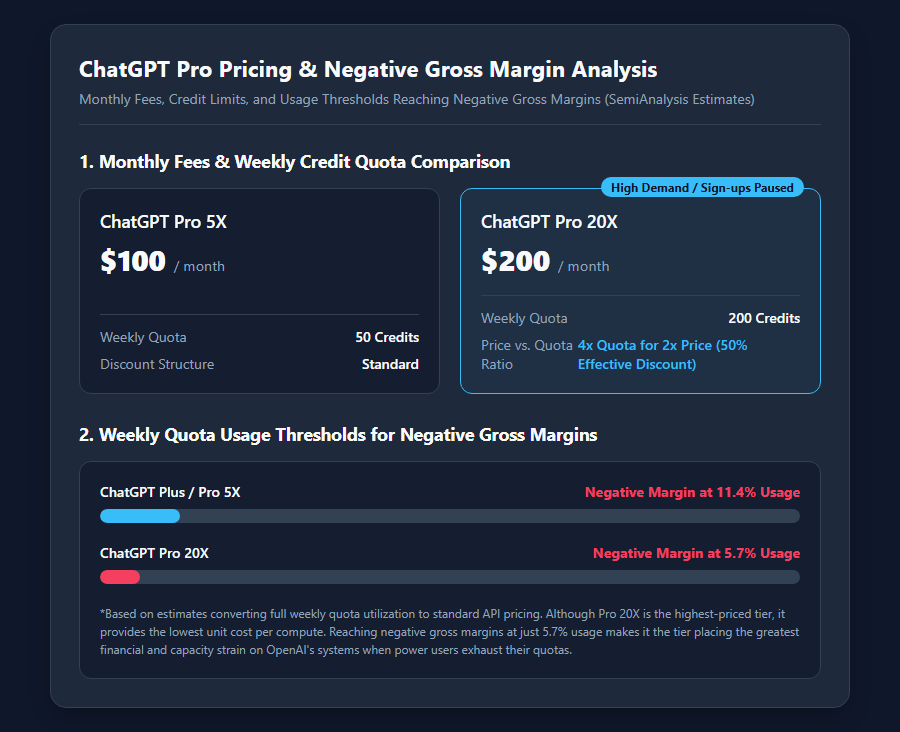
This pricing model incentivized developers and enterprise users—who routinely dispatch hundreds of high-complexity tasks daily and run continuous Codex jobs overnight—to flock to Pro 20X. According to estimates by research firm SemiAnalysis, when converting full weekly quota usage to standard API prices, OpenAI hits negative gross margins at just 5.7% utilization on the Pro 20X tier, compared to 11.4% on the Plus and Pro 5X tiers.
While OpenAI originally operated under the assumption that most subscribers would not fully exhaust their quotas, GPT-6 Astra’s sheer capability dramatically accelerated token consumption among power users, straining both system compute resources and profitability.
Compute Capacity Under Strain: The Astra Effect
Higher Token Pricing and Heavy Compute Burden of Autonomous Agents
Featuring advanced reasoning and autonomous desktop/browser control (“Computer Use”), GPT-6 Astra consumes compute resources at a vastly faster rate than its predecessor, GPT-5.6 Sol. Standard API pricing for Astra is set at \$10 per million input tokens and \$50 per million output tokens—roughly 2.5 times higher than Sol’s promotional rate.
However, when deployed in autonomous agentic workflows involving tool calling and long-context retention rather than single-turn chat, token usage can surge up to 1,000 times that of standard queries. Combined with an architecture that performs iterative calculations during inference, physical GPU load per user has climbed to unprecedented levels.
To mitigate user frustration, OpenAI distributed emergency quota reset passes (including banked resets and global resets) to paid subscribers. However, these temporary remedies have been unable to solve the underlying hardware deficit.
Impact on Semiconductor Markets and Infrastructure Expansion
The surge in compute demand generated by GPT-6 Astra sent strong ripples through equity markets and semiconductor supply chains. Easing fears of an AI capex slowdown, semiconductor and memory stocks rallied sharply. The SOXX Semiconductor ETF rose 3.5% in a single day, while Micron Technology gained 6.1% and SanDisk surged 11.9%. In Asian markets, Samsung Electronics rose 5.7% and SK Hynix jumped nearly 8%, signaling a renewed boom in memory chip demand.
Please refer to the following diagram.
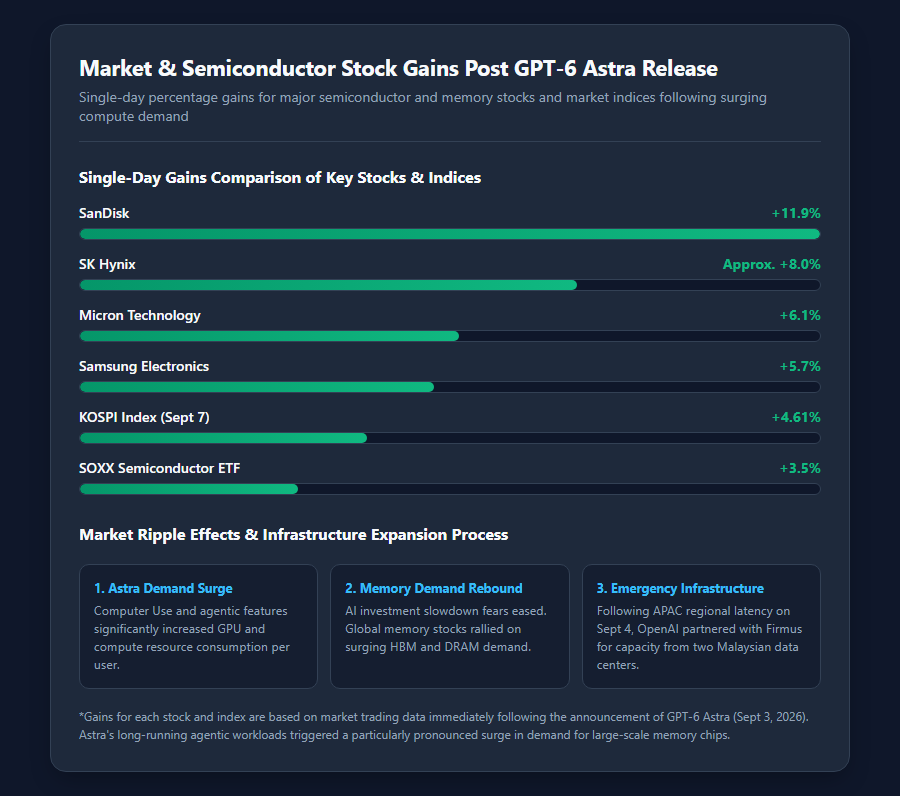
At the same time, the surge in demand exposed regional infrastructure bottlenecks. On September 4, 2026, users across the Asia-Pacific region reported response delays and performance degradation affecting ChatGPT Work and Codex Cloud. In response, OpenAI inked a multi-year deal with Nvidia-backed infrastructure operator Firmus to secure dedicated compute capacity from two data centers in Malaysia.
OpenAI is also accelerating infrastructure diversification through enterprise partnerships, including limited availability via Microsoft Azure and Microsoft Foundry.
The Shifting Economics of Enterprise AI and Future Outlook
From Token Unit Price to “Total Cost per Completed Task”
GPT-6 Astra’s pricing and capabilities are reshaping how enterprises evaluate AI return on investment (ROI). Corporate evaluation metrics are shifting from simple per-million-token unit cost comparisons toward the total cost required to successfully complete a business task at acceptable quality.
OpenAI Chief Financial Officer Sarah Friar noted that AI value must be measured by useful work completed, emphasizing that cheaper models can ultimately cost more if they require multiple retries and human intervention. Indeed, while Astra commands a higher nominal token price, its ability to generate accurate code in roughly one-third the tokens of older models means its effective cost per completed task is often comparable or lower.
Gartner refers to this phenomenon as the “Inference Paradox,” predicting that as AI evolves from simple Q&A to multi-step autonomous execution, enterprise inference costs for agentic workflows will increase more than fivefold by 2028.
Hybrid “Model Routing” and the Benchmark for Capacity Expansion
Faced with rising inference expenses, enterprise adopters are rapidly embracing a hybrid strategy known as “model routing.” Under this architecture, top-tier models like GPT-6 Astra or Claude Fable 5 are reserved for the most complex 5% to 10% of reasoning and planning tasks, while routine or lightweight workloads are delegated to open-weight or cost-effective models such as Qwen, Kimi, DeepSeek, or American lightweight models.
For OpenAI, the suspension of new Pro 20X subscriptions serves as a stark symbol of supply failing to keep pace with skyrocketing demand. As the company invests heavily in data center capacity and infrastructure partnerships, industry attention is fixed on when sales of its flagship tier will resume.
As AI evolution moves beyond human typing speeds into an “AGI era” powered by parallel digital processes, balancing reliable infrastructure supply with sustainable unit economics stands as OpenAI’s most critical strategic challenge.
References
-
[OpenAI Official Index: GPT-6 Astra] https://openai.com/index/gpt-6-astra/
-
[OpenAI Help Center: About ChatGPT Pro Tiers] https://help.openai.com/en/articles/9793128-about-chatgpt-pro-tiers
-
[OpenAI Codex Official Repository] https://github.com/openai/codex
[#OpenAI #GPT6Astra #ChatGPT #AIEconomics #SemiconductorMarket #Technology #CloudInfrastructure #AICosts]


コメント