At a press conference following the Monetary Policy Meeting, Bank of Japan Governor Kazuo Ueda indicated a policy of implementing further rate hikes, raising the policy interest rate in response to improving economic and price conditions and continuing to adjust the degree of monetary easing moving forward. In the background is a situation where rising business-to-business transaction prices—driven by higher crude oil prices stemming from the Middle East situation and the weak yen—are passing through to consumer prices, heightening the risk of an upward overshoot in inflation as the underlying inflation rate approaches the 2% target.
- Background on the Additional Rate Hike at the September 2026 Decision Meeting and the Three-Month Interval
- Recognition of Phase Changes and Contrasting Risk Management Postures
- Long-Term Interest Rates Reaching 3% and the Market’s Search for the Terminal Rate
- Trends in Mortgage Interest Rates and Their Uneven Impact on Corporate Lending
- The Sustainability of the Virtuous Cycle of Wages and Prices and the Focus on the 2027 Spring Wage Negotiations
- Timing of Additional Rate Hikes and Future Points to Watch
Background on the Additional Rate Hike at the September 2026 Decision Meeting and the Three-Month Interval
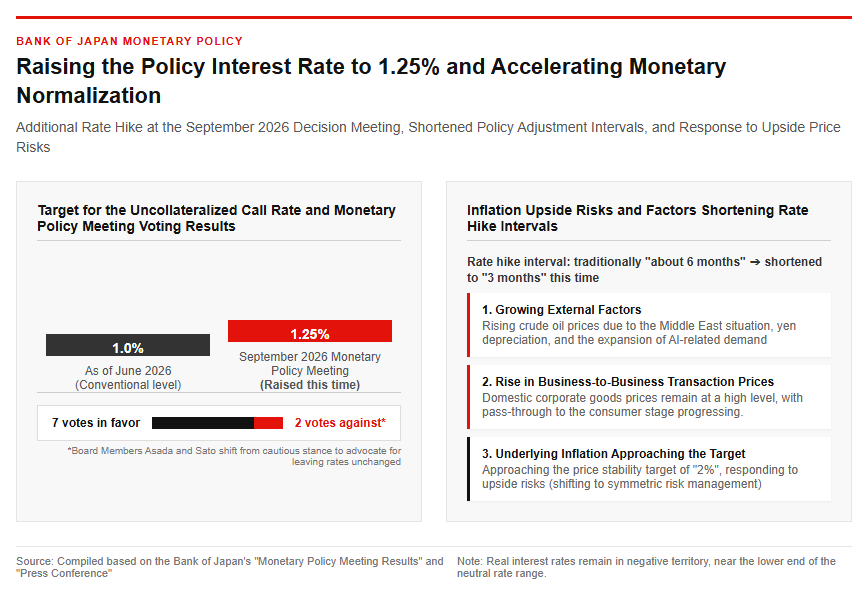
At its Monetary Policy Meeting held from September 17 to 18, 2026, the Bank of Japan decided by a majority vote to raise the target for the policy interest rate, the uncollateralized overnight call rate, from around 1.0% to around 1.25%. The vote was 7 to 2, with Board Members Asada and Sato dissenting, having argued for keeping rates unchanged due to cautious views on current economic conditions and price momentum. This decision marks an additional rate hike just three months after the June 2026 rate increase, representing the shortest interval between policy changes since Governor Ueda took office.
Behind the Bank of Japan’s decision to shorten the interval between interest rate hikes from the conventional roughly six months to three months is the recognition that the underlying inflation rate is steadily approaching the 2% price stability target. As the economy and prices trended in line with the central economic and price outlook presented in the July 2026 Outlook Report, crude oil prices rebounded due to growing uncertainties in the Middle East, including tensions between the U.S. and Iran. In addition, compounded by the depreciation of the yen in the foreign exchange market and the expansion of global AI-related demand, the growth rate of domestic corporate goods prices has remained at a high level. These upward price pressures in business-to-business transactions have begun to be passed on to the consumer stage in succession, leading the BOJ to judge that the risk of inflation overshooting projections has become increasingly tangible. This prompted the bank to move up its traditionally cautious pace and decide to adjust the degree of monetary accommodation earlier than previously planned.
Recognition of Phase Changes and Contrasting Risk Management Postures
At a press conference held at 3:30 p.m. on September 18, Governor Ueda clearly articulated the view that the objectives and phase of monetary policy have shifted in the wake of the latest rate hike. While the primary short-term goal had previously been to raise the underlying inflation rate—which remained below 2%—to the target level, now that it is close to that target, the central challenge has become to firmly anchor and stabilize inflation at around 2%. Accordingly, he signaled a shift in approach from a phase of heavily guarding against downside risks to a risk management stance that responds symmetrically to both upside and downside risks to prices.
Even after raising the policy interest rate to 1.25%, real interest rates remain at low levels in negative territory, centered mainly around the short- to medium-term zones, and financial conditions in Japan as a whole remain sufficiently accommodative. Although they have reached around the lower bound of the estimated range for the nominal neutral interest rate calculated by the BOJ, they have not entered a restrictive territory that would excessively suppress economic activity. While noting that the BOJ will not pre-set a fixed schedule such as specific three-month intervals, Governor Ueda emphasized the stance of continuing to raise the policy interest rate step-by-step in line with improvements and growing certainty in economic, price, and financial conditions. Please refer to the figure below.
The Ripple Effects of Rate Hikes Spreading to Financial Markets and the Real Economy
Long-Term Interest Rates Reaching 3% and the Market’s Search for the Terminal Rate
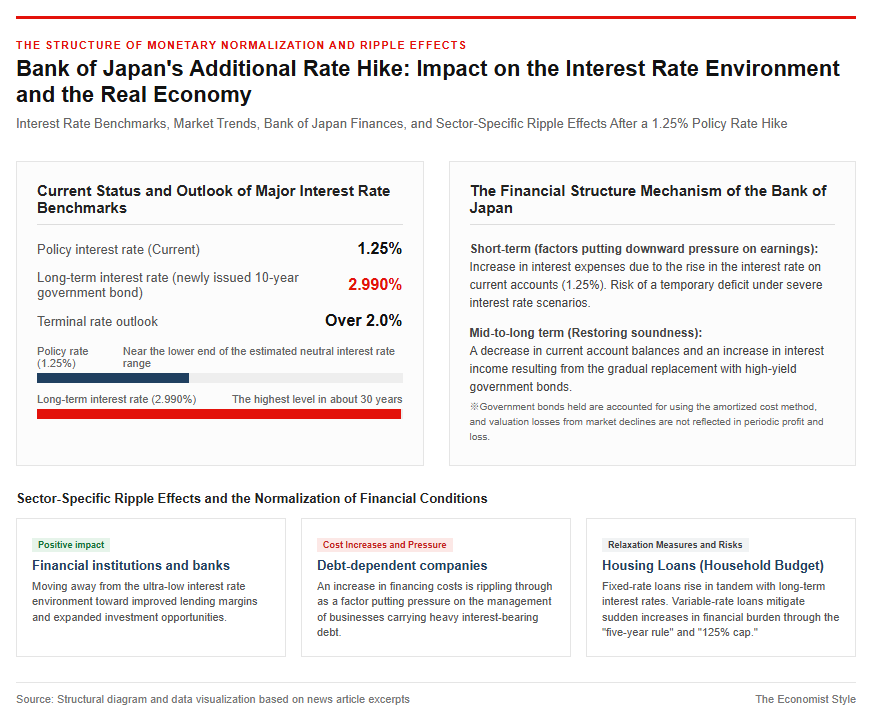
Following the Bank of Japan’s additional rate hike in September 2026, upward pressure on interest rates intensified further in financial markets. In the bond market, the yield on newly issued 10-year government bonds, which serves as the benchmark for long-term interest rates, rose to reach around the 3.0% level at 2.990% in mid-September. This marks the highest level in approximately 30 years, illustrating that the market has begun pricing in future additional rate hikes by the BOJ and the entrenchment of inflation ahead of time. Among market participants, there was also a trend toward revising upward the outlook for the terminal rate—the ultimate endpoint of policy interest rates—to over 2.0%.
Rising interest rates also affect the financial structure of central banks themselves. According to financial projections published by the Bank of Japan (BOJ), under the balance sheet expanded through large-scale monetary easing, rising interest rates applied to current account deposits (around the 1.25% level following the hike) will increase interest payments, putting downward pressure on earnings in the short term. While the projections also indicate the possibility of a temporary deficit under severe interest rate scenarios, the BOJ employs the amortized cost method for the government bonds it holds, meaning that valuation losses from market price declines are not directly reflected in periodic earnings. Additionally, the framework outlines a mechanism whereby current account balances will decrease over time and held government bonds will be progressively replaced with higher-yielding bonds, thereby increasing interest income and restoring financial soundness in the medium to long term.
Trends in Mortgage Interest Rates and Their Uneven Impact on Corporate Lending
An environment in which both policy interest rates and long-term interest rates are rising is having a direct impact on household mortgage selections and corporate fund-raising. Because fixed-rate mortgages are strongly linked to long-term interest rates such as the 10-year government bond yield, noticeable hikes in applicable interest rates for 10-year fixed and all-period fixed products stood out between September and October 2026. Meanwhile, since variable-rate mortgages are based on the policy interest rate and the short-term prime rate, the impact ripples through with a time lag following reviews by various financial institutions. For borrowers who have already taken out loans, sudden increases in financial burden are mitigated by existing safeguards such as the “five-year rule,” which reviews repayment amounts every five years, and the easing measure capping increases at 125% of the previous repayment amount. However, new borrowers are required to conduct careful simulations that factor in the risk of future interest rate hikes.
The impact on industry and financial institutions varies significantly depending on the entity. For financial institutions such as banks, moving away fromซิ the prolonged ultra-low interest rate environment serves as a clear tailwind, bringing improved lending margins and expanded investment opportunities. However, for companies that are heavily dependent on borrowing or businesses burdened with substantial interest-bearing debt, the rise in financing costs acts as a pressure point on management. The Bank of Japan’s policy decision does not simply move market interest rates; it represents a structural turning point that is gradually normalizing the overall financial environment for both corporations and households. Please refer to the figure below.
Future Developments in Monetary Policy and Key Indicators to Watch
The Sustainability of the Virtuous Cycle of Wages and Prices and the Focus on the 2027 Spring Wage Negotiations
The most crucial factor in gauging the future pace of interest rate hikes and their ultimate destination is the confirmation of the “virtuous cycle of wages and prices,” which the Bank of Japan has consistently emphasized. Wage data, such as the Ministry of Health, Labour and Welfare’s Monthly Labour Survey preliminary report, is being examined to see whether the high wage hike rates in the shunto (spring labor-management wage negotiations) are translating into general regular pay increases and base-up wage hikes. Amid a persistent sense of labor shortages, the question is whether a cycle is taking root in the domestic economy where companies appropriately pass on rising labor costs to selling prices, which in turn leads to increased income for workers.
During a press conference, Governor Ueda acknowledged the current situation in which the underlying inflation rate is approaching 2%, while indicating his intention to carefully assess whether this trend will take root sustainably rather than being driven merely by temporary oil price and exchange rate factors. As an important milestone in this process, he pointed to the labor-management negotiation stance and initial momentum toward the spring 2027 wage negotiations (shunto), for which initial information will begin to emerge this fall and onward. If proactive corporate pricing behavior and a commitment to continuous wage increases are confirmed, it will serve as a strong basis for the Bank of Japan to proceed with further scaling back of monetary easing.
Timing of Additional Rate Hikes and Future Points to Watch
Regarding the future course of monetary policy, the central focus of the market is the timing and pace at which additional rate hikes will be implemented in upcoming policy meetings. Among market participants and economists, a consecutive rate hike at the October 2026 meeting is expected to be passed over due to limited available data, and a hike to 1.50% at the December meeting—when a wide range of economic indicators and price trends from the autumn onward will be fully available—is emerging as the central scenario. Furthermore, views have also been expressed in favor of raising interest rates step-by-step to 1.75% in March 2027 and 2.00% in June.
Risk factors that could influence policy management decisions include trends in energy prices driven by heightened tensions in the Middle East, the direction of monetary policy by the U.S. Federal Reserve and the trajectory of U.S. long-term interest rates, and fluctuations in the foreign exchange market. In addition, coordination and discussions with the government are essential elements. The “review of the cumulative impact of past rate hikes” requested by the Cabinet Office representative at the Monetary Policy Meeting, along with discussions based on the neutral interest rate that neither overheats nor cools the economy, will serve as important perspectives for controlling the pace of rate hikes. While exploring flexible responses to address upward price risks, the BOJ will engage in repeated, careful dialogue and reviews to avoid any adverse impact on the real economy from rapid interest rate increases.
Reference Page
- [Bank of Japan] https://www.boj.or.jp/
- [Dai-ichi Life Research Institute] https://www.dlri.co.jp/files/macro/665928.pdf
【#BOJ #PolicyRate #GovernorUeda #RateHike #Mortgages #JapaneseEconomy #LongTermYields】

コメント