Bankruptcies related to the weak yen reached 38 in the first half of fiscal 2026, exceeding the same period of the previous year for the first time in two years. The rapid surge in import costs and delays in price pass-through are directly hitting the cash flows of small and micro enterprises with high procurement dependency.
- Key points of the event: 38 incidents in the first half of the year and the blow to small and micro enterprises
- Industry Bias: Wholesale Trade Accounts for the Majority with 20 Cases
- “Profitable Yet Cash-Strapped”: Ballooning Purchasing Funds and the Cash Flow Trap
- Materialization of Compound Risks: COVID-19 Loan Repayments, Labor Shortages, Rising Costs
- Foreign Exchange Intervention and FSA Business Support: Temporary Yen Appreciation and Requests for Financing
- Future Outlook and Key Points: Pricing Strategies and Cash Flow Management to Protect the Business
Key points of the event: 38 incidents in the first half of the year and the blow to small and micro enterprises
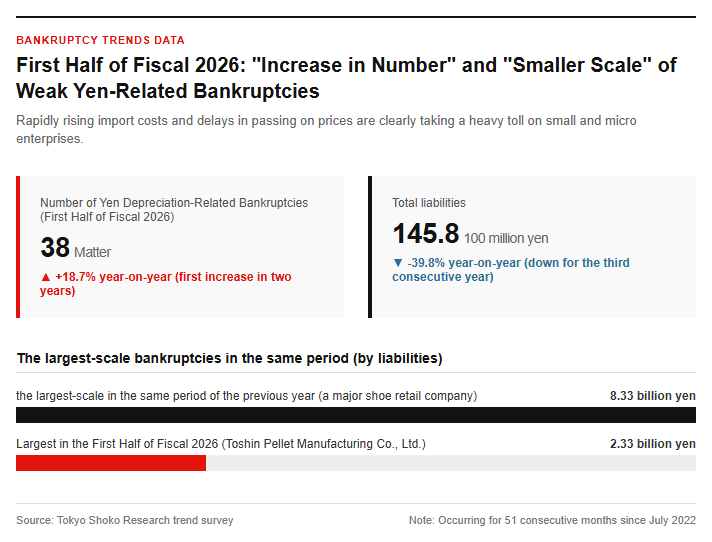
According to a trend survey released by Tokyo Shoko Research, weak-yen-related bankruptcies in the first half of fiscal 2026 (April to September) totaled 38, representing an 18.7% increase from the same period last year. This marks the first increase for the first-half period of a fiscal year in two years, and weak-yen-driven bankruptcies have continued for 51 consecutive months since July 2022. Although the month of September alone showed some moderation with 5 cases (down 28.5% year-on-year), beneath the surface, the plight of companies no longer able to withstand high costs is intensifying.
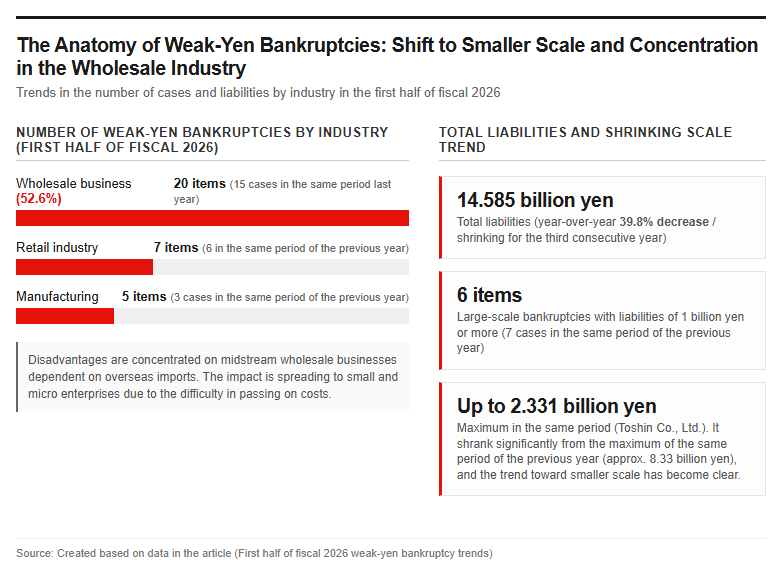
Meanwhile, total liabilities decreased by 39.8% year-on-year to 14.585 billion yen, shrinking for the third consecutive year. Large-scale bankruptcies with liabilities of 1 billion yen or more remained at 6 (compared to 7 in the same period of the previous year), which served to pull down the overall figures. The largest bankruptcy during the period was Toshin Co., Ltd. (Shiga Prefecture, liabilities of 2.331 billion yen), which is engaged in the manufacture and sale of pellets. When compared to the 8.33 billion yen in liabilities of a major shoe retailer that occurred in the same period last year, this highlights the reality that the wave of bankruptcies is shifting toward small and micro-enterprises. As shown in the figure below, an increase in the number of cases and a reduction in scale are progressing simultaneously.
While imported raw material and energy prices remain high, small and micro businesses with limited financial strength are rapidly depleting their cash reserves, further elevating their risk of bankruptcy.
Industry Bias: Wholesale Trade Accounts for the Majority with 20 Cases
Looking at bankruptcies caused by the weak yen in the first half of fiscal 2026 by industry, the wholesale sector stands out, accounting for 20 cases (15 cases in the same period of the previous year) and 52.6% of the total. This was followed by the retail sector with 7 cases (6 cases in the same period) and the manufacturing sector with 5 cases (3 cases in the same period). It is clearly evident that the disadvantages of the weak yen are most heavily concentrated in the wholesale industry, a midstream sector that purchases imported materials and raw materials from overseas and supplies them to domestic buyers.
The textile and apparel-related industry is being particularly severely affected. For apparel wholesalers and manufacturers that depend on overseas imports for much of their clothing and fabric raw materials, soaring procurement costs due to exchange rate fluctuations, combined with rising outsourcing costs to overseas factories, have become a direct burden. For example, there has been a succession of cases where businesses have abandoned the continuation of their operations due to a structural deterioration in profitability, such as a women’s clothing OEM company that went bankrupt with approximately 6 billion yen in liabilities due to rising outsourcing costs.
Wholesalers and manufacturers are finding it difficult to pass on price increases to their retail clients and consumers, leaving them with no choice but to absorb the rising costs themselves. Caught between soaring raw material costs and sluggish sales, and forced to operate on razor-thin margins, an endless stream of companies are running out of working capital and being driven into legal liquidation.
How Difficulty in Passing on Costs and Deteriorating Cash Flow Are Cornering SMEs
“Profitable Yet Cash-Strapped”: Ballooning Purchasing Funds and the Cash Flow Trap
Among small and medium-sized enterprises facing the depreciation of the yen, there is a sharp increase in the crisis of profitable bankruptcy—where cash on hand dries up despite profits being recorded on the income statement. According to tax accountants’ analyses, the primary factor is that as the exchange rate shifts drastically toward a weaker yen from 100 yen to 150 or 160 yen per dollar, the yen-denominated working capital required to procure the same quantity of goods jumps by 1.5 times or more.
For example, for an importing company that purchases $100,000 in goods every month, procurement funds that only required 10 million yen when the rate was 100 yen to the dollar would require 16 million yen at 160 yen to the dollar. Even if sales are growing steadily and book profits are secured, if the collection of sales proceeds is two months away, the payment for the inflated procurement costs must be made first, causing the cash balance in the bank account to plummet rapidly.
Furthermore, many companies are increasing their inventories in anticipation of further depreciation of the yen, but inventory is not converted into cash until it is sold and payment is received. As funds are tied up in inventory and accounts receivable, an increase in procurement funds combined with a mismatch in the sales collection cycle is widening a cash flow trap that leads to insolvency. As shown in the figure below, the divergence between profit and cash flow movements is squeezing the finances of small and medium-sized enterprises.
Materialization of Compound Risks: COVID-19 Loan Repayments, Labor Shortages, Rising Costs
The weak yen is not the only factor troubling small and medium-sized enterprises (SMEs). The arrival in earnest of repayment deadlines for virtually interest-free, unsecured loans (so-called “zero-zero loans”) introduced during the COVID-19 pandemic is further squeezing corporate cash flow. With sales having failed to recover to pre-pandemic levels, the heavy burden of principal and interest payments is weighing heavily on them.
In addition, this is compounded by a severe environment of triple or quadruple hardships, such as rising labor costs associated with historic labor shortages, soaring energy prices like electricity and gas bills, and rising logistics costs. Research by Teikoku Databank has also pointed out that amid insufficient progress in passing on costs, companies are unable to withstand high labor and procurement costs, and “give-up bankruptcies”—where businesses abandon the continuation of operations—are on the rise.
Particularly for small and micro enterprises located at the very bottom of the subcontracting structure, price-negotiation power with clients is extremely weak. In most cases, even if they broach the subject of a price increase, they abandon negotiations out of fear of having their orders halted, choosing instead to absorb the impact by cutting into their own gross profits. These reduced gross profits are insufficient to cover fixed costs and loan repayments, and a structural crisis is underway in which they ultimately run out of cash.
Responses by the Government and Financial Institutions and Defensive Measures Required for SMEs
Foreign Exchange Intervention and FSA Business Support: Temporary Yen Appreciation and Requests for Financing
The Japanese government and the Bank of Japan conducted large-scale foreign exchange interventions totaling 27.1342 trillion yen between April and August 2026 in an effort to curb the rapid depreciation of the yen. However, while this temporarily pushed the yen stronger, it failed to create a lasting trend, and the exchange rate is once again trading at weak levels in the upper 150 yen to around 160 yen per dollar. Due to the structural interest rate differential between Japan and the U.S. and the state of the trade balance, concerns that the weak-yen trend will persist over the long term remain unabated.
In response to this situation, the Financial Services Agency (FSA) issued requests to private and government-affiliated financial institutions in November 2025 and throughout 2026, titled “On Thorough Efforts for Facilitating Finance and Supporting Businesses.” The request asks these institutions to respond promptly and flexibly to conditions changes (rescheduling) and refinancing of existing debts so that business operators do not experience serious disruptions in their cash flow heading into periods of high funding demand around the end of the year and the fiscal year.
Furthermore, financial institutions are being urged not to make lending decisions mechanically based solely on figures in financial statements, but to strengthen hands-on support that closely reflects the actual conditions of business operators. Specifically, frameworks are in place to support the early stabilization of cash flow and business restructuring by utilizing measures such as “Co-support Special Guarantees”—which combine conventional loans and credit guarantees—and “Business Improvement Support Guarantees.”
Future Outlook and Key Points: Pricing Strategies and Cash Flow Management to Protect the Business
Looking ahead, with the yen expected to remain persistently weak and high costs protracted, the disparity in pricing power among companies will be the primary factor driving fluctuations in the number of bankruptcies. Since companies that continue to hesitate on price revisions will be forced to exit the market, establishing a clear pricing strategy and strict cash management to protect their own businesses is an urgent priority.
The top specific measure that business executives should take is the establishment of rules for passing on costs. It is necessary to set a standard that automatically initiates price revision negotiations when purchase prices rise by a certain percentage (for example, 5% or more), and to adopt an approach of reviewing trading conditions based on objective numerical values rather than emotional arguments. Furthermore, it is essential to pay close attention not only to the profit and loss on the income statement (PL) but also to the balance sheet (BS) and cash flow statement, and to advance efforts such as shortening inventory turnover days and improving accounts receivable collection periods.
If concerns arise regarding cash flow, it is recommended to consult with experts and primary financial institutions early on, before cash on hand is depleted, and share a cash flow plan. Moving forward, an increasing number of companies are expected to pursue drastic financial improvements—rather than mere survival—by restructuring unprofitable businesses and utilizing business turnaround procedures, making early assessment of the current situation and prompt action critical factors that will determine the fortunes of management.
Reference Page
- [Tokyo Shoko Research TSR Data Insight] https://www.tsr-net.co.jp/data/detail/1203286_1527.html
- [Teikoku Databank] https://www.tdb.co.jp/report/economic/20260303-enyasu2602/
- [Financial Services Agency] https://www.fsa.go.jp/news/r7/ginkou/20251127/yousei.html
【#WeakYenBankruptcies #SMEs #CashFlow #PricePassThrough #TokyoShokoResearch #TeikokuDatabank #Economy】


コメント