On September 11, 2026, Japan’s Ministry of Economy, Trade and Industry (METI) designated 18 regions nationwide—including Rokkasho Village and Rokunohe Town in Aomori Prefecture—as Green Transformation (GX) Strategic Regions to drive decarbonization and industrial growth. This initiative comes against the backdrop of surging energy demand and a concentrated push for public and private investment aimed at regional revitalization.
- Background: Rokkasho and Rokunohe Designated as “Decarbonized Power Utilization” Hubs
- Concrete Infrastructure Initiatives: Data Center Clusters and Industrial Parks
- Projected Impact: Over ¥120 Billion in Economic Growth and 9,700 New Jobs
- Infrastructure Partnerships and Strategies to Retain and Attract Youth
- Power Demand from Generative AI and Integrated Energy-Telecom Networks
- Nationwide Expansion and Medium- to Long-Term Outlook
Background: Rokkasho and Rokunohe Designated as “Decarbonized Power Utilization” Hubs
On September 11, 2026, the Ministry of Economy, Trade and Industry (METI) officially designated 18 locations across Japan as “Green Transformation (GX) Strategic Regions”—a program designed to leverage local decarbonized energy sources to establish new industrial clusters. This designation followed a competitive selection process launched in August 2025, which evaluated 38 promising regional proposals nationwide. Aomori Prefecture earned its initial designation under the “Decarbonized Power Utilization Type” category for two key locations: the Mutsu Ogawara Development District in Rokkasho Village and the Kanaya Industrial Park in Rokunohe Town, taking advantage of the region’s rich concentration of carbon-free energy sources, including nuclear and wind power.
Under its overarching “GX 2040 Vision,” the Japanese government aims to spur more than 150 trillion yen in combined public and private investment over the next decade, backed by the issuance of 20 trillion yen in “GX Economy Transition Bonds.” This regional designation serves as a central pillar to simultaneously achieve stable energy supply, enhanced industrial competitiveness, and regional carbon emission reductions. Welcoming the announcement, Aomori Governor Soichiro Miyashita described the designation as a major first step toward turning the prefecture’s abundant power generation assets into growth opportunities, affirming his commitment to building a robust industrial base that encourages young residents to remain in or return to the region.
Concrete Infrastructure Initiatives: Data Center Clusters and Industrial Parks
Aomori Prefecture’s strategic GX framework operates along two main axes: “Data Center (DC) Clustering” and “Decarbonized Power Utilization.” In the Mutsu Ogawara Development District in Rokkasho Village, plans are underway to attract next-generation, high-power-consuming data centers by capitalizing on approximately 30 hectares of vast land, low natural disaster risks, and a cool climate ideal for server cooling. Please refer to the conceptual diagram below.
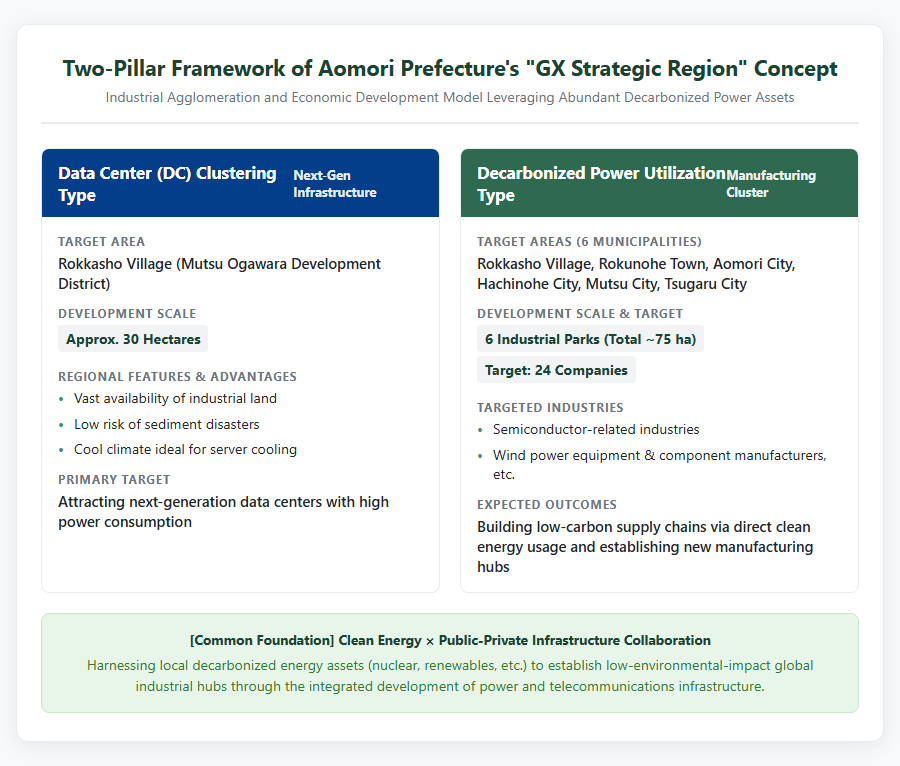
Meanwhile, under the “Decarbonized Power Utilization Type,” six industrial parks totaling approximately 75 hectares across six municipalities—Rokkasho Village, Rokunohe Town, Aomori City, Hachinohe City, Mutsu City, and Tsugaru City—have been targeted for infrastructure upgrades. The prefecture aims to attract a total of 24 companies, including semiconductor-related enterprises and wind power component manufacturers. By offering direct access to clean energy, the plan seeks to establish low-carbon, environmentally sustainable global supply chains while building new manufacturing hubs in Northern Japan.
Economic Impact: Local Job Creation and Community Growth
Projected Impact: Over ¥120 Billion in Economic Growth and 9,700 New Jobs
Aomori Prefecture’s GX Strategic Region initiative represents far more than an environmental measure—it is a large-scale economic policy designed to significantly energize the regional economy. According to prefectural estimates, the influx of data centers and corporate clusters into industrial parks is projected to generate an economic ripple effect of approximately 121.4 billion yen and create roughly 9,700 new jobs.
Outmigration of youth and population decline remain critical challenges for regional communities in Japan. By introducing career opportunities in cutting-edge GX industries and digital infrastructure, the initiative aims to offer attractive employment options for local high school and university graduates. In particular, an increase in highly skilled technical and professional roles related to energy and digital infrastructure is expected to raise regional income levels and boost consumer spending. Please refer to the graph below.
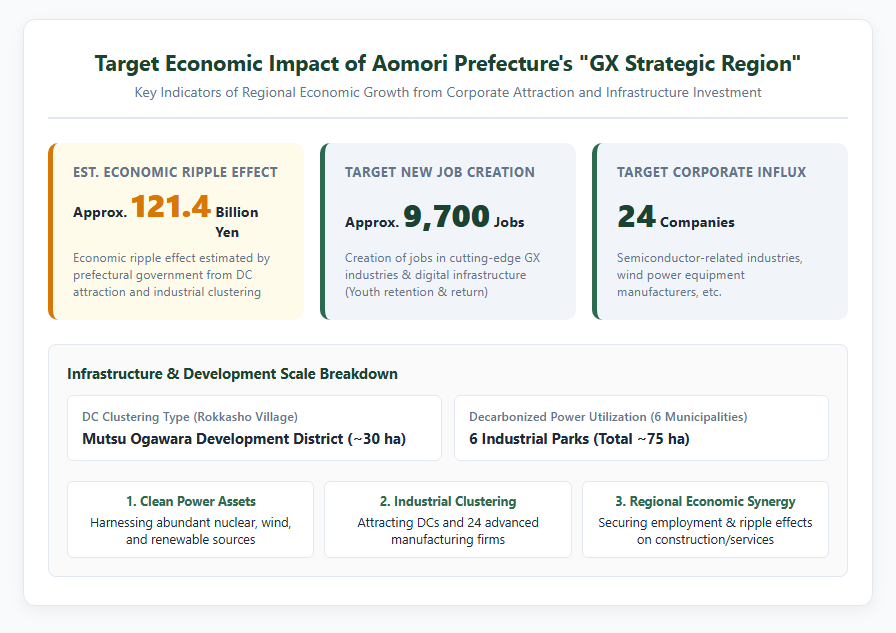
As the 24 target companies begin operations, the broader economic benefits are expected to ripple across various supporting sectors, including local construction, maintenance, and service industries. The ultimate goal of this plan is to establish a self-sustaining regional economic model through a transition toward sustainable industrial structures.
Infrastructure Partnerships and Strategies to Retain and Attract Youth
Operating large-scale data centers and advanced manufacturing plants reliably requires the proactive development of robust power and telecommunications networks. To this end, on February 12, 2026, Aomori Prefecture signed a comprehensive partnership agreement with five major private sector partners, including Tohoku Electric Power and NTT East, both of which possess deep expertise in renewable energy and data center operations.
This public-private collaboration ensures the systematic expansion of ultra-high-speed telecommunications networks—such as optical fiber infrastructure—and guarantees a stable supply of renewable energy. By unifying administrative support with corporate execution, the partnership creates an environment that accelerates corporate recruitment and facility development.
Furthermore, the prefectural government plans to strengthen ties with local educational institutions to establish specialized training programs tailored to GX industries. By creating an ecosystem where young people raised in Aomori can acquire advanced technical skills and build rewarding local careers, the prefecture aims to foster long-term community resilience and sustainable regional growth.
The “Watt-Bit Integration” and National Strategic Objectives
Power Demand from Generative AI and Integrated Energy-Telecom Networks
The rapid surge in generative AI adoption has led to an explosive increase in power consumption by data centers processing massive computational workloads. In response, the Japanese government is promoting “Watt-Bit Integration”—a policy that plans and deploys power grids (“watts”) and high-speed communication networks (“bits”) as an integrated infrastructure. This approach aims to prevent excessive strain on the power grid caused by the concentration of data centers in the Tokyo metropolitan area, strategically relocating these facilities to regional areas rich in decarbonized power.
The Northern Tohoku region, particularly Rokkasho Village in Aomori, boasts vast potential in renewable and zero-carbon energy sources, including wind and nuclear power. By incorporating optical transmission technologies like the All-Photonics Network (APN), data centers in regional areas can achieve ultra-low latency data processing comparable to facilities in urban centers. By resolving geographical friction between energy and communication infrastructures, Japan is establishing an advanced model that simultaneously secures energy self-sufficiency and strengthens digital infrastructure.
Nationwide Expansion and Medium- to Long-Term Outlook
The 18 regions designated by METI also include Ishikari City in Hokkaido, Akita Prefecture, Kawasaki City, and Niigata Prefecture, each tailoring its GX strategy to local energy and industrial characteristics. Minister of Economy, Trade and Industry Ryosei Akazawa stated in a post-cabinet press conference that the government will actively support the refinement of plans for remaining candidate sites, indicating that additional regional designations will be made in future rounds.
The GX Strategic Region system is designed to create new drivers of economic growth by concentrating investment in designated hubs, contributing to the alleviation of over-concentration in Tokyo and encouraging balanced national development. By combining regulatory relief, tax incentives, and focused financial assistance, the policy acts as a catalyst to draw private investment from both domestic and international sources. Initiatives in Rokkasho Village and Rokunohe Town in Aomori Prefecture will serve as pioneering models leading Japan’s broader industrial transformation, drawing widespread attention as national economic policies unfold.
Reference Pages
- 【Ministry of Economy, Trade and Industry: Call for Proposals for GX Strategic Regions】https://www.meti.go.jp/intro/consult/consult_05_gx.html
- 【Ministry of Economy, Trade and Industry Press Release (GX Strategic Region Call)】https://www.meti.go.jp/press/2025/08/20250826003/20250826003.html
- 【Aomori Prefectural Government Press Release】https://www.pref.aomori.lg.jp/release/2025/79255.html
- 【Cabinet Secretariat GX Implementation Council】https://www.cas.go.jp/jp/seisaku/gx_jikkou_kaigi/index.html
【#GXStrategicRegions #AomoriPrefecture #Rokkasho #Rokunohe #DecarbonizedPower #METI #WattBitIntegration #RegionalRevitalization】
発表、コア前月比は0.3上昇_en.jpg)
コメント