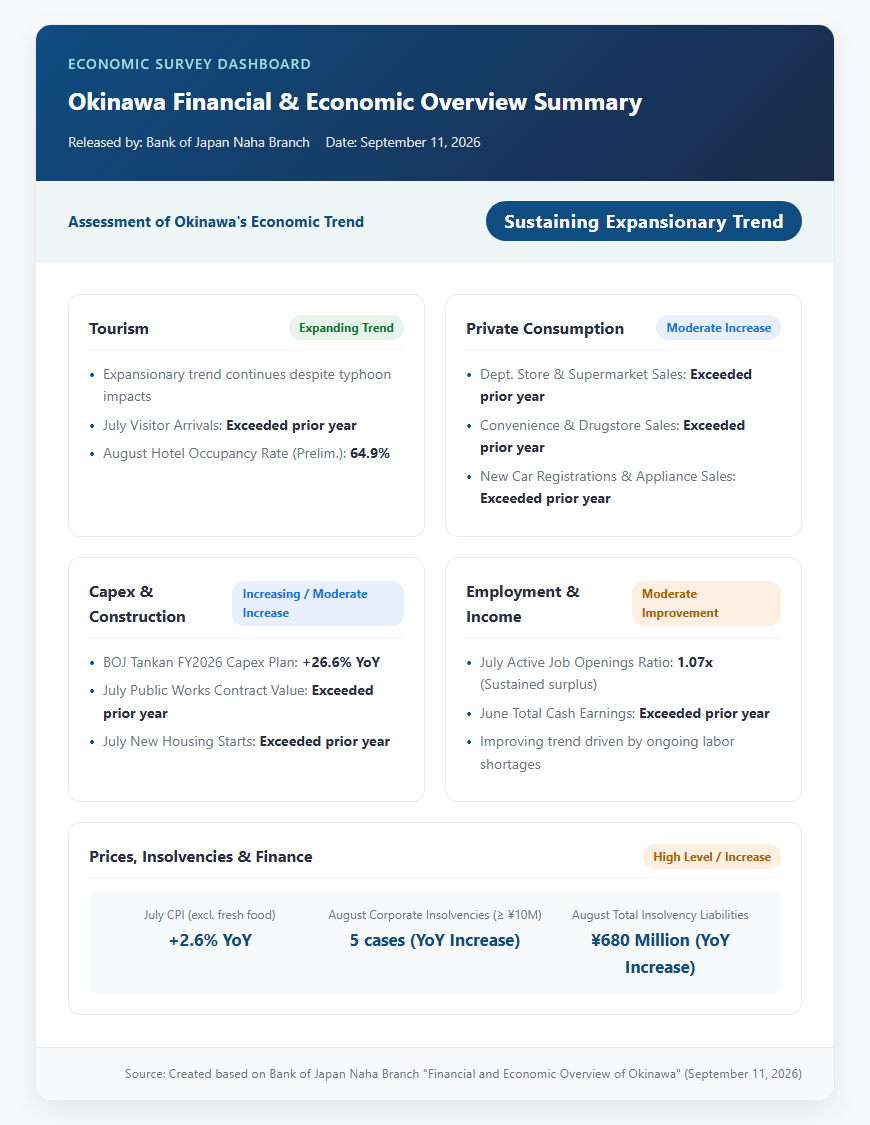
On September 11, 2026, the Bank of Japan’s Naha Branch released its Financial and Economic Overview, maintaining its assessment that Okinawa’s economy continues on an expansionary trend. Robust tourism demand and a gradual increase in private consumption are driving growth, supported by steady capital investment and residential construction.
- Key Takeaways from the BOJ’s September 2026 Report
- The Growth Engine: Tourism Demand Interlocked with Private Consumption
- Tourism and Retail: Navigating Typhoon Impacts and Inbound Demand
- Expanding Capital Expenditure and Accelerating Labor Shortages
- Inflationary Pressures and Corporate Insolvency Risks
- Outlook and Key Watchpoints for Late 2026 and Beyond
Key Takeaways from the BOJ’s September 2026 Report
According to the Financial and Economic Overview published by the Bank of Japan (BOJ) Naha Branch on September 11, 2026, the economy in Okinawa Prefecture maintains an overall trajectory of expansion. Although temporary downward pressures such as approaching typhoons emerged during the summer of 2026, fundamental economic indicators confirm a resilient recovery and sustained expansion. Looking at major demand components, private consumption continues to show a moderate upward trend, while tourism—a cornerstone of the local economy—remains on an expansionary path. Public investment has increased, alongside moderate gains in corporate capital expenditures and housing investment. Against this backdrop, employment and income conditions continue to improve, creating a virtuous economic cycle. The short-term outlook projects that this expansionary trend will persist, drawing attention to Okinawa as a region sustaining exceptionally strong economic performance within Japan.
The Growth Engine: Tourism Demand Interlocked with Private Consumption
The primary catalyst driving Okinawa’s economic growth is the expansion of tourism demand and the resulting surge in private consumption. The influx of domestic and international travelers yields broad ripple effects across related sectors, extending beyond hotels and restaurants to transportation and souvenir sales. Consumer spending by tourists boosts revenue for local businesses, fostering a virtuous cycle that translates into higher employee wages and expanded hiring. In June 2026, total cash earnings surpassed the previous year’s level, enhancing personal purchasing power. While inflation has induced some thriftiness among local residents, robust tourist demand has effectively offset this, lifting overall consumer sentiment. This tight synergy between tourism and consumption represents a structural strength sustaining Okinawa’s expansion relative to other regions.
Sector Trends, Employment, and Investment Landscape
Tourism and Retail: Navigating Typhoon Impacts and Inbound Demand
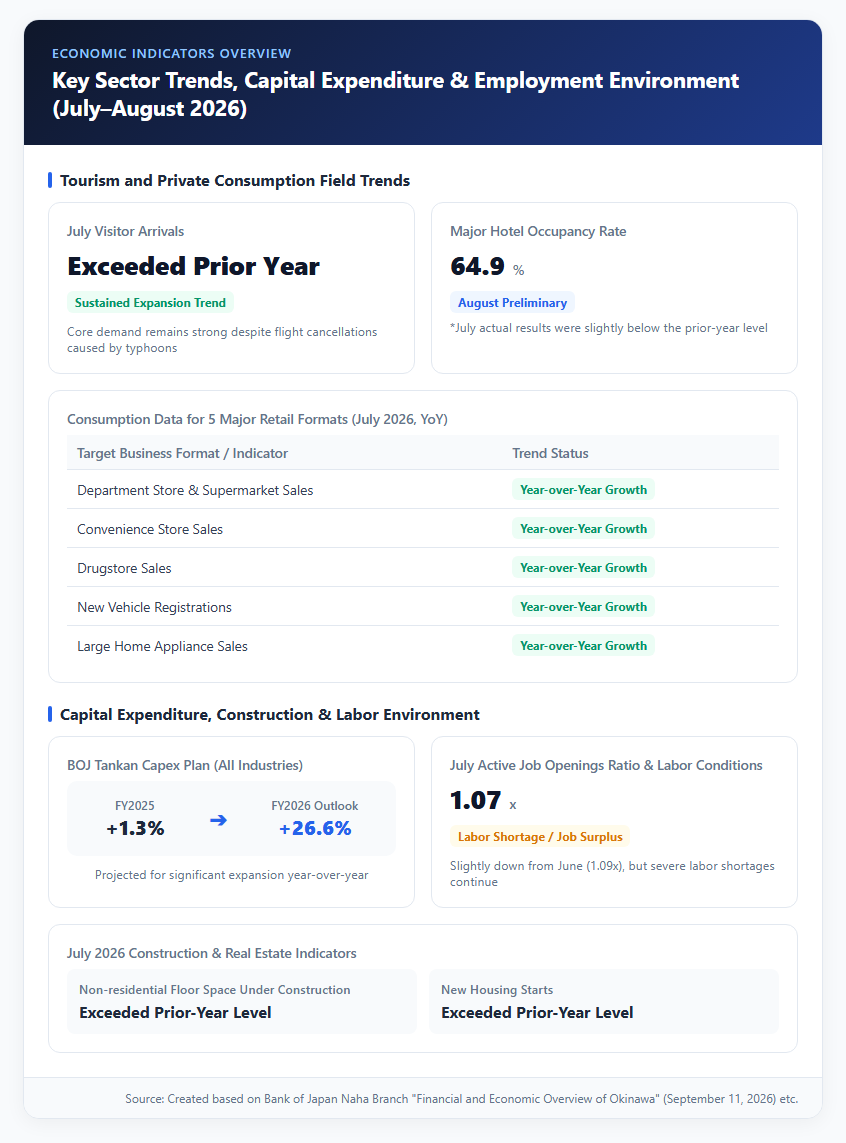
The tourism and retail sectors demonstrate remarkable resilience despite brief disruptions caused by typhoons. In July 2026, visitor arrivals exceeded the same month of the previous year, underscoring the underlying expansion. While occupancy rates at major hotels in July 2026 fell slightly below the previous year, preliminary figures for August 2026 recorded a robust 64.9%, maintaining a high level. Despite flight cancellations resulting from Typhoon No. 6 early in the month and Typhoon No. 7 near the month’s end, core travel demand remained intact. Furthermore, private consumption metrics for July 2026 showed gains across major retail channels compared to the prior year:
- Department store and supermarket sales: Year-over-year growth
- Convenience store sales: Year-over-year growth
- Drugstore sales: Year-over-year growth
- New vehicle registrations and large home appliance sales: Year-over-year growth
Combined with steady local consumer demand, strong spending by visitors continues to lift consumption metrics across the board.
Expanding Capital Expenditure and Accelerating Labor Shortages
In corporate activity, businesses display a forward-looking investment stance aimed at future growth. According to the BOJ Tankan survey, overall capital expenditure across all industries is projected to surge by 26.6% year-over-year in FY2026, following a 1.3% increase in FY2025. Non-residential floor space under construction and new housing starts in July 2026 both surpassed prior-year levels, reflecting vibrant activity in construction and real estate. Conversely, labor shortages are intensifying alongside economic expansion. Okinawa’s active job openings-to-applicants ratio stood at 1.07 in July 2026, slightly down from 1.09 in June, but still indicating more job vacancies than job seekers. High demand for labor in frontline sectors like services and construction is forcing enterprises to focus heavily on raising wages and improving working conditions to recruit and retain talent.
Challenges and Outlook for Sustaining Economic Expansion
Inflationary Pressures and Corporate Insolvency Risks
While Okinawa’s economy expands, rising prices and operational pressures on small and medium-sized enterprises (SMEs) have emerged as key concerns. In July 2026, the Consumer Price Index (excluding fresh food) rose 2.6% year-over-year, remaining elevated in the mid-2% range. Escalating energy prices, raw material costs, and labor expenses continue to squeeze corporate profit margins, particularly affecting small businesses that struggle to pass costs on to customers. In August 2026, corporate insolvencies (liabilities of 10 million yen or more) reached 5 cases, with total liabilities amounting to 680 million yen. Both case count and total liabilities increased compared to August 2025 (2 cases, 200 million yen), highlighting growing risks of bankruptcy driven by cash flow strain and cost inflation. Amid overall economic expansion, widening performance gaps between industries and business scales warrant close attention.
Outlook and Key Watchpoints for Late 2026 and Beyond
Looking ahead to late 2026 and 2027, Okinawa’s economy is expected to sustain a moderate expansionary trend, propelled by solid domestic and international travel demand. Increased airline flights and seasonal routes are anticipated to drive further gains in visitor numbers, while steady defense-related public works and expanding private capital investment will continue to support overall growth. Key watchpoints include how prolonged inflation might impact local purchasing power and whether labor shortages lead to supply constraints and lost business opportunities. Additionally, fluctuations in international affairs and exchange rates will be closely monitored for their effects on inbound spending and procurement costs. Local businesses must pursue strategic productivity enhancements—such as labor-saving investments and digitalization—to translate favorable economic conditions into sustainable corporate growth.
Reference Pages
- 【Bank of Japan Naha Branch】https://www3.boj.or.jp/naha/
- 【Okinawa Prefectural Government Official Website】https://www.pref.okinawa.lg.jp/kensei/kencho/1001519/1001591/1038323/1038392.html
【#OkinawaEconomy #EconomicOverview #TourismDemand #PrivateConsumption #BOJNahaBranch #LaborShortage】
発表、コア前月比は0.3上昇_en.jpg)

コメント