In August 2026, the record-breaking heavy rainfall in Chiba Prefecture dealt a severe economic blow to local small and medium-sized enterprises (SMEs), the agriculture, forestry, and fisheries sectors, and urban infrastructure. With inland flooding and urban infrastructure shutdowns forcing widespread business interruptions and equipment damage, comprehensive economic support—including cash flow relief and employment preservation—has become an urgent priority for business resumption.
- Overview of the Heavy Rain Disaster and Direct Blow to Key Industries
- Infrastructure Disruptions and Supply Chain Paralyzation Driving Operating Losses
- Cash Flow Burdens and Reopening Challenges Facing Affected Businesses
- Employment Preservation and Public Support Measures Against Insolvency Risks
- Limitations of Hazard Maps and the Necessity of Micro-Level Risk Assessments
- Early Regional Economic Recovery and Mid-to-Long-Term Disaster Prevention Infrastructure Investment
Overview of the Heavy Rain Disaster and Direct Blow to Key Industries
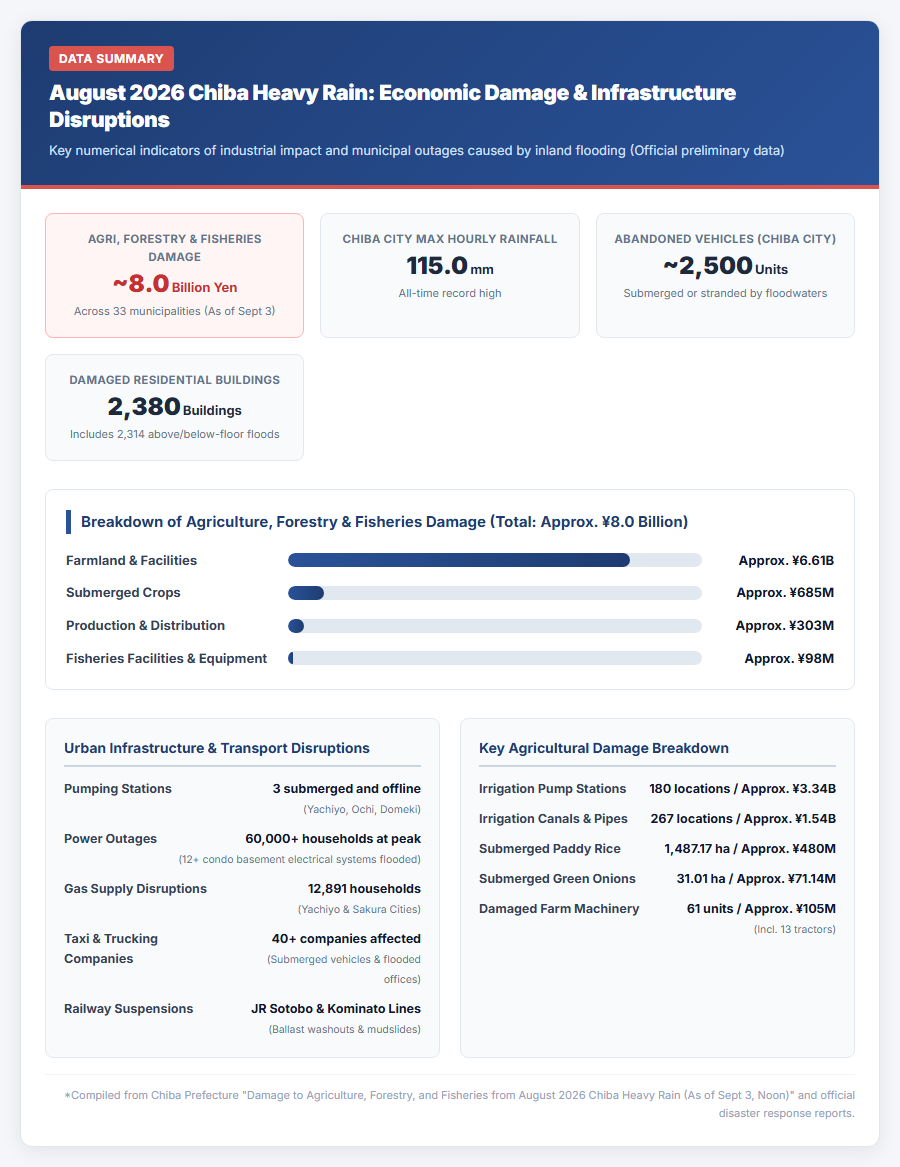
In August 2026 (from August 13 to 14), a series of linear precipitation zones developed over Chiba Prefecture, prompting the Japan Meteorological Agency to officially designate the event as the “August 2026 Chiba Heavy Rain.” Chiba City recorded over 360 mm of 24-hour rainfall—more than three times the average for the entire month of August—and hit an all-time record hourly rainfall of 115.0 mm. This unprecedented downpour severely damaged the region’s core agricultural, forestry, and fisheries industries, as well as local businesses. According to an official report released by Chiba Prefecture as of noon on September 3, 2026, total damage to agriculture, forestry, and fisheries across 33 municipalities reached approximately 8 billion yen. A breakdown shows that crop submersion—including 1,487.17 hectares of paddy rice and 31.01 hectares of green onions—accounted for about 685 million yen, while damage to farmland and agricultural facilities, such as collapsed field ridges and broken irrigation channels, reached approximately 6.6 billion yen. In addition, livestock losses included the deaths of 33,000 broilers and the disposal of 2,500 kilograms of raw milk, alongside the submergence or breakdown of 61 agricultural machines, including grain drying facilities and tractors. Extensive flooding of retail stores and factories resulted in washed-away assets and operational halts, casting a dark shadow over the local economy.
Infrastructure Disruptions and Supply Chain Paralyzation Driving Operating Losses
A defining feature of this torrential rain was that the flooding was primarily driven by inland water overflowing—where rainfall exceeded the drainage capacity of sewerage and gutters—rather than riverbank breaches. This inland flooding inundated and disabled critical drainage infrastructure, including the Yachiyo Pump Station, Chiba City’s Ochi Pump Station, and Mobara City’s Domeki Pump Station, exposing critical vulnerabilities in urban infrastructure. The failure of public utilities directly hit private business operations. In Chiba City, submerged underground electrical equipment in residential buildings led to prolonged power and water outages across more than 12 apartment complexes, while a major general hospital was forced to suspend outpatient medical services due to the flooding of its basement electrical systems. Transportation and logistics were also severely disrupted, with over 2,500 abandoned vehicles obstructing emergency responders and delivery trucks on flooded roads. More than 40 taxi and trucking companies suffered from submerged vehicles or flooded offices, including a tragic incident where an operational taxi flooded, resulting in the death of a passenger. Furthermore, ballast washouts between Honda and Oami stations on the JR Sotobo Line, mudslides onto the Kominato Railway Line, and widespread road closures paralyzed commuter transit and delayed material procurement, severing supply chains across manufacturing and service sectors. Please refer to the diagram below.
Small and Medium Business Crisis and Obstacles to Continuity
Cash Flow Burdens and Reopening Challenges Facing Affected Businesses
Deprived of revenue due to lost inventory, damaged equipment, and prolonged operational halts, affected SMEs and small business owners are facing acute cash flow crises. The initial financial burden required to resume operations—such as store repair costs, replacing water-damaged inventory and raw materials, and purchasing new machinery—is extraordinarily heavy. As concerns grow that many businesses may give up on reopening due to lack of capital, public institutions are rapidly expanding financial relief measures. On August 14, 2026, the Chiba Credit Guarantee Association launched the “Emergency Short-Term Capital Guarantee System” for disaster-affected businesses. This program offers working and equipment capital loans capped at one month of average monthly sales from the most recent fiscal period (up to 10 million yen). To ensure rapid disbursement, special administrative measures have been implemented, such as waiving the requirement for a formal Disaster Victim Certificate and extending eligibility to SMEs located outside official Disaster Relief Act coverage zones. Chiba Prefecture also activated its “General Allocation (Prefectural Designated Disaster)” Safety Net Funds, establishing an 80 million yen financing limit (up to 7 years for working capital and 10 years for equipment) to assist in store repairs and inventory replenishment. Nevertheless, adding new debt on top of existing liabilities poses a significant psychological and financial hurdle, testing the real-world effectiveness of financial support for business continuity.
Employment Preservation and Public Support Measures Against Insolvency Risks
As sharp revenue drops and severe facility damage force some businesses to downsize or face insolvency, preserving employee jobs and securing livelihoods have emerged as critical challenges. When operations grind to a halt and paying wages becomes difficult, workers face immediate risk of job loss and financial distress, making prompt government intervention essential. In response, the Ministry of Health, Labour and Welfare streamlined application procedures for the “Unpaid Wage Solvency Payment System” to protect departing workers. Under this framework, the government steps in to pay up to 80% of unpaid wages and severance pay on behalf of small and medium-sized employers that have become insolvent due to disasters or economic hardship. For workers in affected regions, simplified documentation and expedited verification processes have been introduced to speed up payouts. Additionally, the Employment Adjustment Subsidy is expected to help businesses maintain staff during temporary operational suspensions. On the front lines of care facilities and social welfare providers, however, severe obstacles remain: flooded premises, the difficulty of maintaining care with reduced staff, and infection control risks hinder both the acceptance of external personnel support and the execution of Business Continuity Plans (BCPs). Ensuring both job security and operational recovery will require multifaceted management support that extends well beyond monetary assistance.
Enterprise Flood Risk Management and Future Outlook
Limitations of Hazard Maps and the Necessity of Micro-Level Risk Assessments
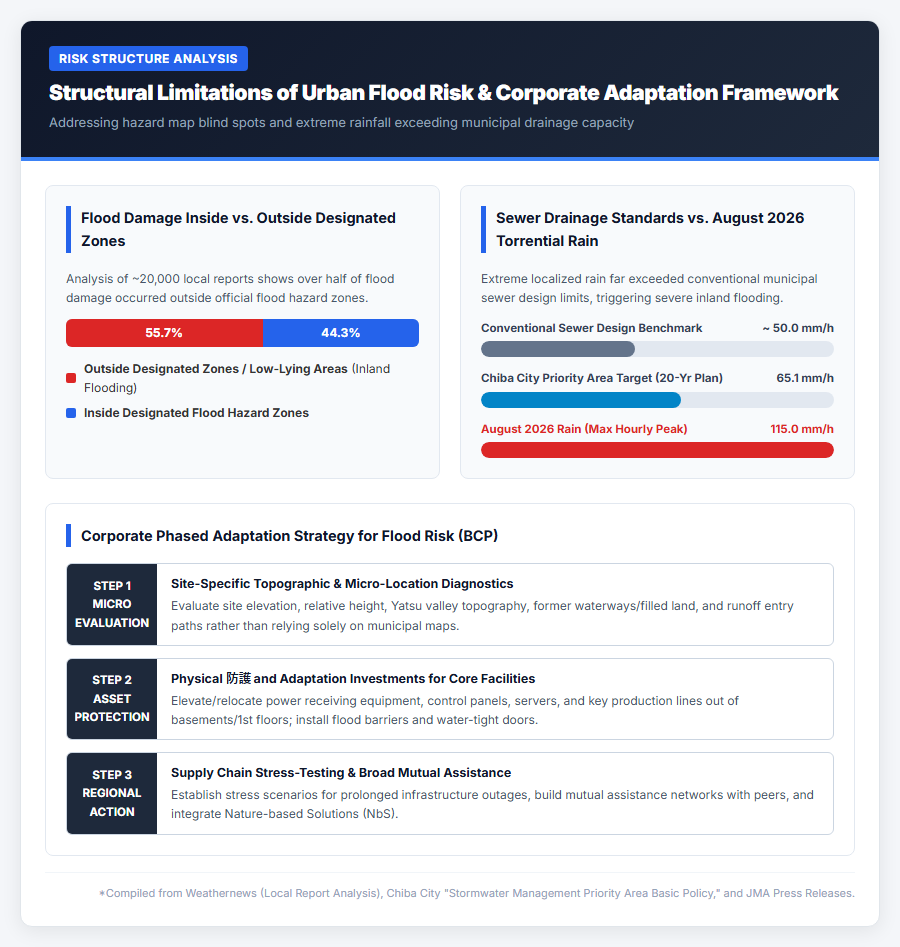
The single greatest lesson this storm delivered to corporate risk management is that flooding can easily occur in areas designated as “safe” on official hazard maps. An analysis of nearly 20,000 local reports conducted by Weathernews revealed that 55.7% of respondents who experienced flooding or inundation were located outside official hazard map flood zone boundaries or low-lying areas. Conventional flood hazard maps are predominantly designed around river overflow and levee breach scenarios; they often fail to adequately account for inland flooding caused by short-duration, extreme downpours that overwhelm municipal drainage. During this event, Chiba City’s Chuo Ward experienced an intense downpour of 110 mm in a single hour. When rain falls at such extreme intensity, water accumulates rapidly on roads and properties regardless of proximity to rivers. Consequently, corporate risk assessments can no longer rely solely on whether a property falls within a designated flood zone. Companies must conduct micro-level risk diagnostics evaluating site elevation, relative height compared to surrounding roads, drainage capacity, runoff pathways, and the presence of underground facilities. Crucially, if vital assets such as power receiving equipment, control panels, servers, or primary manufacturing lines are located in flood-prone basements or ground floors, proactive adaptation investments—such as installing flood barriers or elevating machinery—are imperative. Please refer to the diagram below.
Early Regional Economic Recovery and Mid-to-Long-Term Disaster Prevention Infrastructure Investment
To enhance regional economic resilience against increasingly severe and frequent urban flooding, infrastructure must be reinforced and broad-area cooperation established well beyond individual corporate self-defense. Currently, many municipal stormwater drainage systems are engineered for rainfalls of around 50 mm per hour, leaving them under-equipped for localized deluges exceeding 100 mm per hour, as seen in Chiba City. Although Chiba City is pursuing a 20-year plan to raise its drainage capacity standard to 65.1 mm per hour in priority areas, upgrading physical infrastructure requires immense time and financial resources. Therefore, in addition to strengthening “grey infrastructure” such as sewers and pumping stations, combining them with “green infrastructure” or Nature-based Solutions (NbS)—such as rain gardens and green spaces that temporarily store and infiltrate rainwater—is drawing widespread attention. Furthermore, facilitating rapid economic recovery depends on building flexible, informal support networks among local governments, financial institutions, and regional enterprises. Because neighboring businesses within the same area may be impacted simultaneously, mutual aid among immediate neighbors has clear limits; thus, establishing wide-area support frameworks and sharing inventory and operational status during normal times is essential. By closely monitoring policy and budget developments while integrating climate change risks into core business strategies, companies can help lay the groundwork for a truly resilient regional economy.
Reference Pages
- [Ministry of Land, Infrastructure, Transport and Tourism: On the Damage Situation Caused by the August 2026 Chiba Heavy Rain] https://www.mlit.go.jp/saigai/saigai_260813.html
- [Fire and Disaster Management Agency: Damage and Response Situation of Fire Fighting Organizations regarding the August 2026 Chiba Heavy Rain (13th Report)] https://www.fdma.go.jp/disaster/info/items/20260813chibagouu13.pdf
- [Japan Meteorological Agency: On the Naming of the Heavy Rain in Chiba Prefecture from August 13, 2026] https://www.jma.go.jp/jma/press/2608/14a/20260814_R8chibagouu.html
【#ChibaHeavyRain #SMESupport #BusinessContinuityPlanning #InlandFlooding #FloodRiskManagement #EconomicImpact】


コメント