Alibaba Group has announced the launch of its next-generation in-house AI processor, the “Zhenwu V900,” alongside ambitious expansion plans for its flagship AI model series, “Qwen.” Amid intensifying U.S. export controls on advanced semiconductors to China, the move underscores Alibaba’s strategy to build a vertically integrated computing stack spanning custom silicon to cloud infrastructure.
- Performance of the Custom “Zhenwu V900” Chip and Strategic Objectives
- Scaling the “Qwen” AI Model Family Toward 10-Trillion Parameters
- Navigating U.S. Semiconductor Export Restrictions and the Drive for Domestic Silicon
- $10 Billion Capital Raising and the 20 GW Global Data Center Vision
- Shortened CAPEX Payback Periods and Semiconductor IPO Plans
- Structural Shifts in the AI Industry and Key Outlooks
Performance of the Custom “Zhenwu V900” Chip and Strategic Objectives
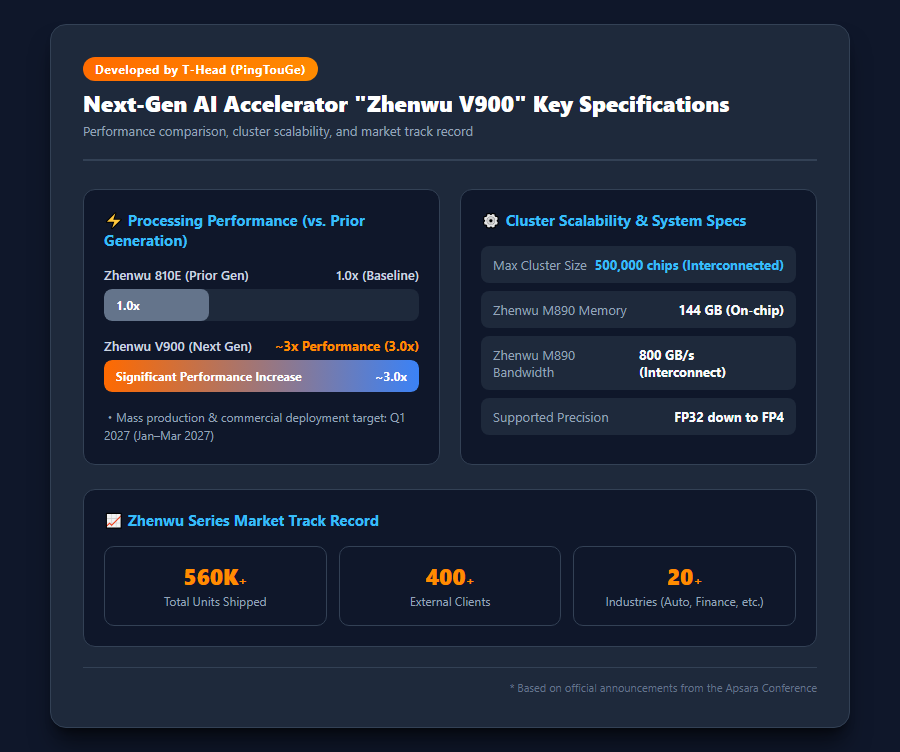
On September 22, 2026, at its annual flagship tech event, the Apsara Conference in Hangzhou, Zhejiang Province, Alibaba Group officially unveiled the “Zhenwu V900,” a next-generation AI accelerator developed by its chip design subsidiary, T-Head (PingTouGe). Delivering approximately three times the processing performance of its predecessor, the Zhenwu 810E, the new chip is scheduled for mass production and commercial deployment in the first quarter of 2027 (January–March). Designed as the foundational core for training and serving ultra-large AI models, the Zhenwu V900 supports massive cluster configurations capable of interconnecting up to 500,000 chips. Existing models in the lineup, such as the Zhenwu M890, featured 144 GB of on-chip memory, 800 GB/s interconnect bandwidth, and native support for precision formats ranging from FP32 down to FP4. To date, Alibaba has shipped more than 560,000 Zhenwu-series chips to over 400 external enterprise clients across more than 20 industries, including automotive and finance. By rolling out custom silicon tailored for cutting-edge AI workloads, Alibaba aims to significantly bolster the competitive edge of its cloud infrastructure.
Scaling the “Qwen” AI Model Family Toward 10-Trillion Parameters
Alongside its hardware overhaul, Alibaba presented a highly ambitious roadmap for its foundational large language model family, “Qwen” (Tongyi Qianwen). Alibaba Group CEO Eddie Wu revealed that the company is currently training ultra-large models scaling from 5 trillion to 10 trillion parameters, designed to execute complex, long-horizon tasks. This represents a dramatic expansion beyond current flagship releases such as the 2.4-trillion-parameter “Qwen 3.8 Max” and its predecessor “Qwen 3.7 Max,” shifting the architectural focus from single-turn responses to sustained task execution endurance required by autonomous AI agents. Supporting this algorithmic leap is an integrated infrastructure stack featuring the “T-Head SAIL” software platform and the “ICN Switch 1.0” networking chip—which offers an aggregate bandwidth of 25.6 Terabits per second (Tbps)—ensuring robust cloud throughput for high-concurrency inference requests. By simultaneously advancing model scaling and infrastructure optimization, Alibaba is asserting its drive to match and potentially surpass global frontier AI technology across both software and hardware.
Vertical Infrastructure Integration and Capital Strategy Under U.S. Export Controls
Navigating U.S. Semiconductor Export Restrictions and the Drive for Domestic Silicon
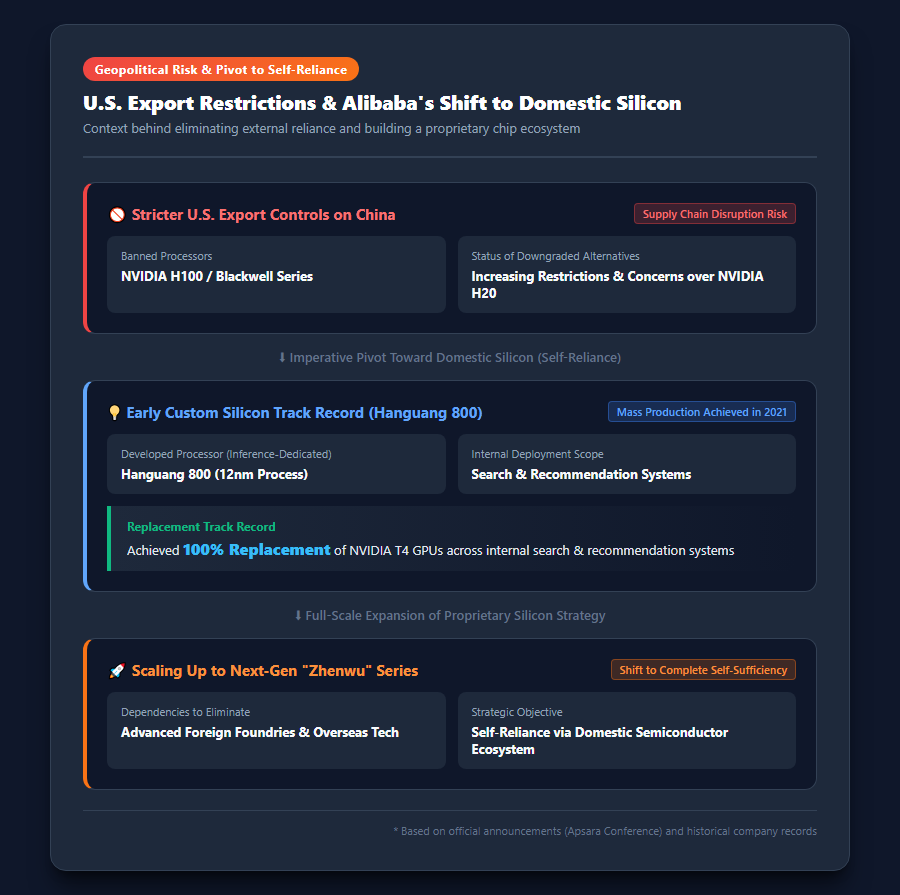
The primary catalyst behind Alibaba’s accelerated in-house chip development is the stringent semiconductor export regime enforced by the U.S. government. Washington has prohibited shipments of top-tier Nvidia AI processors, such as the H100 and Blackwell series, to Chinese entities, while scrutiny and security concerns around downgraded alternative chips like the H20 continue to mount. Faced with severe disruption risks across conventional external supply chains, transitioning to domestic silicon has become an imperative for Chinese technology giants like Alibaba. Alibaba previously proved its custom silicon capabilities in 2021 by mass-producing the 12nm “Hanguang 800,” a dedicated inference processor that fully replaced Nvidia T4 GPUs across its internal search and recommendation systems. The full-scale deployment of the Zhenwu series marks a critical strategic pivot toward self-reliance within China’s domestic semiconductor ecosystem, mitigating dependence on advanced foreign foundries and overseas intellectual property.
$10 Billion Capital Raising and the 20 GW Global Data Center Vision
To support soaring compute demand and the buildout of proprietary infrastructure, Alibaba is deploying massive capital alongside an aggressive global CAPEX plan. Despite holding a robust net cash position of \$30.7 billion, the company raised an additional \$10.2 billion (approx. HK\$80 billion) through a new equity placement dedicated to AI infrastructure expansion. Roughly 60% of these proceeds are allocated toward expanding global computing infrastructure, with the remaining 40% earmarked for building specialized AI Data Centers (AIDCs) and upgrading existing cloud operations. Alibaba Cloud has set an ambitious target to scale its global data center power capacity beyond 20 gigawatts (GW) by 2032, expanding its footprint with new cloud regions across Europe (including Turkey, Finland, and the Netherlands) and the Middle East. Furthermore, Alibaba introduced the “Panjiu AL128 Supernode Server,” which houses 128 accelerators within a single rack and delivers petabit-per-second class fabric bandwidth to handle the bursty, high-frequency compute demands generated by agentic AI workloads.
Economic Efficiency of Custom Silicon and Broader Market Impact
Shortened CAPEX Payback Periods and Semiconductor IPO Plans
Beyond mitigating geopolitical risk, adopting custom-designed silicon yields substantial cost efficiencies and accelerates capital return timelines. According to financial analyst estimates, Alibaba’s custom Proprietary Processing Units (PPUs) achieve inference performance comparable to Nvidia’s H20 while reducing the Bill of Materials (BOM) cost by approximately 40%. Consequently, the payback period for data center infrastructure investments is projected to shrink from three years down to 2.0–2.5 years, driving Return on Invested Capital (ROIC) up from 15% to a range of 20%–30%. In parallel, capital market developments indicate that Alibaba’s T-Head semiconductor subsidiary is planning a dual initial public offering (IPO) on the Hong Kong Stock Exchange (HKEX) alongside Baidu’s AI chip unit, Kunlun Xin. The joint listings are expected to raise around \$7 billion, valuing each chipmaker at over 50 billion yuan (approx. \$7 billion). Spun-off capital raising will allow Alibaba to leverage external funding to further solidify its full-stack “chip-cloud-model-device” vertical integration.
Structural Shifts in the AI Industry and Key Outlooks
Alibaba’s synchronized expansion across silicon, foundation models, and cloud infrastructure extends beyond an isolated corporate milestone, signalling broader structural shifts in the global AI industry. Commercial traction is already evident, with Alibaba’s annualized AI-related revenue run-rate reaching \$7.3 billion in a recent quarter and on track to surpass the \$10 billion milestone shortly—demonstrating a clear transition into the monetization phase. Moving forward, market attention will center on three key areas: first, the mass-production yield and practical cluster efficiency of the Zhenwu V900 upon its early-2027 rollout; second, how effectively the 5-to-10-trillion-parameter Qwen models translate into real-world autonomous agent deployments; and third, how potential further tightening of U.S. export controls and HKEX capital expansion shape Alibaba’s competitive positioning against Western cloud hyperscalers. As the race for AI supremacy shifts toward end-to-end stack ownership—spanning frontier intelligence down to silicon and power infrastructure—global competition is set to intensify even further.
Reference Pages
- [Alibaba Group News and Resources] https://www.alibabagroup.com/en-US/news-and-resource
【#Alibaba #AIChips #Qwen #CloudInfrastructure #THead #ZhenwuV900】
コメント