On July 15, 2026, Chinese authorities officially approved the provision of Apple’s proprietary AI technology, “Apple Intelligence.” To comply with local regulations, the company plans to partner with major Chinese IT giants such as Alibaba and Baidu to develop localization models tailored specifically to the Chinese market.
- The significance of overcoming 22 months of regulatory review and official approval
- Alibaba and Baidu Implement the ‘Dual Engine’ Strategy
- Apple’s stock price hits new highs and expectations for sales recovery in the Chinese market
- The AI supremacy battle with Chinese players like Huawei and Xiaomi
- “Private Cloud Compute” Rejection and Data Localization
- Data Access Based on Chinese Domestic Law and User Concerns
- Launch in late 2026 and impact on the iPhone 18 cycle
- The Shadow of a New ‘Foreign Enemy’ as OpenAI Enters the Hardware Market
The significance of overcoming 22 months of regulatory review and official approval
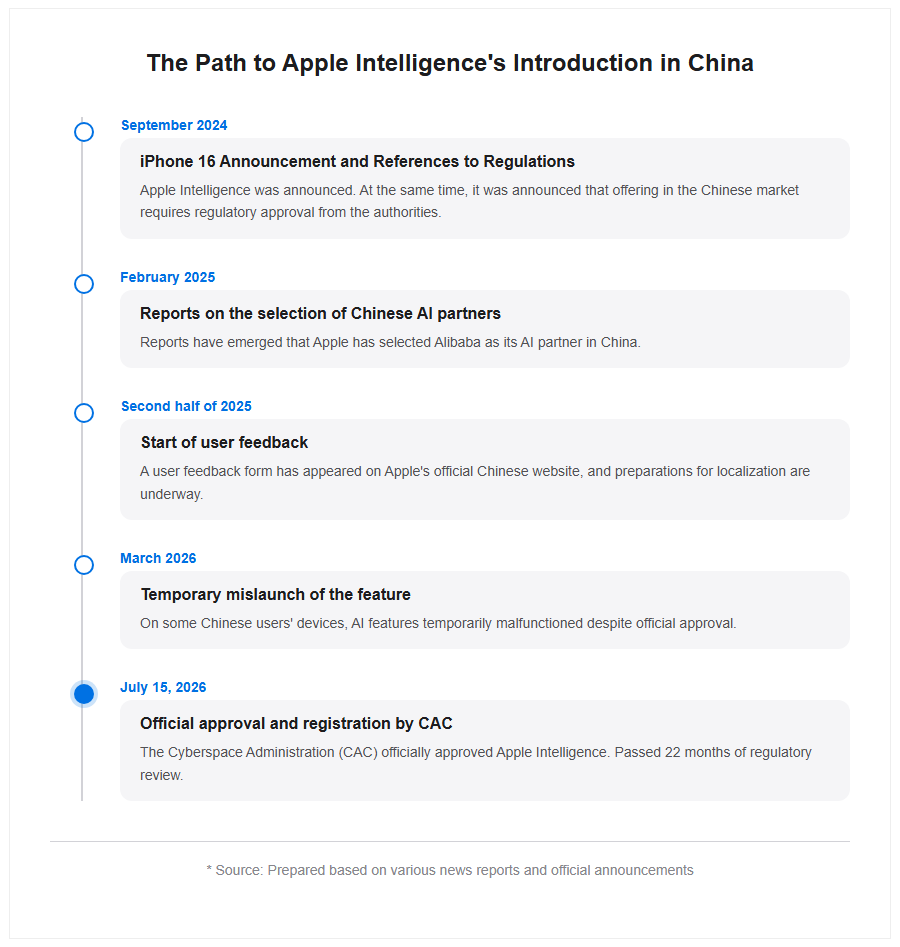
On July 15, 2026, China’s Internet Regulatory Authority, the Cyberspace Administration (CAC), officially approved and registered Apple’s generative AI service, “Apple Intelligence.” This is a decisive breakthrough, finally realized after about 22 months since the iPhone 16 was announced in September 2024 and Apple mentioned the need to comply with regulations in China. In China, registration with authorities is required before generative AI services are made public, and Apple has removed this biggest regulatory barrier.
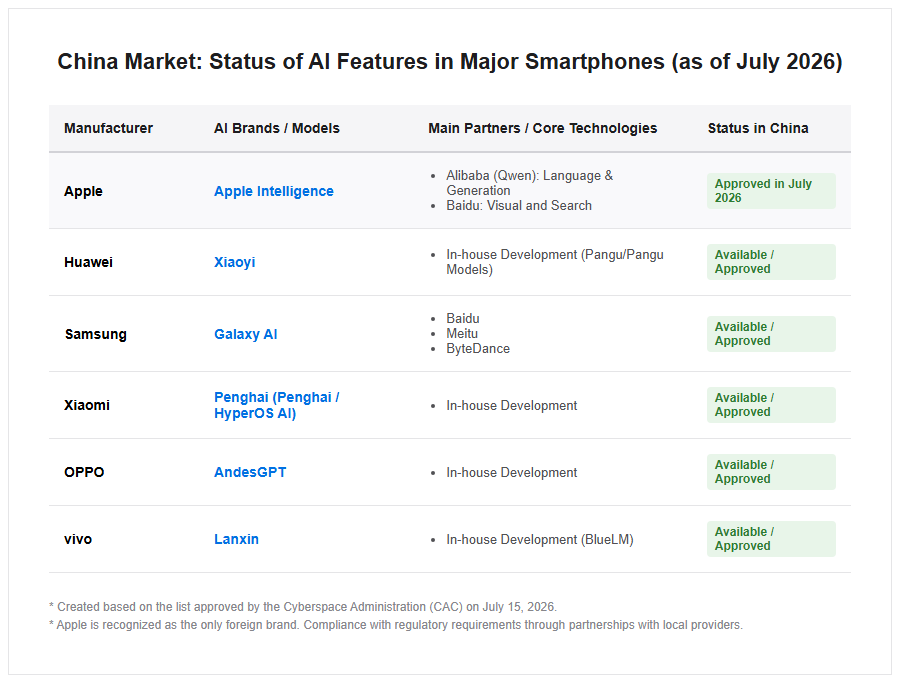
The approved list includes a total of seven mobile AI products, such as Apple, Huawei’s “Xiaoyi,” Xiaomi’s “Pengpai,” and OPPO’s “AndesGPT,” with Apple being the only foreign brand to be listed. This approval not only signifies the completion of the procedure but also suggests that a well-established operational pattern has established in which even foreign companies can enter the market by partnering with providers within China. The diagram below illustrates the complex journey of responding to AI regulations in China.
Alibaba and Baidu Implement the ‘Dual Engine’ Strategy
The biggest feature of the Chinese version of Apple Intelligence is that it replaces Apple’s proprietary foundational model used in the global version by integrating AI models from domestic Chinese companies. Specifically, Alibaba’s large language model “Qwen” has been adopted as a major language AI, handling text generation, image understanding, and content creation functions across major operating systems such as iOS, iPadOS, and macOS. This allows users to access advanced AI features in the system’s native environment without switching between apps.
Meanwhile, Baidu mainly handles auxiliary roles such as AI-based search functions and “Visual Search.” Baidu’s technology is deeply integrated into the Chinese version of Siri, supporting accurate information searches and interactions tailored to local contexts. This “dual-engine” structure between Alibaba and Baidu combines the strengths of Alibaba’s general-purpose model with Baidu’s advantages in search technology, representing an advanced strategic division of roles to provide an optimized experience for the Chinese market.
Economic Impact and Intensifying Market Competition
Apple’s stock price hits new highs and expectations for sales recovery in the Chinese market
This approval news had an extremely positive impact on the market, with Apple’s stock price rising 4% from the previous day to $327.50 in the U.S. market on July 15, 2026, setting a new all-time high. Investors are confident that the unlocking of AI features in China, the world’s largest smartphone market, will provide a strong tailwind for future iPhone sales. In fact, the lack of AI features has been a factor in declining sales in China, but in the second quarter of 2026, Greater China sales are expected to reach about $20.5 billion, showing signs of recovery, and the full-scale adoption of AI is expected to further accelerate this trend.
On the other hand, it is important to note that Apple’s projected price-to-earnings ratio (PER) is a high level of 34.6 times, significantly exceeding the five-year average of 27.7 times. The market has already priced in “future positive factors,” and the earnings announcement scheduled for July 30, 2026, is expected to be a true stress test. If uncertainty remains regarding the specific timing of AI feature launches or their contribution to revenue, there is a risk that overly high valuations may enter a period of adjustment.
The AI supremacy battle with Chinese players like Huawei and Xiaomi
In the Chinese market, Apple is already facing fierce competition from strong domestic brands such as Huawei, Xiaomi, vivo, and OPPO, which have already integrated proprietary AI features into their smartphones. Until now, the lack of AI features in the Chinese iPhone was considered a weakness, but with this approval, the countdown to bridging the functional gap with its rivals has begun. For Apple, in addition to its own strength in vertically integrating hardware and OS, it is poised to compete with local AI from companies like Alibaba to compete with leading domestic manufacturers.
According to market analysts, about 850 million iPhones worldwide are outdated devices that cannot run Apple Intelligence, and including devices that do not support AI versions of Siri, there is a potential replacement demand of another 1.3 billion units. Especially in the Chinese market, where the presence or absence of AI features is a decisive incentive for upgrades, localization through partnerships with Alibaba and Baidu is expected to serve as a powerful “growth logic” that goes beyond merely adding features. The chart below compares the AI feature adoption status of major manufacturers in the Chinese market.
Technical Separation and Challenges of Privacy and Data Sovereignty
“Private Cloud Compute” Rejection and Data Localization
The global version of Apple Intelligence, which emphasizes “Private Cloud Compute (PCC)” as a key privacy protection feature, is unlikely to be adopted in the Chinese version based on media reports. China enforces strict data localization regulations, requiring that critical data be stored and processed within domestic infrastructure. Therefore, the Chinese version of AI processing will be conducted not on Apple’s proprietary cloud but on infrastructure operated by partner partners within China.
Apple has built a new system foundation called the “Search Partner Inference Provider,” which dynamically switches AI partners based on the device’s location, starting with iOS 27 Beta 2, enabling it to flexibly comply with regulations worldwide. However, the fact that the PCC framework, which uses encryption technology to block data from external sources after adapting to China’s unique regulatory environment, is not maintained, is a major turning point in technical design.
Data Access Based on Chinese Domestic Law and User Concerns
When using the Chinese version of Apple Intelligence, local laws such as China’s Cybersecurity Law (effective 2017), Data Security Law (effective 2021), and National Information Law apply. Under these laws, companies have a legal obligation to cooperate with government information requests, and AI queries processed by Alibaba and Baidu’s infrastructure may be subject to regulatory requests. This is an extension of Apple’s longstanding stance of migrating iCloud data in China to servers operated by local companies and complying with local regulations.
For users, it is important to understand under which legal frameworks their AI usage history and input data might be protected or accessed. Apple has stated that “the company’s values do not change in any country, but we must comply with each country’s laws,” and will continue to face the extremely difficult balance between privacy protection and maintaining market access.
Future developments and new competitive risks to watch
Launch in late 2026 and impact on the iPhone 18 cycle
Although approval from authorities has been obtained, the specific start date for the service has not yet been announced as of July 20, 2026. Many analysts expect it to be launched in the latter half of 2026 (Q3–Q4), likely to align with the release cycle of the next flagship model, the iPhone 18 series. Introducing it at this timing should be a key milestone that stimulates iPhone replacement demand in China and decisively restores market share.
At launch, attention will be on how smoothly Alibaba’s Qwen and Baidu technologies integrate into the iOS ecosystem, and how much the experience differs from other language versions like Japanese. Additionally, whether additional charges will apply only to the Chinese version or how integration with external AI like ChatGPT will be handled remains to be seen.
The Shadow of a New ‘Foreign Enemy’ as OpenAI Enters the Hardware Market
While Apple is solidifying its foothold in China, the movement of “outsiders” aiming to overturn the very concept of smartphones from a medium- to long-term perspective is accelerating. OpenAI has acquired the company of Jonathan Ivy, Apple’s former chief designer, for about $6.5 billion, and is rapidly advancing the development of a screenless “AI phone.” Aiming for mass production in the first half of 2027, this device focuses on the experience of an “AI agent” where AI performs tasks directly on behalf of the user, eliminating the hassle of opening apps.
If a future where AI handles everything is realized, Apple’s main revenue pillar—the App Store and its ecosystem—could be threatened. For Apple, the biggest challenge going forward will be not only regulatory compliance in China and competition in the existing smartphone market, but also how to counter emerging forces like OpenAI, which are trying to redefine human-machine interaction.
[#AppleIntelligence #生成AI #Apple #中国ビジネス #アリババ #株価ニュース #テックトレンド #サイバーセキュリティ]


コメント