
Fourteen countries, including Japan, the United States, and the Philippines, issued a joint statement declaring that China’s claims in the South China Sea lack legal basis. Behind this is the ongoing attempt to change the status quo by force and rising geopolitical tensions, even ten years after the 2016 arbitration award.
- [The Core of the News] A Historic Joint Statement by 14 Countries
- [Rule of Law] Ten Years of Arbitration Awards and the Illegality of the ‘Nine-Dash Line’
- [Economic Losses] Realistic risks of blocking maritime routes (sea lanes)
- [Impact on Industry] Rebuilding the Semiconductor Supply Chain and Economic Security
- [Market Perspective] Normalization of Geopolitical Risks and Focus on Defense-Related Stocks
- [Future Developments] Deepening Multilateral Cooperation and Strengthening Monitoring Systems
[The Core of the News] A Historic Joint Statement by 14 Countries
On July 12, 2026, 14 countries including Japan, the Philippines, the United States, the United Kingdom, and Germany issued a joint statement marking 10 years since the 2016 ruling by the International Court of Arbitration that rejected China’s extensive territorial claims in the South China Sea. This statement reiterates that China’s determination that its maritime interests based on “historical rights” lack legal basis is “final and legally binding.” Participating countries include Australia, Canada, Italy, New Zealand, as well as the Baltic states such as Estonia and Lithuania, Romania, and Slovenia, demonstrating that the South China Sea issue is an international concern beyond Asia. The statement strongly opposes harassment and intimidation by maritime security agencies and maritime militias against other countries, emphasizing the importance of upholding freedom of navigation and overflight. In response, the Chinese side dismissed the decision as “mere worthless paper,” reaffirmed its sovereignty, and even called the chief minister of the Japanese Embassy in China to protest, intensifying its opposition.
[Rule of Law] Ten Years of Arbitration Awards and the Illegality of the ‘Nine-Dash Line’
The basis for this statement is the unanimous ruling of the Permanent Court of Arbitration in The Hague on July 12, 2016. This lawsuit was filed by the Philippines in 2013 under the United Nations Convention on the Law of the Sea (UNCLOS). At that time, the court denied China’s “nine-dash line” claim and ruled that historical rights to marine resources in the area were invalid to the extent exceeding UNCLOS provisions. Specifically, it is also clearly stated that there is no legally recognized “island” in the Spratly Islands, and there is no basis for creating an Exclusive Economic Zone (EEZ). However, China refused to participate in this arbitration process and, even after the ruling, forcibly proceeded with the creation of large-scale artificial islands, runway construction, and even the deployment of military aircraft and radar, effectively turning it into a military base. The joint statement for the 10th year demonstrates the international community’s unwavering commitment to not tolerate such “rule by force” and to maintain the regional order based on international law.
Impact on the Global Economy and Supply Chains
[Economic Losses] Realistic risks of blocking maritime routes (sea lanes)
The South China Sea is a vast maritime area covering approximately 3.5 million square kilometers annually and plays a vital role as a major logistics artery supporting the global economy. Nearly half of the world’s crude oil tankers pass through here, and for Japan, it is a “lifeline” through which just over half of maritime trade and the majority of crude oil imports pass through this area. If the conflict threatens navigation in the South China Sea, crude oil tankers (VLCCs) destined for Japan will be forced to reroute to places like the Lombok Strait, making chartering costs higher due to increased routes inevitable. According to estimates, the rerouting from the Strait of Malacca to the Lombok Strait is expected to increase costs by about 1.5 billion yen per month, and if the situation worsens and the route goes around southern Australia, securing the necessary vessels will become difficult. Logistics delays directly impact manufacturing production lines that require “just-in-time,” carrying risks that could cause major disruptions to the global economy. Thus, the stability of the South China Sea is not merely a diplomatic issue, but a pressing economic challenge directly linked to the prices and energy security of each country.
[Impact on Industry] Rebuilding the Semiconductor Supply Chain and Economic Security
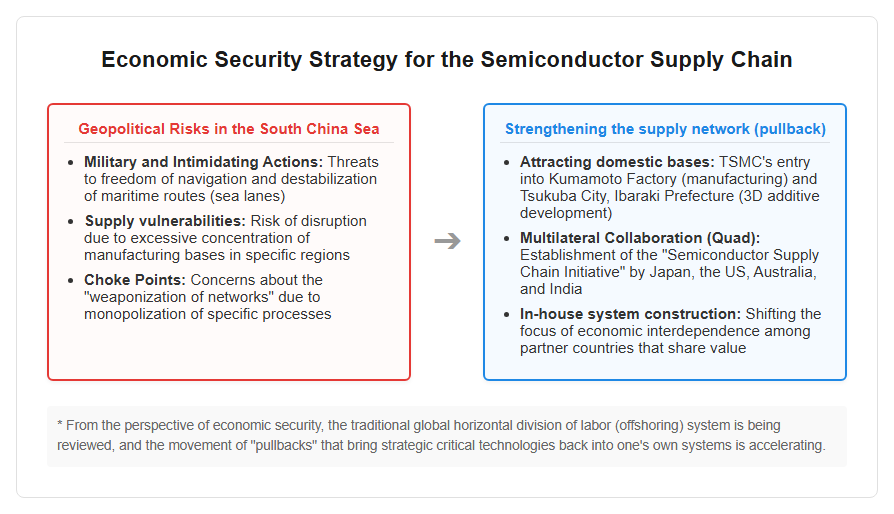
Amid intensifying competition among major powers, geopolitical risks in the South China Sea are also being considered important from the perspective of “economic security.” In particular, in the semiconductor supply chain, bases in East Asian countries, which play a major role in manufacturing processes, are closely linked to the risks in the South China Sea. Currently, countries like the United States and Japan are accelerating the “pullback” movement, which involves pulling back supply chains that have stretched across borders into their own systems. For example, the project to attract Taiwan’s TSMC to Japan (in Ibaraki and Kumamoto Prefectures) is based on a national strategy to ensure a stable supply of advanced semiconductors. Additionally, the launch of the Semiconductor Supply Chain Initiative by the Quad (Japan, the US, Australia, India) is part of cooperation to reduce excessive dependence on specific regions and overcome vulnerabilities. Militarization and conflict in the South China Sea threaten to shake the foundations of these high-tech industries and significantly influence private companies’ investment decisions and location strategies. Please refer to the diagram below.
Market Trends and Future Outlook
[Market Perspective] Normalization of Geopolitical Risks and Focus on Defense-Related Stocks
The normalization of geopolitical risks is also bringing changes to investment themes in financial markets. In recent years in emerging Japanese markets, defense-related stocks have maintained strong popularity due to budget measures and budget requests aimed at strengthening defense capabilities. Specifically, companies such as Astroscale Holdings in the satellite sector and Terra Drone and ACSL in the drone sector are actively trading, with government policies strengthening defense capabilities providing strong investment clues. To counter coercive actions in the South China Sea, the Philippine government has provided coastal surveillance radar (worth about 600 million yen) from Japan, and multilateral cooperation through Government Security Capacity Enhancement Assistance (OSA) is also advancing as a tailwind for related industries. Furthermore, the “proactive transparency strategy,” which disseminates video evidence to the world regarding incidents such as the use of water cannons and military lasers by the China Coast Guard, has not only won domestic and international public opinion but also played a role in increasing support for military modernization budgets. In an uncertain international environment, the value of companies possessing technologies that contribute to security is being reassessed from a long-term perspective.
[Future Developments] Deepening Multilateral Cooperation and Strengthening Monitoring Systems
Going forward, the focus will be on the Philippines’ moves as it looks toward assuming the ASEAN Chair in 2026, as well as further deepening of multilateral cooperation. The Marcos administration, determined not to cede even an inch of territory, is revitalizing its alliance with the United States and expanding the U.S. military-accessible bases (EDCA sites). Please refer to the diagram below.
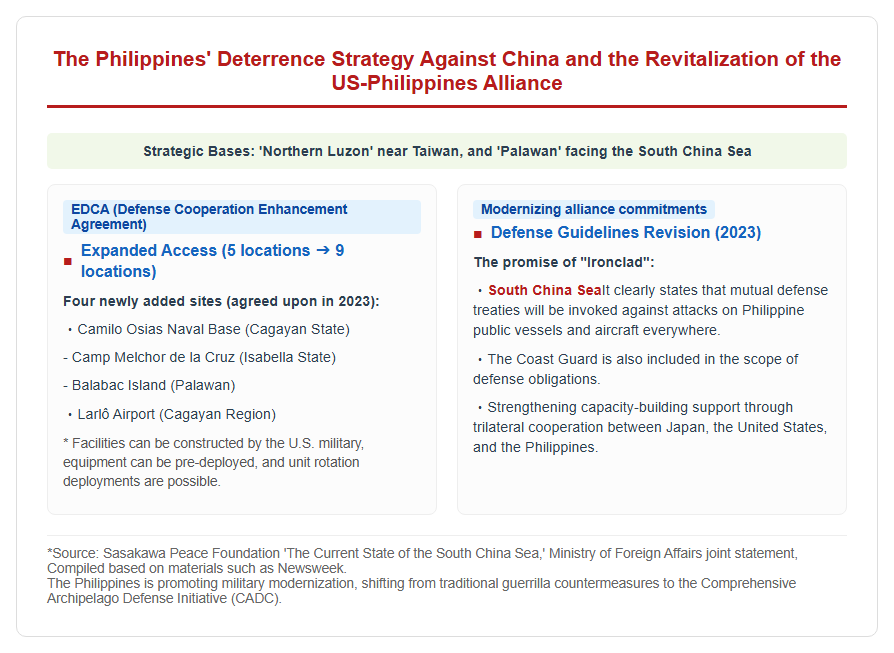
Furthermore, trilateral cooperation between Japan, the U.S., and the Philippines has steadily evolved since the 2024 summit, including the signing of the Agreement to Facilitate Cooperation between Forces (RAA). Meanwhile, China has also taken legal countermeasures, such as setting a baseline for territorial waters at Scarborough Shoal, and maritime tensions are expected to intensify. Japan is required to continue effectively ensuring freedom of navigation through cooperation and capacity-building support for law enforcement agencies, while supporting ASEAN’s vision of the South China Sea as a “sea of peace, stability, cooperation, and prosperity.” In today’s world, where economics and security are inseparable, multilateral pressure to comply with international law will continue to function as an indispensable tool for long-term regional stability.
[#南シナ海 #共同声明 #経済安全保障 #サプライチェーン #防衛関連株 #海洋法条約]


コメント