On August 13, 2026, Medley, Inc. announced that it will begin offering “MALL Cloud,” a cloud-based electronic health record system for hospitals and clinics with inpatient beds, from January 2027 onward. The background to this includes the government-promoted healthcare DX policy, the target for electronic health record adoption by 2030, and a wave of system renewals based on the 6th edition of the safety management guidelines.
- Announcement of the Development of “MALL Cloud”, an Electronic Health Record System for Hospitals
- The Government’s Healthcare DX Policy Urging Cloud Migration and Its Background
- How Generative AI Dramatically Reduces Medical Documentation Time
- Achieving Enhanced Functionality through Single-Screen Operation of Departmental Systems and External Integration
- Security Measures Required by the Medical Information Guidelines 6.0
- Monetization and Future Outlook of Medical Platforms
Announcement of the Development of “MALL Cloud”, an Electronic Health Record System for Hospitals
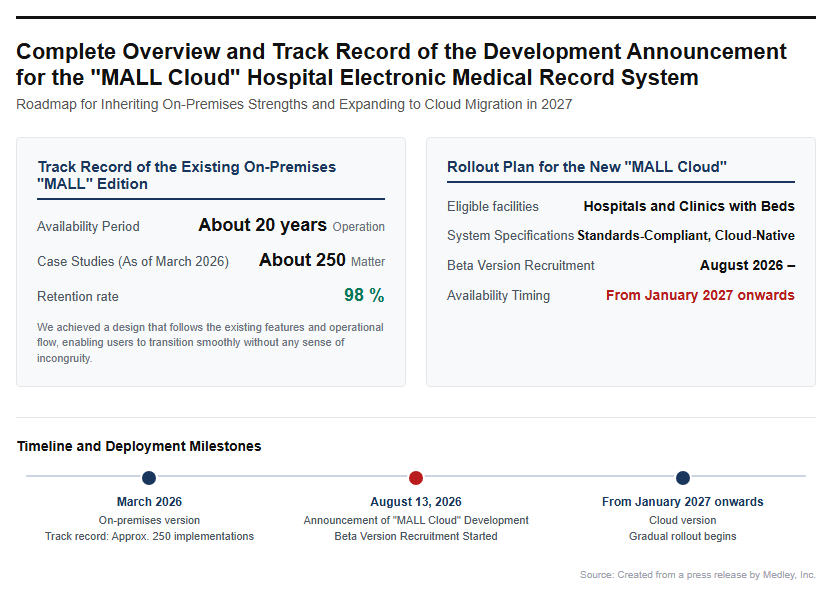
On August 13, 2026, Medley, Inc. announced that it is developing “MALL Cloud,” a cloud-native electronic health record (EHR) system for hospitals and clinics with beds that complies with the standard specifications set by the Ministry of Health, Labour and Welfare. The company aims to begin phased rollout of this system starting in January 2027. “MALL,” the on-premise electronic health record system that Medley has provided for approximately 20 years, has reached an installation record of about 250 facilities as of March 2026, maintaining a high user retention rate of 98 percent. The development of this new cloud version is designed to carry over the core specifications that have been highly praised in the current on-premise version, such as its features and operational workflows. As a result, a major advantage is that existing users will be able to transition to the cloud environment smoothly and without feeling out of place. Ahead of the official launch, Medley will introduce a beta version starting in August 2026 and simultaneously began recruiting pilot users—hospitals and clinics with beds that will cooperate in testing the system in actual medical settings. For an image diagram, please refer to the figure below.
The Government’s Healthcare DX Policy Urging Cloud Migration and Its Background
Based on the “Roadmap for Promoting Healthcare DX” approved by the Cabinet in June 2023, the government has set a goal to introduce electronic medical records in nearly all medical institutions across Japan by 2030 in order to share necessary patient information. Furthermore, the Act on Assurance of Medical and Long-Term Care Services, amended in December 2025, explicitly mandates achieving a 100% electronic medical record adoption rate by December 31, 2030. As part of these government-led reform policies, the Ministry of Health, Labour and Welfare (MHLW) strongly recommends transitioning from the conventional on-premise model—which involves installing dedicated servers within hospitals—to secure cloud-native systems operating in public cloud environments. Particularly for hospital information systems, a direction has been indicated to comprehensively migrate electronic medical records, medical billing computers, and departmental systems to the cloud in an integrated manner. Medley participates as a member of the “Council for the Renewal of Hospital Information Systems” hosted by the Digital Agency and the MHLW, and is rapidly advancing the development of systems that completely align with national policies while incorporating the latest discussions on institutional design.
Healthcare Innovation Brought by AI-Natives
How Generative AI Dramatically Reduces Medical Documentation Time
The defining characteristic of the MALL Cloud is that it is an “AI-native” electronic health record (EHR) system designed from the ground up on the premise of utilizing artificial intelligence. Medley is also offering a pilot version of a generative AI-powered medical document creation assistance feature for its existing on-premises system, starting December 4, 2025. This AI document creation assistant analyzes vast amounts of data stored within the EHR—such as patient medical histories, test results, nursing records, and inpatient progress—to automatically generate drafts with a single click. The five types of documents supported are discharge summaries, medical information provision letters, primary physician opinion papers, discharge nursing summaries, and progress summaries. Verification data from pilot tests conducted at select medical institutions confirmed that this feature reduces creation time by an average of over 70% for discharge summaries, and by up to approximately 80% for discharge nursing summaries. This is expected to dramatically reduce the burden of peripheral administrative tasks for doctors, nurses, and other staff, enabling healthcare professionals to secure more time to focus on their primary mission: interacting directly with patients.
Achieving Enhanced Functionality through Single-Screen Operation of Departmental Systems and External Integration
The MALL Cloud features high interoperability that thoroughly supports the efficiency of daily operations in medical settings. Specifically, it is structured so that in-house developed departmental systems for pharmacy, nutrition, laboratory testing, dialysis, and other areas can be handled seamlessly on the same screen, enabling automatic data integration. This eliminates the hassle of switching between systems, thereby preventing data entry errors and missed confirmations. Furthermore, it flexibly accommodates external integration with external testing equipment, medical accounting systems, imaging systems (PACS), and various peripheral devices already implemented by medical institutions. Medley’s electronic health record system offers exceptionally high customizability tailored to the individual needs of each facility; by adjusting approximately 3,500 detailed setting items, it is possible to build an optimal environment that matches each hospital’s operational rules. In this way, its strength lies in being designed as an all-in-one package that transcends the boundaries of a single charting tool to facilitate the smooth circulation of information across the entire hospital.
The 2027 “Renewal Wave” and Future Prospects
Security Measures Required by the Medical Information Guidelines 6.0
Amid the global increase in sophisticated cyberattacks targeting medical institutions, the Ministry of Health, Labour and Welfare published the “Guidelines for the Safe Management of Medical Information Systems (Version 6.0)” in March 2024. These guidelines set forth clear security standards looking toward fiscal 2027, requiring that “two-factor authentication” be adopted in principle when newly introducing or updating systems expected to be operational in fiscal 2027. Furthermore, rather than leaving things entirely up to vendors, strict maintenance access controls are also required, such as reviewing audit logs and connection procedures for maintenance lines used to remotely maintain systems from the outside. Although not a legal obligation, it is extremely likely to become widely established as the future security standard (de facto standard). Because many medical systems will enter their renewal cycles between fiscal 2025 and fiscal 2027, decision-making during fiscal 2026 will serve as a practical turning point. Migrating to cloud-based systems offers an effective solution to flexibly meet these advanced security requirements.
Monetization and Future Outlook of Medical Platforms
According to Medley’s financial results for the second quarter (interim period) of the fiscal year ending December 2026, the company’s net sales increased by 22.8 percent year-on-year to 22.68 billion yen, and operating profit surged by 67.4 percent to 2.45 billion yen, indicating extremely strong performance. However, the majority of its revenue is driven by its human resources platform business, such as Job Medley (net sales of 16.68 billion yen), whereas the medical platform business (net sales of 5.49 billion yen) posted a segment loss of 480 million yen due to aggressive growth investments in AI-related initiatives and organizational structure. Moving forward, the primary focus will be to achieve profitability and improve earnings in the medical platform business through efforts such as the full-scale rollout of the newly announced MALL Cloud. Additionally, on August 3, 2026, Medley acquired RM Career Co., Ltd. for 1 billion yen, integrating its expertise in recruitment support for physicians and pharmacists. In the future, using this recruitment outsourcing service as a starting point, the company also envisions expanding into a business process outsourcing (BPO) business for medical institutions leveraging AI and digital transformation, aiming to evolve into a company that underpins the entire healthcare infrastructure.
Reference page
- 【Medley Develops AI-Native “MALL Cloud,” a Standards-Compliant Cloud-Native Electronic Medical Record System】https://www.medley.jp/release/20260813.html
- [Medley Launches Pilot Version of New AI-Powered Medical Document Creation Support Feature for “MALL” Hospital Electronic Health Record System] https://www.medley.jp/release/20251204.html
【#MedicalDX #ElectronicMedicalRecord #GenerativeAI #Medley #MedicalAI #SafetyManagementGuidelines #TwoFactorAuthentication #MALLCloud】


コメント