Hong Kong Chief Executive John Lee has announced the city’s first-ever “1st Five-Year Plan for Economic and Social Development (2026–2030)” alongside his 2026 Policy Address, outlining a strategic roadmap focused on accelerating economic growth and improving public livelihood. The initiatives aim to align closely with Mainland China’s 15th Five-Year Plan, bolstering Hong Kong’s competitiveness as an international financial hub while addressing pressing structural challenges.
- Key Highlights of the Policy Address and Background of the Five-Year Plan
- Alignment with National Strategy and the “Financial South, Innovation North” Spatial Structure
- Expanding Financial Infrastructure: Digital Currency and Offshore RMB Business
- Accelerating Northern Metropolis Development and Attracting Innovation
- Expanding Housing Supply, Supporting Families, and Boosting Employment
- Long-Term Outlook: Addressing Labor Shortages and Fiscal Balance
Key Highlights of the Policy Address and Background of the Five-Year Plan
On September 16, 2026, Hong Kong Chief Executive John Lee officially unveiled the city’s historical “1st Five-Year Plan (2026–2030)” alongside the 2026 Policy Address. Highlighting economic achievements over the past four years, Hong Kong’s real GDP growth rebounded from -3.7% to +3.6% in 2025, reaching a five-year peak of 5.1% year-on-year growth in the first half of 2026. Gross Domestic Product (GDP) surpassed HK\$3.3 trillion in 2025. Leveraging this robust economic momentum, the government introduced the Five-Year Plan as a top-level blueprint to guide long-term growth.
The Five-Year Plan and the Policy Address outline five primary objectives:
- Opening new breakthroughs in economic development
- Continuously enhancing international competitiveness and global influence
- Accelerating the construction and efficiency of the Northern Metropolis
- Achieving marked improvements in public livelihood and social welfare, including housing and employment
- Making significant progress in integrating into and contributing to overall national development
With the median monthly employment earnings rising by approximately 20% over four years, the broader economic foundation has strengthened. The annual Policy Address serves as an operational framework, allocating budgetary resources and setting key performance indicators to systematically execute the long-term goals of the Five-Year Plan.
Alignment with National Strategy and the “Financial South, Innovation North” Spatial Structure
A defining feature of Hong Kong’s First Five-Year Plan is its proactive alignment with Mainland China’s “15th Five-Year Plan.” Under the national blueprint, Hong Kong is designated as “Four Centers” (international financial, shipping, trade, and I&T hubs) and a strategic “talent hub for international high-caliber professionals.” In response, the Hong Kong government outlined a strategy to upgrade its domestic industrial landscape.
Central to this strategy is the “Financial South, Innovation North” spatial development vision. While reinforcing the strengths of the traditional financial and commercial districts in the south, Hong Kong is establishing a major high-tech innovation corridor in the north near the boundary with Mainland China. Please refer to the following diagram.
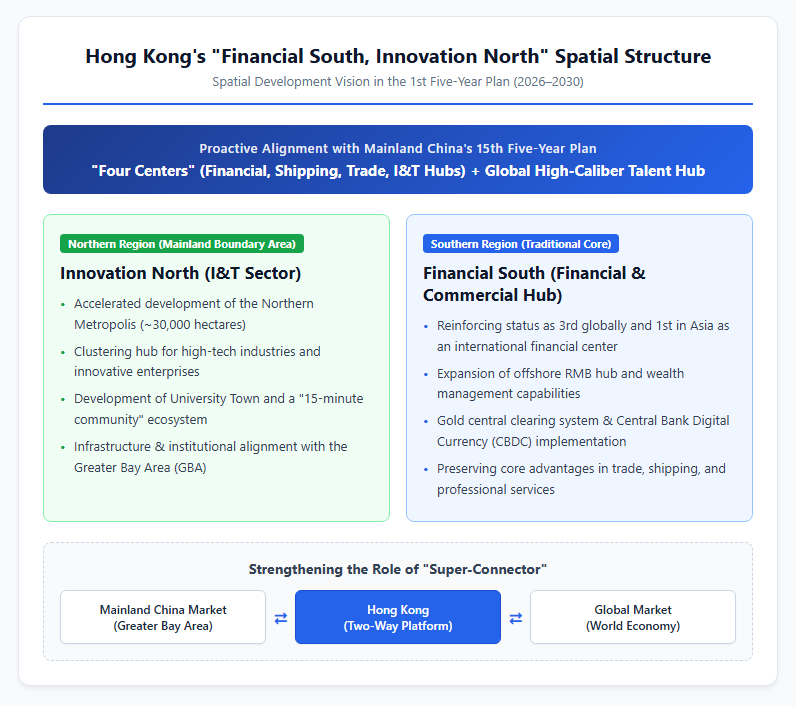
Furthermore, by deepening infrastructure connectivity and institutional mechanisms with the Guangdong-Hong Kong-Macao Greater Bay Area (GBA), Hong Kong aims to strengthen its role as a “super-connector” linking Mainland China with global markets.
Strategic Initiatives for Economic Growth and Strengthening the Financial Hub
Expanding Financial Infrastructure: Digital Currency and Offshore RMB Business
Hong Kong continues to solidify its position as a leading international financial center, ranking 3rd globally and 1st in Asia for four consecutive editions in the 40th Global Financial Centres Index (GFCI) report. Total bank deposits grew by over 10% in 2025 to exceed HK\$19 trillion, while capital raised through Initial Public Offerings (IPOs) surged past HK\$280 billion, highlighting the city’s rising appeal as a safe haven for international capital.
To maintain and expand this competitive advantage, the government and the Hong Kong Monetary Authority (HKMA) are advancing key financial and payment infrastructure developments:
- Launch of Gold Central Clearing and Settlement System: Scheduled for formal operation in Q1 2027 to establish Hong Kong as an international precious metals trading hub
- Central Bank Digital Currency (CBDC) Implementation: Introducing CBDC-based payment infrastructure by the end of 2026
- Enhancement of Offshore RMB Hub: Expanding RMB-denominated financial products and deepening market liquidity
In parallel, regulators including the Securities and Futures Commission (SFC) are updating oversight frameworks, enforcing virtual asset service provider licensing, and tightening due diligence standards to ensure market transparency and security.
Accelerating Northern Metropolis Development and Attracting Innovation
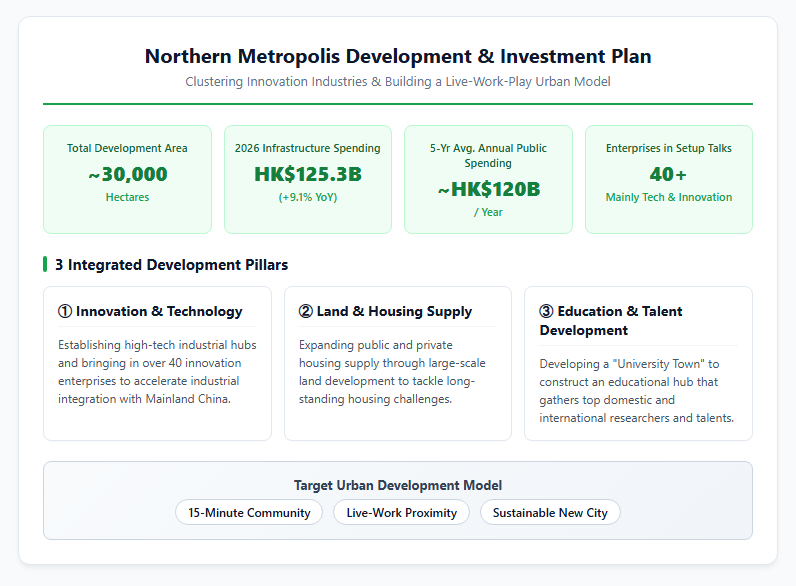
The Hong Kong government views the 30,000-hectare “Northern Metropolis” development along the boundary with Mainland China as its primary growth engine. This project aims not only to expand land supply but also to cluster innovation and technology (I&T) industries while addressing long-standing housing shortages.
According to government estimates, public infrastructure expenditure related to the Northern Metropolis will average approximately HK\$120 billion annually over the next five years, with 2026 infrastructure spending rising 9.1% year-on-year to HK\$125.3 billion. Over 40 major enterprises—predominantly in high-tech and innovation sectors—have already entered discussions regarding setup in the district.
The development plan incorporates a “15-minute community” model and a University Town, aiming to build a sustainable, live-work-play urban ecosystem. Please refer to the following diagram.
The completion of the Northern Metropolis is expected to significantly enhance Hong Kong’s overall industrial competitiveness and sustainable growth momentum.
Improving Public Livelihood and Addressing Medium-to-Long-Term Challenges
Expanding Housing Supply, Supporting Families, and Boosting Employment
Improving public livelihood stands alongside economic growth as a core priority in the Policy Address. To tackle chronic housing shortages, the government committed to constructing 196,000 public housing units over the next five years. Through measures like the “Basic Housing Units Ordinance,” the government aims to phase out substandard subdivided units (“tong fong”) by 2030 and reduce the average waiting time for public rental housing to below 4 years by FY2030–31.
To counter declining birth rates, the government introduced a comprehensive 11-point support package:
- Newborn Cash Bonus: Extending the HK\$20,000 bonus scheme for an additional three years
- Multiple Child Bonus: Providing HK\$30,000 over three years for the second child and subsequent births
- Tax Allowance Increase: Raising the child tax allowance from HK\$140,000 to HK\$160,000 for second and subsequent children
These financial incentives and housing policies aim to reduce economic burdens on families and encourage favorable demographic trends.
Long-Term Outlook: Addressing Labor Shortages and Fiscal Balance
A key structural challenge facing Hong Kong’s economy is an acute workforce shortage driven by an aging population and low fertility rates. Government projections indicate that surging labor demand will outpace supply, resulting in an estimated shortage of 180,000 workers by 2028. In response, the government is expanding targeted non-local talent admission while restructuring the Employees Retraining Board (ERB) into “Upskill Hong Kong” to promote workforce reskilling.
On the fiscal front, while strong stock market performance boosted stamp duty revenues and drawdown of Exchange Fund investment income yielded a temporary surplus, structural vulnerabilities in the tax base and rising health and social welfare expenditures remain long-term concerns. Please refer to the following diagram.
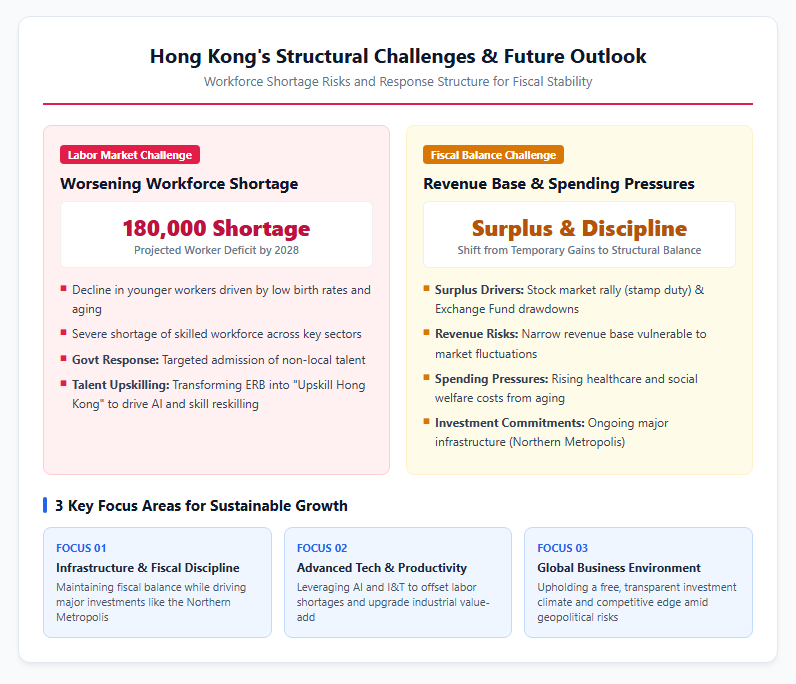
Key focus areas for future development include:
- Balancing massive infrastructure investments in the Northern Metropolis with strict fiscal discipline
- Boosting labor productivity and upgrading industrial structure through AI and advanced technology adoption
- Maintaining a transparent, free, and competitive business environment amid shifting global geopolitical dynamics
The successful execution of the Five-Year Plan will be pivotal in ensuring that the fruits of economic growth benefit all residents and drive long-term sustainable prosperity for Hong Kong.
Reference Pages
【#HongKong #FiveYearPlan #PolicyAddress #EconomicGrowth #NorthernMetropolis #InternationalFinancialCenter #DemographicPolicy】

コメント