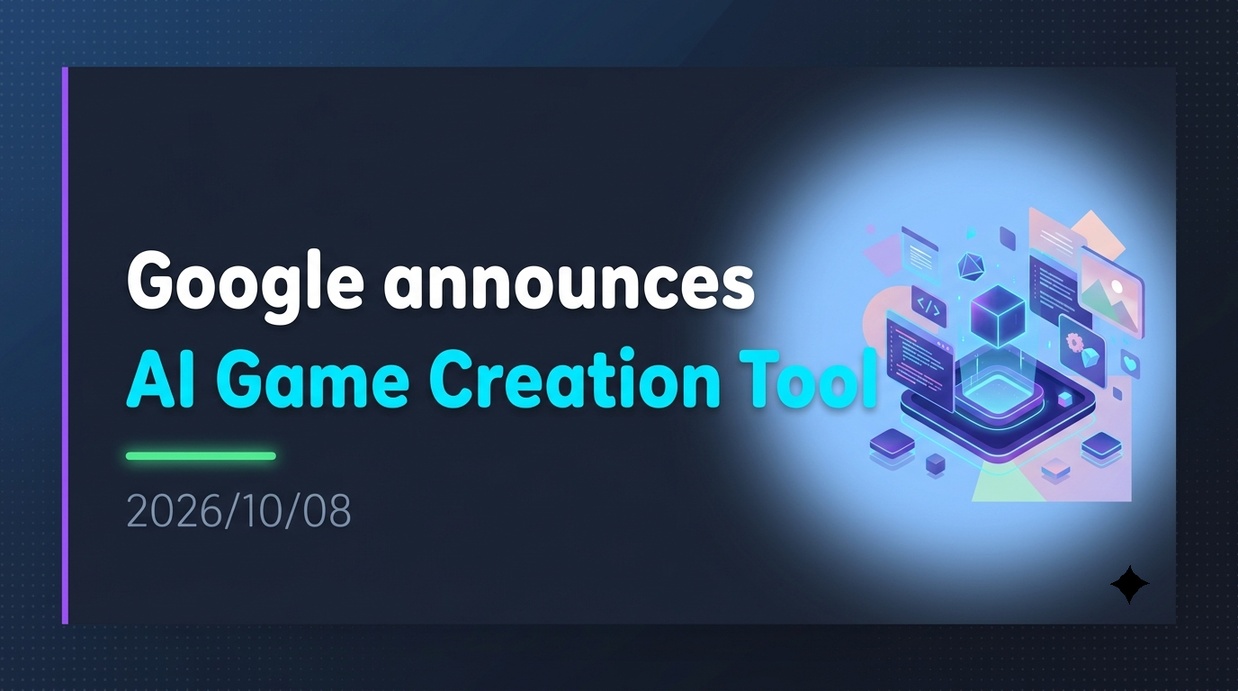
US-based Google and Unity Software have announced “Playground,” an experimental platform that allows users to create games using only text instructions. This development is driven by advances in generative AI and foundational world models, making it possible even for individuals without coding skills to develop games. At the same time, however, it brings to light issues such as market oversaturation and legal challenges surrounding copyright in the gaming industry.
- Launch of “Playground” to Generate Games from Natural Language Prompts
- World Model “Genie 2” and the Evolution of Real-Time 3D Generation
- Unity Spark Integration and Cost Reduction for Producer Features
- Over 20,000 Releases Per Year and the Risk of Market Oversupply
- The Copyright “Human Authorship Requirement” and DMCA and Intellectual Property Risks
- The Arrival of a New Distribution Paradigm Where Discoverability Holds the Key
Launch of “Playground” to Generate Games from Natural Language Prompts
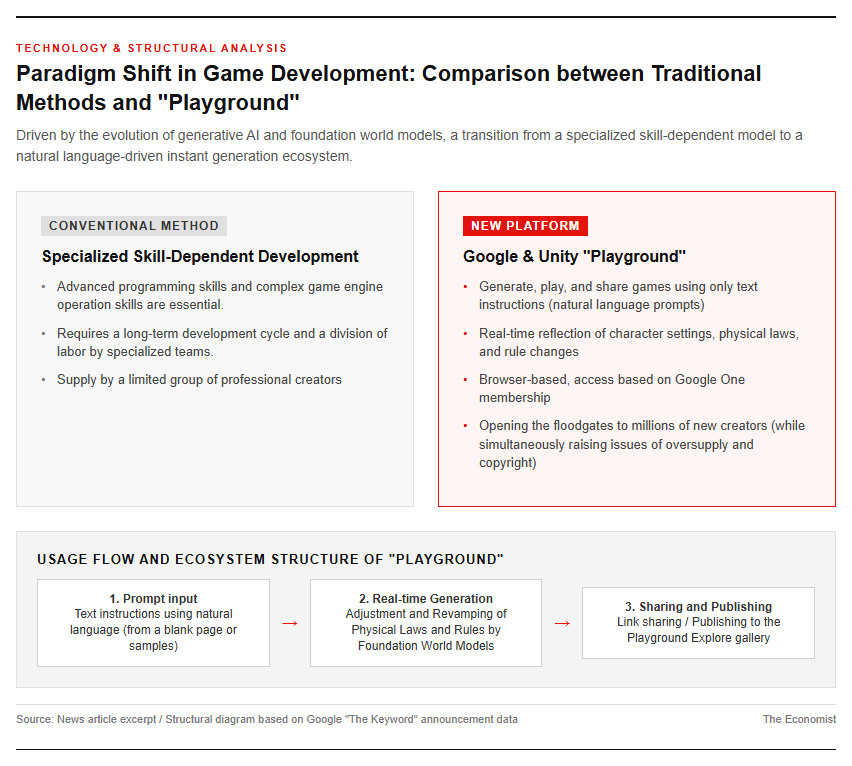
On October 7, 2026, Maryam Karimzadehgan, a software engineer on Google’s AI Innovation + Research team, and her colleagues announced on the official blog “The Keyword” an experimental platform called “Playground” that allows users to create, play, and share games using just text prompts. The service has launched on web browsers for users aged 18 and older residing in the United States, with creation access allocated based on Google One membership tiers. Users can draw inspiration from a blank slate or sample prompts, and through natural language dialogue, perform actions in real time such as configuring character settings, adjusting physics, changing game rules, and revamping environments. Created games can not only be kept private, but can also be shared with friends via link or published to the “Playground Explore” gallery. The platform is also equipped with multiplayer and leaderboard features, establishing a mechanism where popular works are featured based on play achievements and user ratings. By eliminating the need for programming or complex game engine operational skills, it aims to open the doors of game creation—previously restricted to creators with specialized knowledge—to millions of new creators.
World Model “Genie 2” and the Evolution of Real-Time 3D Generation
The technology underlying Playground is the “World Model” technology that has been advanced by Google and Google DeepMind. The foundational world model “Genie 2,” announced by Google DeepMind in December 2024, has the ability to simulate interactive 3D spaces featuring physical laws and object interactions in real time from text or a single image prompt. While conventional generative AI has been limited to generating text, still images, and short videos, Genie 2 employs an Autoregressive Latent Diffusion Model, instantly calculating and outputting in-game viewpoint changes and character actions (such as jumping, swimming, and attacking) in response to keyboard and mouse inputs. Furthermore, it features a long-term memory function that remembers the positional relationships of backgrounds and objects that have gone off-screen, as well as rendering capabilities that accurately depict complex lighting and physical effects such as smoke, water, and gravity. By combining it with advanced image generation models such as Imagen 3, it instantly generates playable 3D worlds from a single piece of concept art, drastically accelerating the training and prototyping processes for AI agents.
Transformation of Development Environments and Impact on the Indie Game Industry
Unity Spark Integration and Cost Reduction for Producer Features
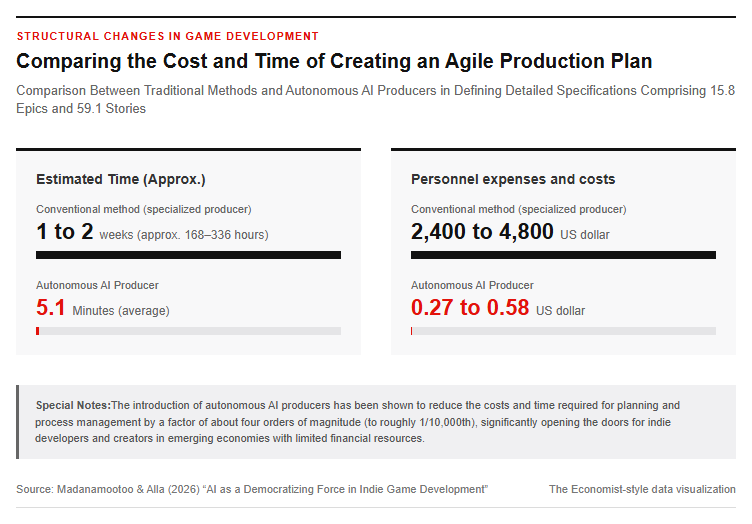
Google also announced a strategic partnership with major game development platform Unity Software, integrating the professional 3D production tool “Unity Spark” into Playground by the latter half of 2026. Leveraging the assets of the Unity runtime and Asset Store, Unity Spark makes it possible to build advanced game mechanics and high-definition 3D graphics while maintaining simple prompt-based operations using natural language. This technological innovation aims to fundamentally redefine process management and production costs—the greatest barriers in indie game development. According to data from a research paper by Madanamootoo and Alla (2026) titled “AI as a Democratizing Force in Indie Game Development,” an agile production plan (a detailed specification consisting of 15.8 epics and 59.1 stories) that traditionally took a professional producer 1 to 2 weeks and cost approximately $2,400 to $4,800 in labor can now be generated using an autonomous AI producer in an average of 5.1 minutes, at a cost of just $0.27 to $0.58—a reduction of about four orders of magnitude (roughly 1/10,000th of the original cost). An environment is thus being established where even individual developers with limited financial resources and creators in emerging nations can instantly access professional-level planning and process management.
Over 20,000 Releases Per Year and the Risk of Market Oversupply
The drastic reduction in production costs and the democratization of tools have driven the rapid market expansion of indie games while simultaneously causing the serious issue of “structural oversupply.” The annual number of indie game releases on Steam surged from 5,559 in 2022 to 8,570 in 2024 (a 42.7% increase year-over-year), and surpassed 20,000 in 2025. Approximately 20% of new releases in 2025 disclosed that they used generative AI in their production process, and the number of game titles flooding the market continues to break records. Meanwhile, the player population and purchasing power of the overall gaming market have fallen back to pre-pandemic levels; titles with annual sales exceeding $1 million (approx. 150 million yen) account for only about 1.5% of the total (around 300 titles), and a polarization is underway, with nearly half—over 9,300 games—generating virtually no meaningful revenue. Furthermore, in a 2026 survey conducted by the GDC (Game Developers Conference) targeting over 2,300 industry professionals, 52% of professionals responded that “generative AI is having a negative impact on the industry,” and deep-rooted resistance persists within the industry due to concerns over layoffs and the homogenization (commoditization) of quality.
The Copyright “Human Authorship Requirement” and DMCA and Intellectual Property Risks
With the widespread adoption of game development using generative AI, addressing intellectual property rights and legal risks has become a critical challenge. Under U.S. copyright law (17 U.S.C. § 102(a)) and U.S. Copyright Office (USCO) guidelines, “Human Authorship” is deemed essential for copyright protection, meaning that assets and code generated completely autonomously by AI are not eligible for copyright. Similarly, the “Overseas Research Report on AI and Copyright” (March 2024) published by Japan’s Agency for Cultural Affairs and legislative trends worldwide emphasize the degree of human creative involvement—such as prompt refinement and manual post-editing—as a key criterion for determining copyrightability. Furthermore, using existing game characters or copyrighted works without permission as training data or in prompts carries the risk of triggering infringement lawsuits and takedown notices under the Digital Millennium Copyright Act (DMCA). Even under Playground’s Terms of Service (Playground Additional Terms of Service), while the copyright to the generated games themselves belongs to the user, the generation of content that infringes upon the intellectual property rights of third parties is strictly prohibited, and users are required to clearly indicate AI-generated content using metadata (such as the C2PA standard) and comply with community guidelines.
The Arrival of a New Distribution Paradigm Where Discoverability Holds the Key
Now that the barriers to entry for game development are virtually zero, the bottleneck in the game industry has completely shifted from “how to make games (production)” to “how to get them found (discoverability).” In an environment where tens of thousands of titles flood open stores like Steam every year, traditional storefront featuring and simple algorithmic exposure are no longer enough to reach players. Moving forward, crucial importance is expected to be placed on “viral-native game design”—featuring built-in voice chat or clip-sharing functions that make the game itself a topic of discussion on social media and video platforms—and development styles that build a fan base first, driven by the community, much like itch.io. At the same time, the value of curation layers to distinguish high-quality works from the flood of AI-generated content, filtering technology using AI tags, and “human aesthetic sense and judgment” to properly evaluate and select proposed production plans will become more important than ever. Looking ahead to 2027, the game industry is set to make a major pivot away from competition in development tools and toward the establishment of a new distribution and promotion paradigm that wins player attention and trust.
Reference page
- [Google Official Blog: Playground Announcement] https://blog.google/innovation-and-ai/technology/ai/playground-experimental-gaming-platform/
- [Unity Spark Official Webpage] http://unity.com/spark
- Google DeepMind: Genie 2 Foundation World Model
- 【arXiv Working Paper: AI as a Democratizing Force in Indie Game Development】https://arxiv.org/abs/2607.00000
- 【Agency for Cultural Affairs: Report on Foreign Surveys Regarding AI and Copyright (March 2024)】https://www.bunka.go.jp/
【#AIGameDevelopment #GooglePlayground #Genie2 #UnitySpark #IndieGameDevelopment #CopyrightAndAI】

コメント