The Okinawa gubernatorial election set for vote on September 13, 2026, has entered a heated phase between incumbent Denny Tamaki and newcomer Genta Koja. Moving beyond the traditional binary of “bases vs. economy,” both candidates are putting economic revitalization and living support front and center, raising fundamental questions about the future of Okinawa’s economy and Japan-U.S. security cooperation.
- The Election Landscape and Conservative Unification Ahead of Vote Day
- Moving Beyond “Bases vs. Economy” Toward Economic-Centered Debate
- Tamaki’s “Circular Economy” and Direct Support for Residents
- Koja’s “New 5K Economy” and Alignment with the Takaichi Administration
- Trends in the Business Community and the Transformation of “All Okinawa”
- Shifting Public Opinion and Mindset on the Henoko Relocation
- Addressing Per Capita Income and Child Poverty
- Maritime Stability, Economic Security, and Post-Election Focal Points
The Election Landscape and Conservative Unification Ahead of Vote Day
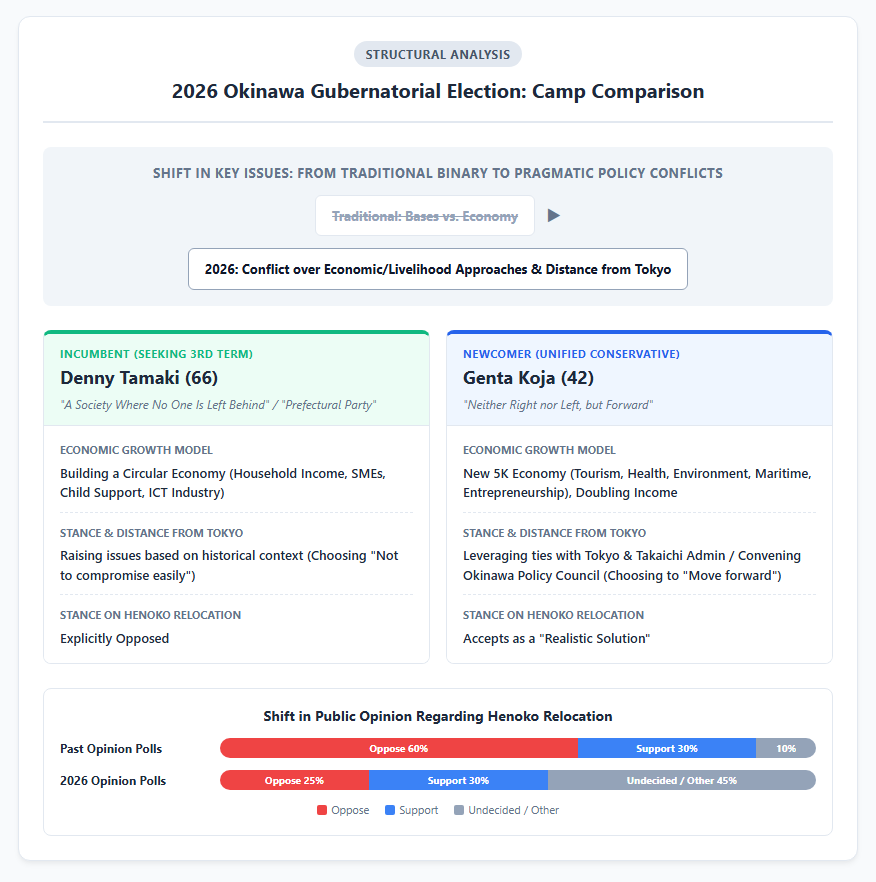
The Okinawa gubernatorial election, with voting scheduled for September 13, 2026, has essentially become a head-to-head race between incumbent Denny Tamaki (66), who is seeking a third term, and newcomer Genta Koja (42), a former vice mayor of Naha. Following the official campaign announcement on August 27, 2026, Mikio Shimoji—who had initially declared his candidacy—withdrew after signing a policy agreement with the Liberal Democratic Party (LDP) headquarters to back Koja, successfully unifying the conservative camp. This conservative unification turned the election into a tightly contested battle from the start, with major media polls conducted in early September 2026 showing both candidates locked in a dead heat.
This election is particularly significant as Tamaki attempts to secure a third term—a feat achieved by only one governor in Okinawa’s history—while also serving as the first major local election since the inauguration of the Takaichi administration in Tokyo. While past gubernatorial elections were fought along clear ideological fault lines between progressive and conservative blocs, both camps in this election are heavily highlighting their economic agendas. With voter interest shifting toward livelihood stability and regional development, the campaign battle heading into election day has reached a high pitch.
Moving Beyond “Bases vs. Economy” Toward Economic-Centered Debate
For decades, Okinawa gubernatorial elections have been framed around a binary choice: a base-focused stance that directly confronts the central government over U.S. military bases versus an economy-focused stance that prioritizes economic growth through cooperation with Tokyo. In the 2026 election, however, both Tamaki and Koja have positioned economic issues at the core of their platforms, making the traditional “bases vs. economy” framing obsolete. This shift is driven by pressing real-world challenges directly impacting residents’ daily lives, including persistent inflation, low per capita income, and structural issues in the tourism sector.
The key distinction between the two candidates lies in their relationship with the Japanese government and their approach to Okinawa’s historical identity. Koja adopts the slogan “Neither Right nor Left, but Forward,” advocating for leveraging strong ties with Tokyo to address immediate challenges. In contrast, Tamaki calls for a “Society Where No One Is Left Behind,” emphasizing Okinawa’s historical narrative while seeking an appropriate distance from the central government. The following image illustrates the geographic relationship between U.S. military bases and surrounding areas in Okinawa.
Although the base issue has by no means disappeared, the choice presented to voters has evolved into a pragmatic policy debate focused on economic realities.
Proposed Economic Stimulus Measures and Policy Platforms
Tamaki’s “Circular Economy” and Direct Support for Residents
Incumbent Governor Denny Tamaki, while highlighting the achievements of his eight-year administration across two terms, advocates for building a “circular economy” that distributes the benefits of growth to local household incomes, small and medium-sized enterprises (SMEs), and future generations. Specifically, he focuses on measures closely tied to daily life, such as anti-inflation support, direct financial assistance for families raising children and young adults, and the expansion of public transportation networks. On the industrial front, Tamaki aims to foster and aggregate information and communications technology (ICT) industries alongside traditional tourism to transition toward a balanced economic structure.
Regarding the relocation of MCAS Futenma to Henoko, Tamaki maintains his clear opposition. However, by shifting his administration’s focus to economic activation and living standards, he seeks to draw broad voter support. Emphasizing his stance as representing a “Prefectural Party” (Kenmin-to), Tamaki downplays party affiliation to position himself as a champion for all Okinawan residents. His strategy aims to build a sustainable local community through a unique circular model while avoiding the economic stagnation caused by past confrontations with Tokyo.
Koja’s “New 5K Economy” and Alignment with the Takaichi Administration
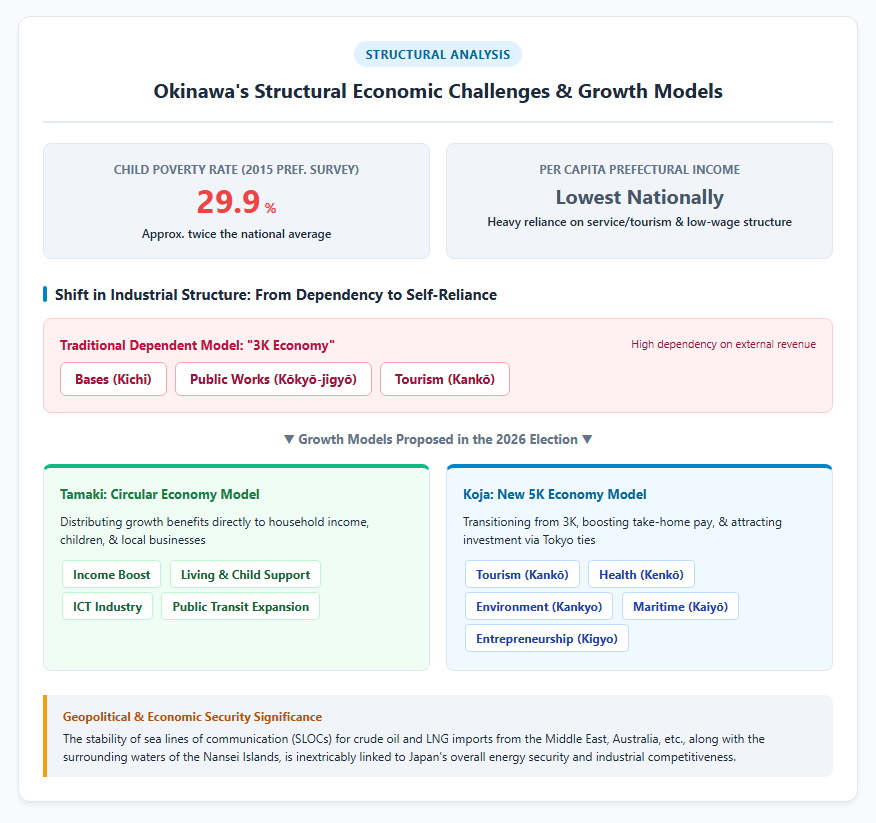
Newcomer Genta Koja, backed by a coalition including the LDP, Komeito, the Democratic Party for the People, and Sanseito, proposes a plan for economic resurgence backed by strong channels to the central government. Koja calls for departing from Okinawa’s traditional “3K Economy” (Kichi/bases, Kōkyō-jigyo/public works, and Kankō/tourism) to embrace a “New 5K Economy” (Kankō/tourism, Kenkō/health, Kankyo/environment, Kaiyō/maritime, and Kigyo/entrepreneurship). His specific measures include doubling prefectural income to increase take-home pay, lowering social insurance premiums, and expanding free education to boost disposable income. Furthermore, he plans to urge Tokyo to convene the Okinawa Policy Council at an early date to secure direct development funds and attract private investment.
Koja’s vision aligns with national industrial policies and enterprise attraction initiatives promoted by the Takaichi administration, aiming to develop Okinawa into an advanced industrial cluster. On removing the dangers posed by MCAS Futenma, Koja accepts the Henoko relocation as a “realistic solution,” adopting an approach that balances reducing the security burden with fostering economic growth. His strong push for private investment and support for local businesses has generated high expectations among conservative voters and the business community.
Realignment of Political Forces and Shifting Public Sentiment
Trends in the Business Community and the Transformation of “All Okinawa”
The “All Okinawa” political coalition, formed during the 2014 gubernatorial election, was a landmark framework where conservative and progressive figures, business leaders, and civic groups united under the single objective of opposing the construction of a new base in Henoko. Prominent business figures played central roles, exemplified by Morimasa Goya, chairman of the Kanehide Group, serving as head of Tamaki’s campaign supporters’ association. However, following Goya’s resignation in 2020 amid economic strain from the COVID-19 pandemic on tourism and local commerce, conservative supporters departed in succession. As a result, the coalition took on a stronger progressive color, forcing a gradual transformation of its once-broad base.
In the 2026 gubernatorial election, the Kanehide Group, which once supported All Okinawa, decisively shifted its backing to Koja. This move highlights a major realignment in Okinawa’s conservative and business circles. The Tamaki campaign’s decision to rebrand its platform from “All Okinawa” to “Prefectural Party” reflects concerns over the coalition’s changed perception and a desire to appeal to unaffiliated voters. The realignments of major corporate groups carry substantial weight in shaping voter behavior through employment and investment considerations.
Shifting Public Opinion and Mindset on the Henoko Relocation
Public sentiment regarding the relocation of the U.S. base to Henoko in Nago City has also undergone noticeable shifts in recent years. In past public opinion polls, opposition to the Henoko relocation consistently accounted for roughly 60% of residents, far outstripping support at around 30%. However, by 2026, polls show that opposition has dropped to between 20% and 30%. Meanwhile, support has remained steady at around 30%, while the largest growth has occurred among respondents answering “Undecided” or “Don’t know,” which has climbed to approximately 30%.
Behind this shift in public opinion lies a growing sense of fatigue and complex sentiment, particularly among younger generations, as legal battles between Tokyo and the prefecture have dragged on while construction work has progressed. This has led to a widespread feeling that continued opposition does not change the physical reality on the ground. The diversification of awareness and shifting interest regarding base issues directly impact vote distribution in the election. The following chart illustrates recent economic growth trends in Okinawa.
As residents’ values become more multifaceted, a complex political environment has emerged that can no longer be categorized by a single issue.
Structural Challenges in Okinawa’s Economy and Long-Term Outlook
Addressing Per Capita Income and Child Poverty
The most pressing structural challenge facing Okinawa Prefecture is its per capita income, which remains at the lowest level in Japan, alongside severe child poverty. According to a 2015 survey conducted by Okinawa Prefecture, the proportion of children living in households earning less than half the national median income (the child poverty rate) reached 29.9%, roughly double the national average. Distortion in the industrial structure—characterized by an over-reliance on service industries, tourism, construction, and base-related businesses—has long been cited as a primary driver of low wage levels and employment instability.
The incoming governor will face the urgent task of implementing structural reforms that go beyond temporary subsidies or payouts, fostering high-value-added industries and enhancing local business productivity. Whether the administration can swiftly execute sustainable policies to elevate daily living standards—such as ensuring educational opportunities for children, supporting young entrepreneurs, and reducing social security burdens—will be crucial in shaping Okinawa’s economic trajectory.
Maritime Stability, Economic Security, and Post-Election Focal Points
Okinawa’s geopolitical significance extends far beyond the presence of U.S. military bases; it is inextricably linked to Japan’s overall economic security and regional maritime stability. As Japan imports the vast majority of its crude oil from Middle Eastern nations like Saudi Arabia and relies heavily on Australia and Gulf states for Liquified Natural Gas (LNG), maintaining sea lines of communication (SLOCs) through the South Western Islands, including the East China Sea and Bashi Channel, is a matter of national survival. Any geopolitical instability or disruption in the waters surrounding Okinawa could drive up maritime transport costs and break supply chains, dealing a direct blow to Japan’s industrial competitiveness and energy security.
Following the September 13, 2026 election, the new governor will face the demanding task of balancing local relief from base burdens and community safety with effective coordination alongside the central government and the international community. Navigating state-level security imperatives while minimizing friction with national policies and fostering regional economic vitality will remain the critical focal point in the post-election period.
Reference Pages
- [Ruling and Order for Correction Regarding Disapproval of Public Water Body Reclamation] https://www.pref.okinawa.jp/site/chijiko/henoko/r4revise/hantai.html
- [Overview of the SACO Final Report] https://www.mod.go.jp/j/approach/zaibeigun/saco/saco_final/index.html
- [Government Policy Concerning the Relocation of MCAS Futenma] https://www8.cao.go.jp/okinawa/7/7212.html
- [Court History and Precedent Search (Henoko Disapproval Rulings)] https://www.courts.go.jp/app/files/hanrei_jp/891/089891_hanrei.pdf
【#OkinawaGubernatorialElection #HenokoRelocation #OkinawaEconomy #JapanUSSecurity #LocalAutonomy #TakaichiAdministration #TourismDevelopment #EconomicSecurity】


コメント