On September 18, 2026, Japan’s Ministry of Land, Infrastructure, Transport and Tourism (MLIT) announced plans to consider raising drainage performance targets for urban sewer systems to counter severe inland flooding. Amid a surge in record-breaking torrential downpours that exceed conventional infrastructure design limits, the government aims to finalize a comprehensive package of structural and non-structural measures by the end of the year.
- Key Elements and Drivers of the September 2026 Announcement
- Conventional Drainage Targets and Proposed Revisions
- Challenges Facing the Expert Panel Ahead of Year-End Recommendations
- The August 2026 Chiba Torrential Rain and Underpass Inundations
- Urban Function Paralyzed by the September 2026 Tokai Downpours
- The Threat of Localized Rainstorms Exceeding 100 mm/h Driven by Climate Change
- The 1999 Fukuoka Flood and the Fatal Hakata Station Underground Inundation
- Delayed Communication and the Inherent Hazards of Underground Evacuation
- Evolution of MLIT Flood Control Guidelines over the Decades
- Risks Across Japan’s 490,000 km Sewer Network and 40-Year-Old Pipes
- Fiscal 2026 Budgeting: 20 Trillion Yen for National Resilience and Joint Municipal Support
- Cost Reduction Through Water PPPs and Digital Asset Management
- Integrating Structural Engineering with Non-Structural Preparedness
- Addressing Municipal Fiscal Constraints Through Regional Collaboration
- Next-Generation Flood Control Driven by Digital Transformation
Key Elements and Drivers of the September 2026 Announcement
On September 18, 2026, the Ministry of Land, Infrastructure, Transport and Tourism (MLIT) convened an expert panel and announced that it will consider raising drainage capacity targets for sewer systems, particularly in urban areas. This decision is driven by a series of localized, high-intensity rainstorms—such as the Chiba torrential rain in August 2026 and heavy downpours across the Tokai region in September—which triggered widespread inland flooding, inundated roadways, and submerged underground spaces. Because recent rainfall events have repeatedly breached conventional design thresholds, MLIT also indicated that it will re-examine the rainfall assumptions underpinning hazard maps. The ministry plans to compile a comprehensive policy package combining physical infrastructure upgrades with improved evacuation systems by the end of this year.
Conventional Drainage Targets and Proposed Revisions
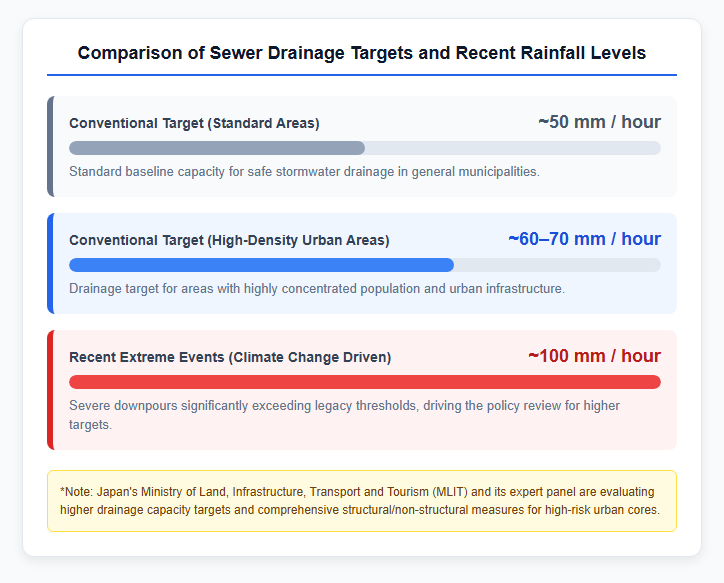
When local municipalities construct sewer systems, they historically set drainage targets based on MLIT guidelines. In standard residential areas, the baseline capacity handles roughly 50 millimeters of rainfall per hour. In designated high-density commercial or administrative hubs, systems are engineered to manage 60 to 70 millimeters per hour. However, climate change has driven a marked rise in extreme weather events, bringing intense rainbursts near 100 millimeters per hour to urban centers. The current policy review focuses on determining how much higher these design targets should be set, prioritizing high-risk urban cores and underground commercial districts. Please refer to the diagram below.
Challenges Facing the Expert Panel Ahead of Year-End Recommendations
A central hurdle in raising drainage targets is the dramatic increase in capital expenditure and the physical constraints of existing infrastructure. Boosting drainage capacity requires major civil engineering works: replacing existing pipes with larger storm mains, excavating underground retention basins, and installing high-capacity pumping stations. In densely built urban areas, securing space beneath roadways and buildings is exceedingly difficult. Furthermore, local governments face massive financial burdens to fund these projects. Consequently, the panel is evaluating how to balance long-term structural construction with soft measures, such as expanding rainwater infiltration facilities and speeding up emergency messaging.
Recent Urban Water Disasters and Structural Risks of Inland Flooding
The August 2026 Chiba Torrential Rain and Underpass Inundations
During the heavy rainfall that hit Chiba Prefecture in August 2026, urban sections including Chuo Ward in Chiba City suffered severe roadway and underpass flooding. Underpasses—depressed road segments passing beneath railway tracks or intersecting highways—naturally collect runoff from surrounding slopes. When rainfall intensity exceeds sewer intake capacity, water rushes into these low points faster than dedicated pumps can discharge it. In the Chiba storm, several underpasses submerged rapidly, trapping vehicles and rendering them inoperable. This event highlighted the acute vulnerability of localized urban infrastructure under extreme precipitation.
Urban Function Paralyzed by the September 2026 Tokai Downpours
On September 8, 2026, an intense localized storm battered the Tokai region, striking Nagoya City in Aichi Prefecture with an all-time record hourly rainfall of 104.5 millimeters. The downpour triggered severe inland flooding across the city. All six lines of the Nagoya Municipal Subway suspended operations due to surrounding road inundation and safety inspections, while major regional rail operators—including JR Central, Meitetsu, and Kintetsu—experienced widespread cancellations and delays. Occurring during the evening commute, the transit shutdown stranded thousands of commuters. Approximately 200 vehicles were submerged or abandoned on city streets, and local authorities temporarily issued Level 5 Emergency Safety Measures to roughly 550,000 households, temporarily paralyzing urban functionality.
The Threat of Localized Rainstorms Exceeding 100 mm/h Driven by Climate Change
The fundamental driver behind these frequent water disasters is global climate change. Meteorological records and climate models consistently show an upward trend in short-duration, extreme precipitation events. Traditionally, Japanese flood management focused primarily on riverine flooding caused by overflowing rivers. However, urban landscapes are largely covered by asphalt and concrete, preventing rainwater from soaking into the ground and directing massive runoff into sewer networks almost instantly. When rain falls at rates exceeding 100 millimeters per hour, sewer systems overflow, causing severe inland flooding even without riverbank breaches.
Lessons from Past Urban Disasters: Underground Vulnerability and Drainage Capacity
The 1999 Fukuoka Flood and the Fatal Hakata Station Underground Inundation
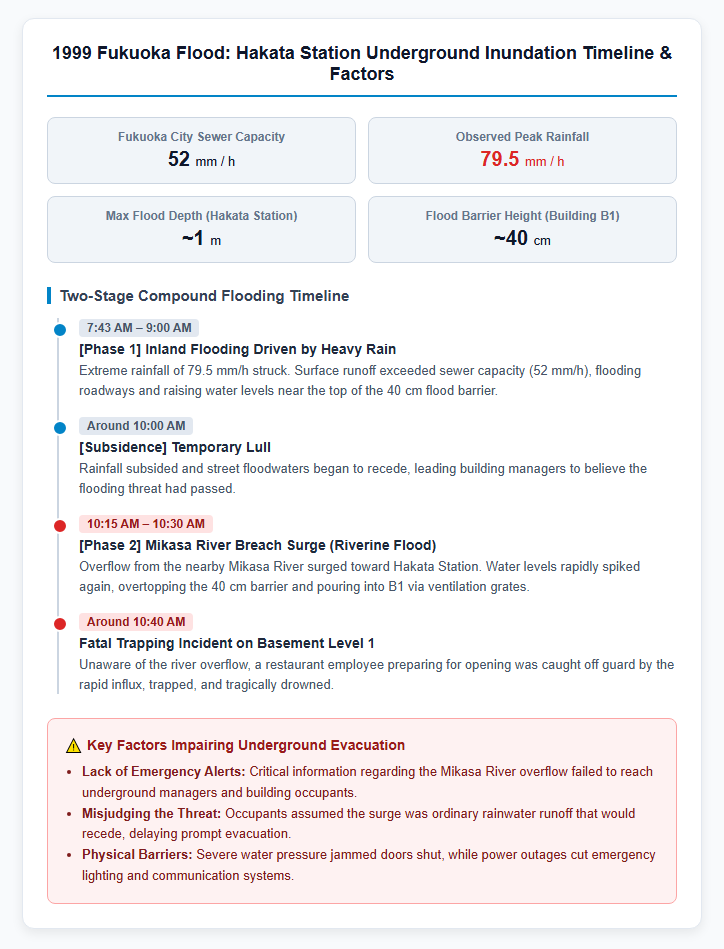
A seminal case in Japanese urban flood history is the Fukuoka Flood of June 29, 1999. Fukuoka City had constructed storm drainage systems rated for 50 millimeters per hour, but a record downpour dumped 79.5 millimeters in a single hour at the local meteorological observatory. Overland flow quickly overwhelmed the sewers, causing surface flooding up to one meter deep around Hakata Station. At the Tofuku No. 2 Building near the station’s Chikushi Exit, water surged into the first basement level, where an employee preparing a restaurant for opening was trapped and tragically drowned. Please refer to the diagram below.
Delayed Communication and the Inherent Hazards of Underground Evacuation
A key lesson from the 1999 Hakata Station disaster was the failure to communicate river overflow risks to occupants in underground spaces. On that day, rainfall temporarily subsided, causing surface water to recede briefly and lulling building managers into assuming the threat had passed. Shortly after, the nearby Mikasa River overtopped its banks, sending a second, larger wave of floodwater back into the city streets. People underground received no information about the river breach and mistook the incoming surge for ordinary surface runoff. Water pressure made basement doors impossible to open, while power outages cut lighting and communications, demonstrating the critical need for real-time risk broadcasts and structured evacuation protocols.
Evolution of MLIT Flood Control Guidelines over the Decades
In response to the 1999 Fukuoka Flood and the 2000 Tokai Heavy Rain, MLIT progressively revised its technical standards for urban drainage and underground flood safety. In 2021, the ministry updated its Rainwater Management Comprehensive Planning Guidelines to reflect climate projections from the IPCC. These guidelines introduced pre-disaster planning framework adjustments, factoring in projected rainfall increases of 1.1x to 1.5x. However, because actual climate impacts are outscaling earlier models, MLIT’s current initiative to raise baseline drainage targets represents a necessary shift toward even higher infrastructure resilience standards.
National Resilience Initiatives and Aging Sewer Infrastructure
Risks Across Japan’s 490,000 km Sewer Network and 40-Year-Old Pipes
Japan’s sewer infrastructure expanded rapidly during the post-war economic boom, creating a vast nationwide network spanning approximately 490,000 kilometers. Today, over 25 percent of these pipelines have exceeded 40 years of service, approaching or surpassing their statutory 50-year service life. Aging pipes are prone to cracking and structural degradation, which reduces drainage efficiency and causes surrounding soil to erode, leading to road cave-ins. Major urban road collapses in cities like Yashio and Osaka have been linked to deteriorating sewer mains, underscoring the urgent need for systematic pipeline replacement.
Fiscal 2026 Budgeting: 20 Trillion Yen for National Resilience and Joint Municipal Support
To protect lives and economic assets, the Japanese government is expanding its National Resilience Program. The fiscal year 2026 budget allocates over 20 trillion yen toward public infrastructure, with significant funding directed at seismic retrofitting, pipeline reconstruction, and storm surge defenses for sewerage systems. Recognizing that smaller municipalities lack the financial and technical resources to handle these overhauls alone, the government is expanding direct subsidies and joint business integration frameworks. These initiatives enable neighboring municipalities to execute joint procurement and construction, lowering costs and accelerating infrastructure renewals.
Cost Reduction Through Water PPPs and Digital Asset Management
To address fiscal constraints and municipal staffing shortages, public-private partnerships—specifically Water PPPs—are being deployed nationwide. Under the Level 3.5 PPP model, local governments retain infrastructure ownership while delegating long-term management and operational rights to private sector operators. Pioneered in cities such as Moriya and Hamamatsu, this approach leverages private expertise to streamline maintenance. Furthermore, digital transformation (DX) technologies—such as autonomous inspection drones for narrow pipe interiors and AI-driven structural diagnostics—are being adopted to reduce labor costs while ensuring the safety of drainage networks.
Future Outlook and Urban Disaster Prevention Challenges
Integrating Structural Engineering with Non-Structural Preparedness
Raising sewer drainage targets is essential for building long-term urban flood resilience. However, constructing wider storm mains, underground detention vaults, and high-capacity pumping stations requires billions of yen and decades of continuous construction. In the interim, cities must rely heavily on non-structural measures. Municipalities are encouraging the installation of flood barriers at building entrances, promoting rain barrels and green infrastructure to temporarily capture runoff, and deploying real-time digital flood mapping. A multi-layered defense strategy uniting public works and private preparedness is vital.
Addressing Municipal Fiscal Constraints Through Regional Collaboration
While the national government sets higher drainage targets, the burden of execution falls on municipal water utilities. Many local governments face declining fee revenues due to demographic shrinking, making new capital investments difficult to fund. Sustained national subsidies and financial backing are critical. Simultaneously, municipalities must expand watershed-based regional management, coordinating across municipal boundaries to manage storm runoff holistically. Aligning river management agencies with local sewer departments is crucial for effective flood mitigation.
Next-Generation Flood Control Driven by Digital Transformation
Emerging technologies will play a pivotal role in the future of urban flood defense. IoT sensor networks are being installed inside sewer lines for real-time water level monitoring, while AI weather models predict localized inundation risks hours in advance. These digital tools allow automated, optimized operation of rainwater pumps and enable precise, timely evacuation warnings for residents. As MLIT finalizes its national strategy later this year, the integration of digital technology into urban water management stands out as a key area to watch.
Reference Pages
- 【Sewerage Flood Mitigation Measures – Ministry of Land, Infrastructure, Transport and Tourism】https://www.mlit.go.jp/mizukokudo/sewerage/crd_sewerage_tk_000117.html
- 【Promoting Urban Flood Mitigation Measures for Sewerage Systems Considering Climate Change – Ministry of Land, Infrastructure, Transport and Tourism】https://www.mlit.go.jp/mizukokudo/sewerage/mizukokudo_sewerage_tk_000659.html
【#InlandFlooding #MLIT #SewerageInfrastructure #UrbanFlooding #ClimateChangeAdaptation #NationalResilience】

コメント