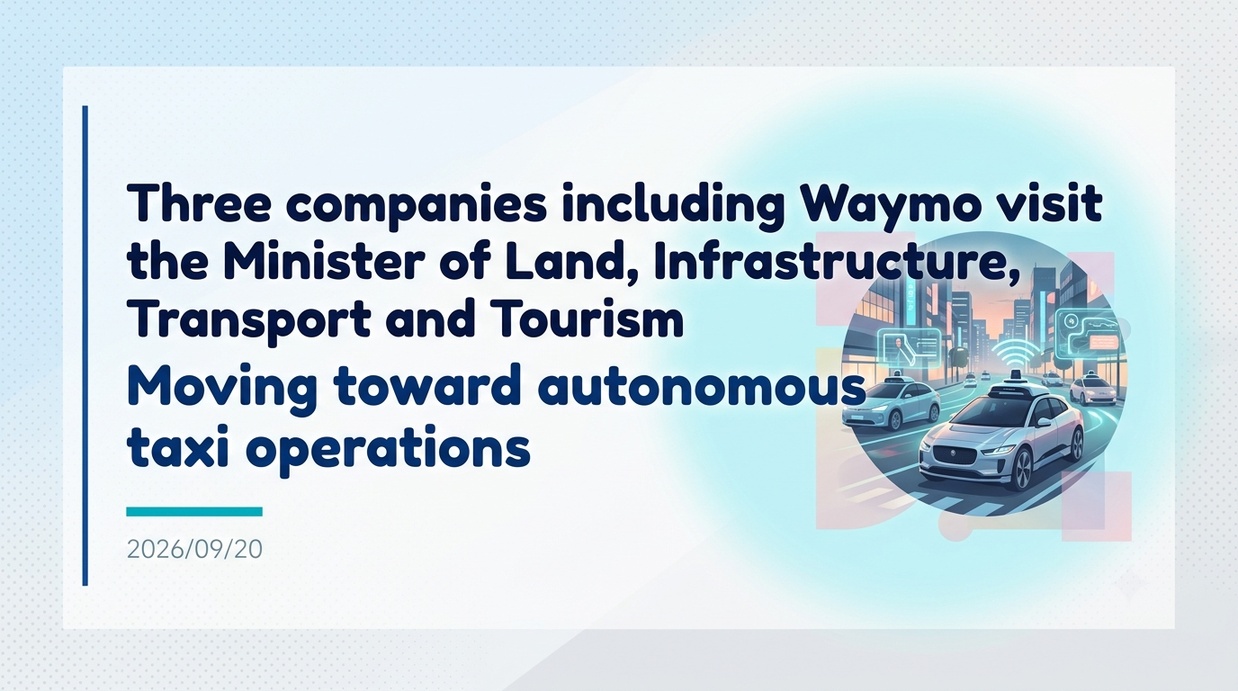
On September 15, 2026, executives from Waymo, GO, and Nihon Kotsu visited the Ministry of Land, Infrastructure, Transport and Tourism to brief Transport Minister Yasushi Kaneko on their tripartite agreement to launch fully driverless taxis in Tokyo. Aiming to address critical social challenges such as driver shortages and transit gaps, the partnership plans to commercialize Level 4 autonomous taxi services across seven central Tokyo wards within 2027.
- The Ministerial Briefing on September 15, 2026, and the Tripartite Alliance
- Commercializing Level 4 Services within 2027 and Scaling to 100 Vehicles in Central Wards
- Sharp Decline in Taxi Drivers and Surging Tourism Pressure
- Collaborative Model: Waymo’s AI Technology Stack Meets Nihon Kotsu’s Ground Operations
- Liability under the Automobile Liability Security Act and Insurance Frameworks
- Outlook Toward the 2030 Goal of 10,000 Autonomous Service Vehicles
The Ministerial Briefing on September 15, 2026, and the Tripartite Alliance
On September 15, 2026, top executives from US autonomous vehicle developer Waymo, leading Japanese ride-hailing platform GO, and Japan’s largest taxi operator Nihon Kotsu visited the Ministry of Land, Infrastructure, Transport and Tourism (MLIT). The delegation included Waymo Co-CEO Tekedra Mawakana, Ichiro Kawanabe (Chairman of the Japan Taxi-Cab Association, Chairman of GO, and Director of Nihon Kotsu), Nihon Kotsu President Yasuharu Wakabayashi, and GO President Hiroshi Nakajima. They formally briefed Minister Yasushi Kaneko on their joint agreement to commercialize driverless taxi services in Tokyo. Described as the most significant transformation in the 115-year history of Japanese taxis, Minister Kaneko expressed strong enthusiasm, calling autonomous vehicles a key breakthrough for solving Japan’s pressing mobility issues.
At the core of the agreement is the deployment of Level 4 fully autonomous taxis operating without a human driver inside the vehicle. Waymo test vehicles have already been gathering mapping and sensor data across Tokyo, with Nihon Kotsu drivers onboard acting as safety monitors to help the Waymo Driver system learn Tokyo’s unique traffic rhythms and complex urban navigation. This official announcement marks the transition from extensive field testing to the commercial implementation phase, pending final regulatory approvals from relevant government ministries and local municipalities.
The following image illustrates the testing phase of autonomous vehicles in Tokyo.
Commercializing Level 4 Services within 2027 and Scaling to 100 Vehicles in Central Wards
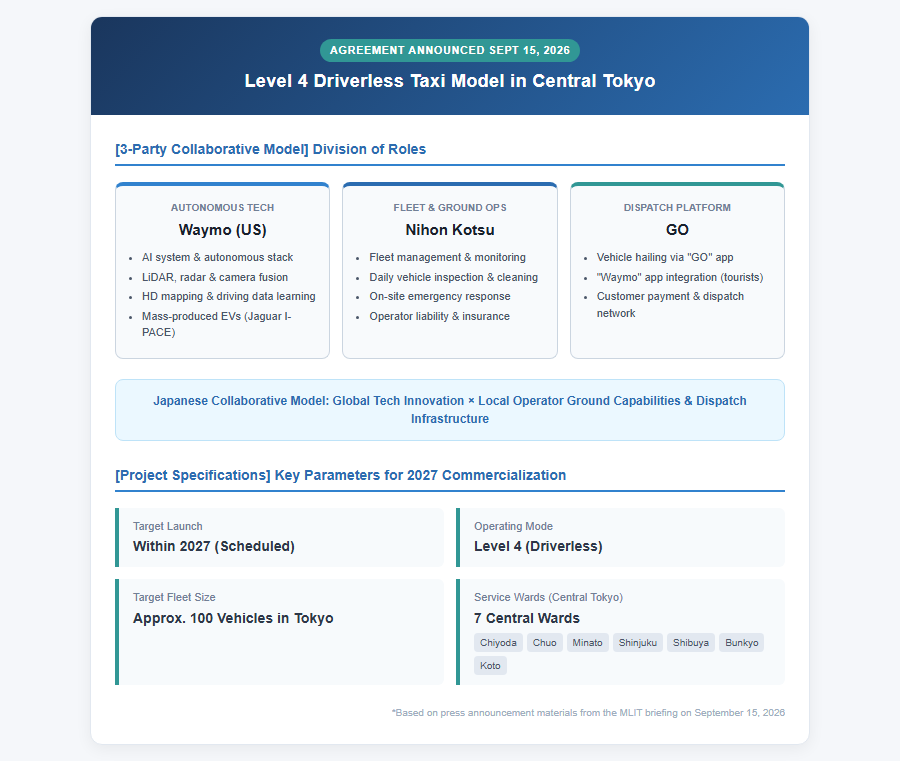
The coalition aims to launch Level 4 driverless taxi operations within 2027 across seven central Tokyo wards, including Chiyoda, Chuo, Minato, Shinjuku, Shibuya, Bunkyo, and Koto. Initial operations will begin with a limited validation phase reserved for employees of affiliated companies. Once safety and operational reliability are fully confirmed, the service will expand to the general public. The fleet will gradually scale to approximately 100 autonomous vehicles across the Tokyo metropolitan area.
Riders will be able to summon vehicles seamlessly using either Japan’s widely adopted “GO” app or the “Waymo” app, catering to both domestic residents and international tourists who already use Waymo overseas. Passengers select their destination in the app and enjoy a fully private, driverless ride. The fleet will feature mass-produced electric vehicles, such as the Jaguar I-PACE, integrated with Waymo’s advanced sensor suite and AI technology stack.
- Target Launch: Within 2027
- Service Area: 7 central Tokyo wards
- Initial Fleet Goal: Approximately 100 vehicles in Tokyo
- Booking Apps: GO App and Waymo App
- Operating Mode: Level 4 fully driverless (no onboard safety driver)
Social Context Behind Implementation and Operational Synergy
Sharp Decline in Taxi Drivers and Surging Tourism Pressure
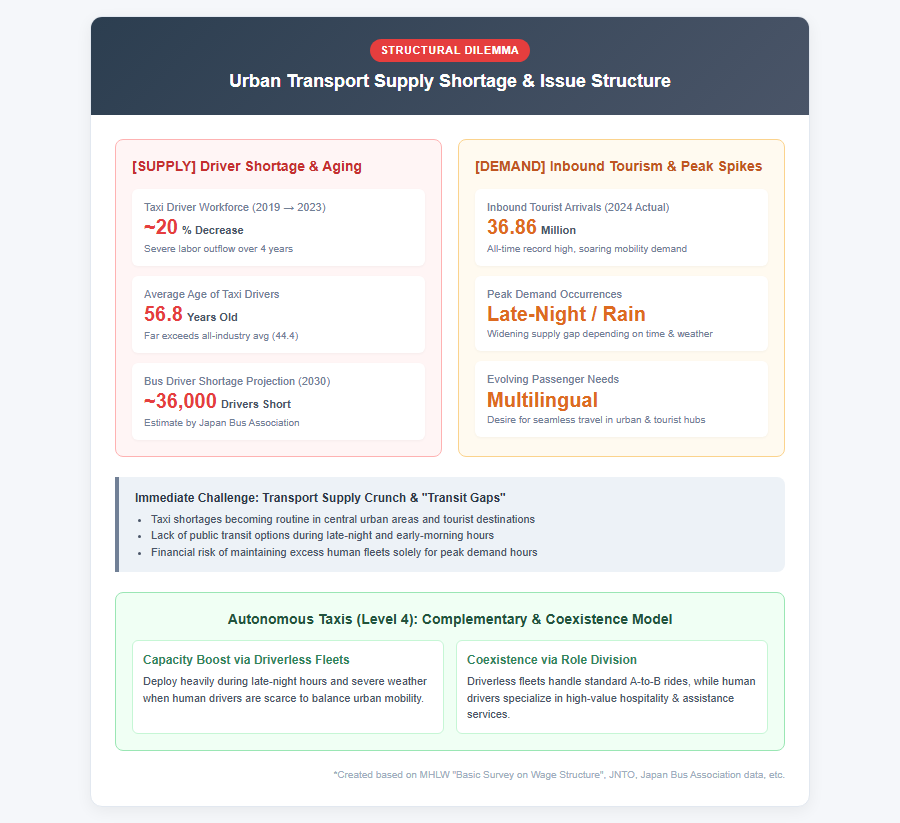
The urgent push for driverless taxis in Japan is driven by a widening gap between shrinking transport supply and rising mobility demand. The number of taxi drivers in Japan plummeted by approximately 20% between 2019 and 2023, while the average driver age reached nearly 58 years (56.8 years according to Ministry of Health, Labour and Welfare statistics), highlighting rapid demographic aging. In contrast, inbound tourism surged to a record 36.86 million visitors in 2024, significantly surpassing pre-pandemic levels and continuing its upward trajectory through 2025 and 2026. This surge has exacerbated severe taxi shortages and local transport gaps, particularly in major urban centers and popular tourist destinations.
Furthermore, bus operators face a projected shortage of roughly 36,000 drivers by 2030, threatening the sustainability of regional public transportation. Traditional human-driven fleets struggle to handle demand surges during late-night hours and severe weather. Autonomous taxis offer an essential structural solution to supplement transportation capacity without overburdening existing labor forces.
The diagram below illustrates the supply-demand imbalance and mobility challenges in urban transport.
Collaborative Model: Waymo’s AI Technology Stack Meets Nihon Kotsu’s Ground Operations
A defining feature of this project is its “collaborative” implementation model, which integrates global tech innovation with local operators rather than disrupting established domestic industries. Waymo brings unmatched technical expertise, backed by hundreds of thousands of weekly driverless commercial trips across US cities like Phoenix, San Francisco, and Los Angeles. Its technology stack combines sensor fusion (LiDAR, millimeter-wave radar, and high-resolution cameras) with high-definition 3D mapping and redundant safety systems.
Meanwhile, ground-level operations—including daily vehicle inspections, sensor cleaning, fleet maintenance, cabin sanitation, and emergency field response—will be handled by Nihon Kotsu, leveraging its century-old expertise in taxi management. Customer interface and payment processing will be managed through GO’s established digital platform. This division of labor allows Waymo to enter the Japanese market with an asset-light approach, while preserving local employment and allowing human drivers to focus on high-value hospitality services like passenger assistance and VIP transport.
Legal Frameworks, Liability Structure, and Future Outlook
Liability under the Automobile Liability Security Act and Insurance Frameworks
Regarding legal liability during Level 4 driverless operations, civil compensation will remain grounded in Article 3 of Japan’s Automobile Liability Security Act (“Operation Manager Liability”). Even without a human driver present, the fleet operator (Nihon Kotsu), as the entity exercising operational control and deriving operational benefit, assumes primary liability for third-party personal injury. This ensures that accident victims receive prompt compensation through compulsory automotive liability insurance and voluntary insurance policies without waiting for complex technical investigations into software glitches or hardware defects.
In cases involving system glitches or software defects, secondary recourse can be pursued through Product Liability (PL) claims against vehicle manufacturers or system providers. Meanwhile, criminal liability under Japanese law remains tied to natural persons, such as remote monitoring personnel or fleet managers, where duty of care violations can be proven. Police agencies, transport authorities, and the insurance industry are collaborating to refine investigative protocols and streamline compensation frameworks for autonomous vehicle incidents.
Outlook Toward the 2030 Goal of 10,000 Autonomous Service Vehicles
The Japanese government has established a national target of deploying 10,000 autonomous service vehicles—including buses, trucks, and taxis—by fiscal year 2030. The Tokyo driverless taxi rollout represents a landmark milestone toward achieving this goal. Key operational challenges moving forward include navigating Tokyo’s dense urban canyons (where high-rise buildings can disrupt GNSS satellite signals), handling complex edge cases in heavy mixed traffic, and fostering public trust.
Research indicates that individuals who have experienced riding in autonomous vehicles demonstrate nearly five times higher trust in the technology compared to non-riders. Transparent data sharing, public trial opportunities, and close coordination between government bodies, police authorities, and local communities will be crucial as the 2027 commercial launch approaches.
Reference Pages
- [GO Inc. Press Release] https://goinc.jp/news/pr/2026/09/15/6pzjypdxzuza8kawb2ocfg/
- [Waymo Japan Official Page] https://waymo.com/intl/jp/waymo-in-japan/
- [MLIT Autonomous Driving Implementation Report] https://www.mlit.go.jp/jidosha/content/001751816.pdf
- [Digital Agency Mobility Working Group Report] https://www.digital.go.jp/assets/contents/node/basic_page/field_ref_resources/1fd724f2-4206-4998-a4c0-60395fd0fa95/9979bca8/20240523_meeting_mobility-subworking-group_outline_04%20.pdf
【#AutonomousVehicles #Robotaxi #Waymo #GO #NihonKotsu #MLIT #Level4 #Mobility】


コメント