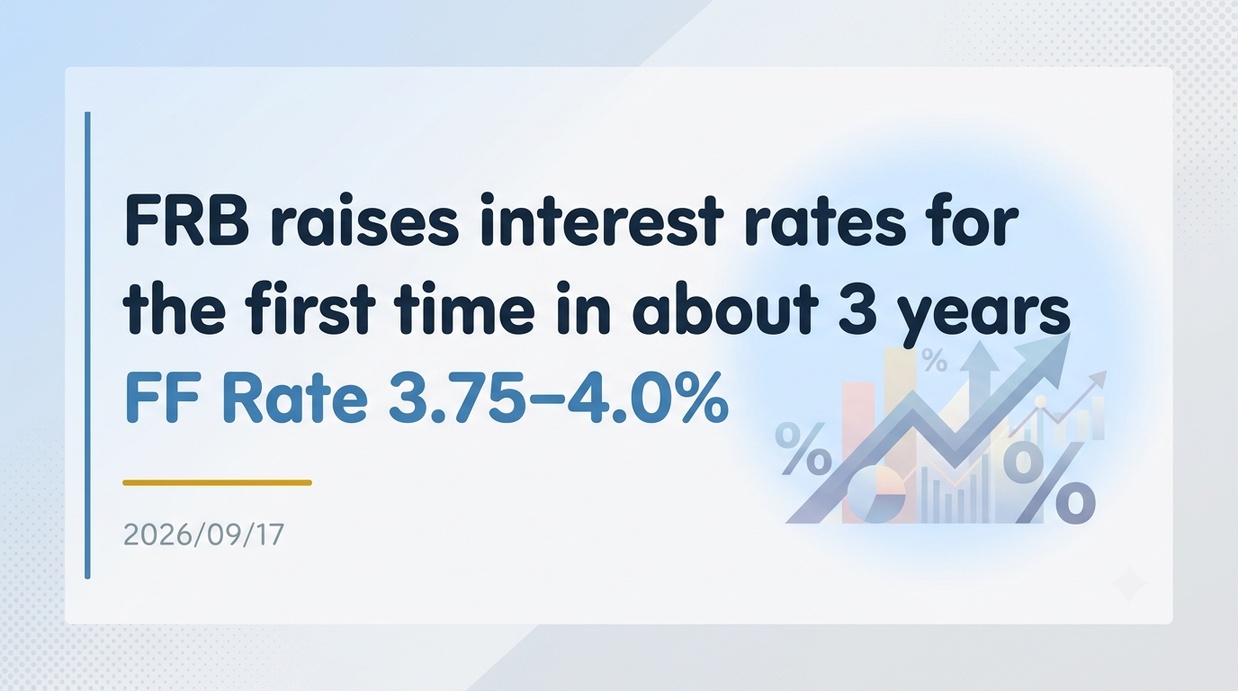
The Federal Reserve Board (FRB) decided at its September 2026 Federal Open Market Committee (FOMC) meeting to raise the target range for the federal funds rate by 25 basis points to 3.75–4.00%. This decision comes against the backdrop of persistent, elevated inflation alongside resilient U.S. economic fundamentals, including robust consumer spending and labor market stability.
- Unanimous 25 bp Rate Hike Marks First Tightening in Over Three Years
- Shift in Committee Stance Since July and Persistent Inflation Concerns
- Dot Plot Signals a “Higher-for-Longer” Rate Trajectory
- Chair Warsh’s Press Conference and Commitment to Price Stability
- Complex Dynamics Across U.S. Equities, Bonds, and Foreign Exchange Markets
- Spillover Effects on the Bank of Japan Meeting and Key Outlook Drivers
Unanimous 25 bp Rate Hike Marks First Tightening in Over Three Years
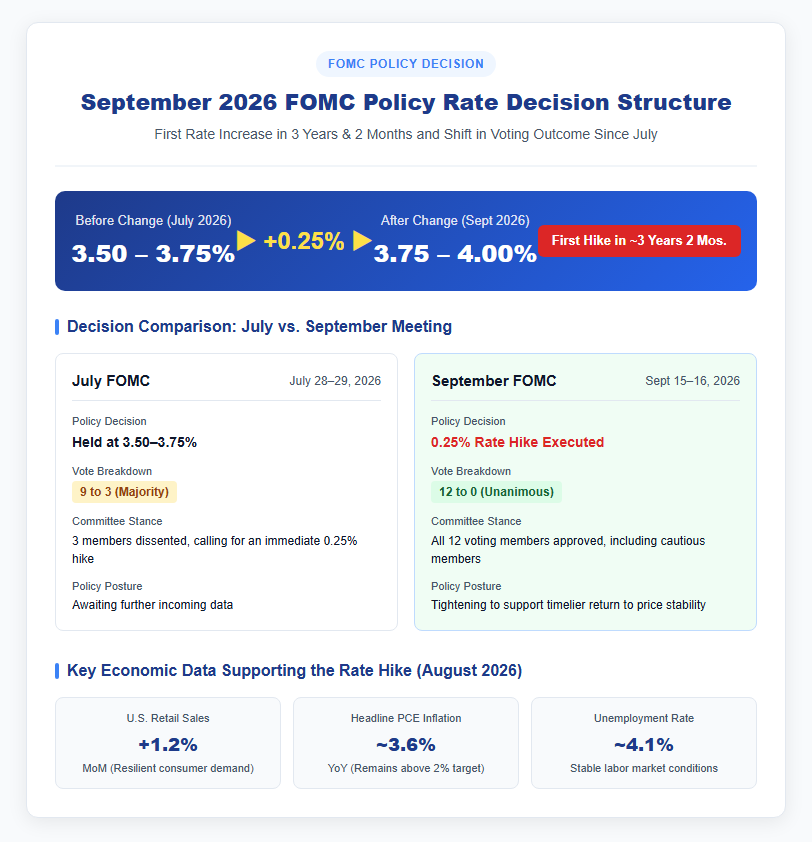
The U.S. Federal Reserve Board (FRB) convened its Federal Open Market Committee (FOMC) on September 15–16, 2026, deciding to raise the target range for the federal funds rate by 0.25 percentage points to 3.75–4.00%. This marks the Fed’s first rate increase since July 2023, approximately three years and two months ago. Notably, the decision was approved unanimously by all 12 voting members. At the previous FOMC meeting in July 2026, the committee had voted 9–3 to hold rates steady at 3.50–3.75%, with three dissenting members calling for an immediate 25 basis point hike. By the September meeting, however, even cautious members aligned with a unified monetary tightening posture. In its policy statement, the Fed noted that while elevated uncertainty remains due to geopolitical developments, domestic spending has proven resilient, supported by strong productivity growth and robust capital investment. Furthermore, U.S. retail sales for August 2026, released just prior to the announcement, grew by 1.2% month-over-month—substantially outperforming market expectations and providing compelling evidence that U.S. consumer demand can withstand higher interest rates. The figure below illustrates the trajectory of the federal funds rate and the decision-making structure at the FOMC.
Shift in Committee Stance Since July and Persistent Inflation Concerns
During the approximately seven weeks following the July 2026 FOMC meeting, the Fed’s policy posture shifted decisively from “awaiting further incoming data” to “taking concrete action.” At the July meeting, a majority of officials opted to maintain interest rates to assess the impact of supply shocks, such as energy price spikes, on broader inflation. However, subsequent economic data reinforced both the resilience of the U.S. economy and the stickiness of inflationary pressures. In August 2026, estimates for the Personal Consumption Expenditures (PCE) price index—the Fed’s preferred inflation metric—showed headline PCE rising around 3.6% year-over-year, with core PCE up approximately 3.2%, remaining well above the Fed’s 2% long-term target. During his press conference, Fed Chair Kevin Warsh highlighted that summer inflation metrics showed insufficient improvement in underlying trends, noting that price increases above 3% persist across a wide range of categories. With inflation remaining above target for more than five years, the Fed acted to fulfill its primary mandate of price stability by initiating an earlier return toward its 2% inflation goal.
Higher Rate Projections and the Fed’s Monetary Policy Posture
Dot Plot Signals a “Higher-for-Longer” Rate Trajectory
Alongside the policy announcement, the Fed released its updated Summary of Economic Projections (SEP), featuring an upward revision to the dot plot that delivered a notable hawkish surprise to financial markets. Out of 18 participating Fed officials, 16 indicated that a higher policy rate would be appropriate by the end of 2026. Specifically, the median projection for the federal funds rate at year-end 2026 was raised to 4.1%, up 0.3 percentage points from the 3.8% projected in June. This implies the likelihood of one additional 25 basis point rate hike before the end of the year. Furthermore, the median rate projection for year-end 2027 was held flat at 4.1%, effectively abandoning earlier rate-cut expectations in favor of maintaining a restrictive policy stance over an extended period. The revised macroeconomic forecast also raised the real GDP growth projection for 2026 to 2.3%, while pushing the 2026 PCE inflation forecast up to 3.7%. Steady economic expansion and labor market stability combined with persistent price stickiness have compelled the Fed to sustain higher interest rates.
Chair Warsh’s Press Conference and Commitment to Price Stability
In his post-meeting press conference, Fed Chair Kevin Warsh characterized the 25 basis point rate hike as “removing a dose of accommodation,” noting that it remains difficult to describe broader financial conditions as restrictive. Opening his remarks, Warsh stated that “the plain fact is that inflation is too high and has been for too long,” emphasizing that with unemployment holding steady at around 4.1%, the labor side of the Fed’s dual mandate remains in good shape, leaving price stability as the committee’s primary focus. He further explained that the committee determined the action threshold he outlined at the Jackson Hole symposium in August—namely, gaining confidence that underlying inflation is moving clearly and with sufficient speed toward the target—had not been met. While maintaining that the Fed is not in the business of providing pre-committed forward guidance, Warsh stressed that the unanimous vote underscores the committee’s firm resolve to achieve price stability on a more timely basis, demonstrating institutional independence despite political pressures.
Market Reactions and Implications for Future Monetary Policy
Complex Dynamics Across U.S. Equities, Bonds, and Foreign Exchange Markets
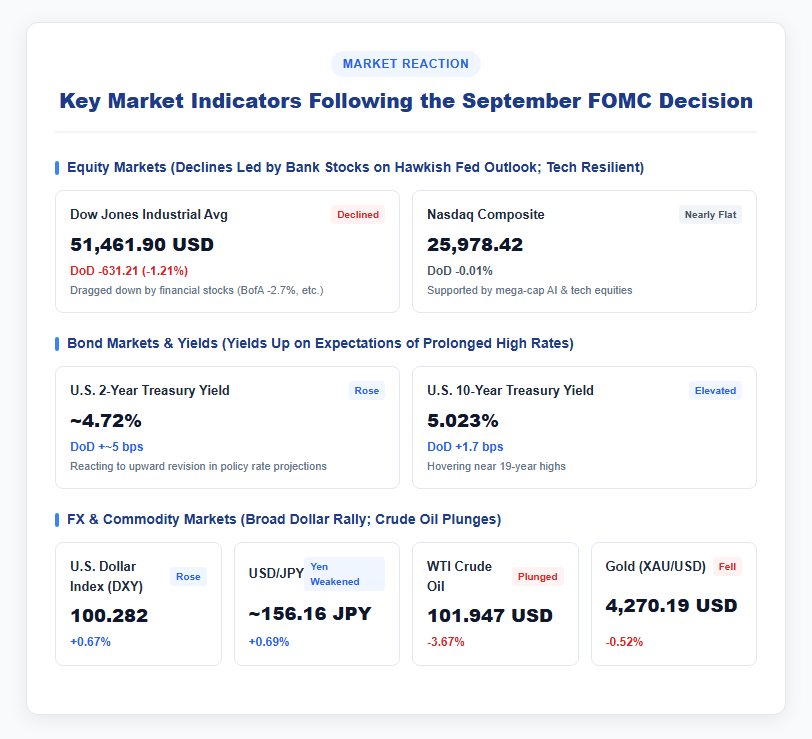
Although the 25 basis point rate hike was largely priced in by markets prior to the announcement, the hawkish dot plot and Chair Warsh’s firm rhetoric triggered significant market volatility. On September 16, 2026, U.S. equity markets tumbled on fears of prolonged high interest rates, with the Dow Jones Industrial Average falling 631.21 points (-1.21%) to close at 51,461.90. Major banking stocks bore the brunt of the sell-off due to rising borrowing costs and credit concerns. Conversely, the Nasdaq Composite edged down just 0.01% to 25,978.42, buoyed by resilience in large-cap technology and AI-related equities. In the fixed-income market, the policy-sensitive 2-year Treasury yield rose approximately 5 basis points to around 4.72%, while the 10-year Treasury yield climbed to 5.023%, hovering near 19-year highs. Foreign exchange markets saw broad-based U.S. dollar strength, pushing the U.S. Dollar Index (DXY) up to 100.282, while USD/JPY surged toward the 156.16 level. The figure below highlights the key market indicator movements following the decision.
Spillover Effects on the Bank of Japan Meeting and Key Outlook Drivers
Immediately following the Fed’s rate hike, the Bank of Japan (BOJ) convened its Monetary Policy Meeting on September 17–18, with markets closely watching for the policy outcome and Governor Kazuo Ueda’s press conference. A consensus survey of private-sector economists conducted prior to the meeting showed 97% expecting the BOJ to raise its uncollateralized overnight call rate target from around 1.0% to 1.25%. However, even if the BOJ delivers a 25 basis point rate hike, the simultaneous tightening by the Fed means the nominal interest rate differential between the U.S. and Japan remains unchanged, offering no immediate relief from yen depreciation pressures. Looking ahead, global market trends will be heavily influenced by energy price fluctuations and their pass-through to underlying inflation, alongside upcoming U.S. inflation and employment metrics leading into the October and December FOMC meetings. As markets seek clarity on where the Fed’s terminal rate lies, central bank navigation between inflation control and economic momentum will remain the primary macroeconomic risk factor.
Reference Pages
- 【Federal Reserve Board, Federal Reserve issues FOMC statement, September 16, 2026】https://www.federalreserve.gov/newsevents/pressreleases/monetary20260916a.htm
- 【Federal Reserve Board, Summary of Economic Projections, September 16, 2026】https://www.federalreserve.gov/monetarypolicy/fomcprojtabl20260916.htm
- 【Federal Reserve Board, September 15–16, 2026 FOMC Meeting / Press Conference】https://www.federalreserve.gov/monetarypolicy/fomcpresconf20260916.htm
【#Fed #FOMC #InterestRates #RateHike #Inflation #USEconomy #USDJPY #BankOfJapan】


コメント