In a public opinion survey conducted by TV Tokyo and The Nikkei in September 2026, the approval rating for Prime Minister Takaichi’s Cabinet stood at 62%, remaining flat from the previous month. While public support is sustained by expectations for economic policies and the retention of key economic ministers, scrutiny remains intense over appointments linked to political funding controversies.
- Key Highlights of the September Survey and Support Structure for the Takaichi Cabinet
- Evaluation of Cabinet Reshuffle and Mixed Views on Minister Retentions
- Public Evaluation and Expectations for “Responsible Proactive Fiscal Policy”
- Financial and Market Policy Continuity Brought by Retaining Economic Ministers
- Party Support Ratings and Coalition vs. Opposition Dynamics
- Administrative Challenges and Future Key Points to Watch
Key Highlights of the September Survey and Support Structure for the Takaichi Cabinet
According to a public opinion poll conducted jointly by TV Tokyo and The Nikkei from September 18 to 20, 2026, the approval rating for the Takaichi Cabinet remained unchanged from August at 62%. Meanwhile, the disapproval rating rose by 1 percentage point to 33%. The survey polled 1,007 men and women aged 18 and older nationwide via landline and mobile phones. Please refer to the figure below.
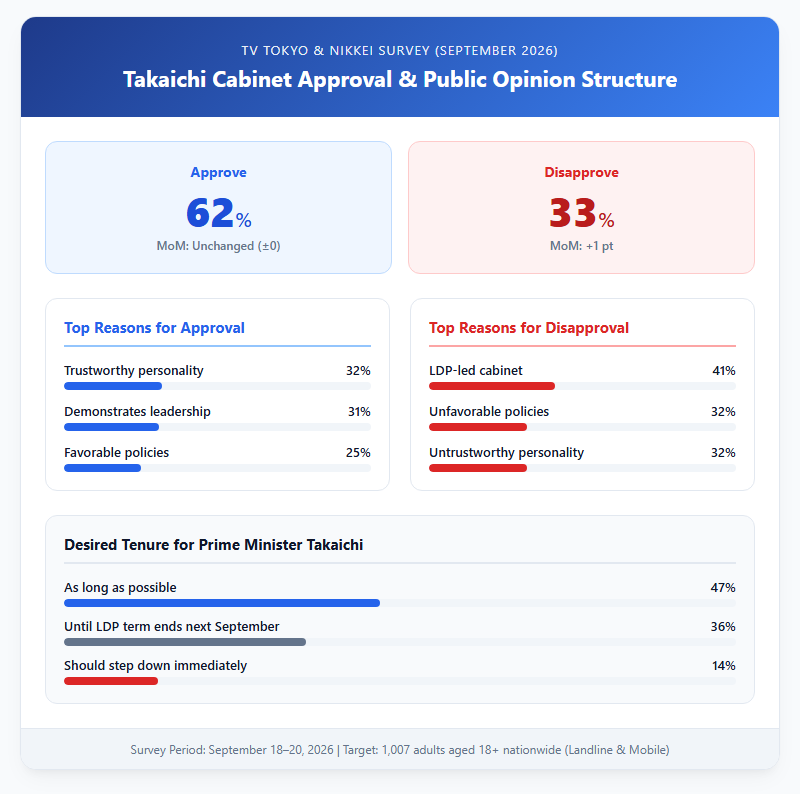
The most common reason cited for supporting the cabinet was “Trustworthy personality” at 32%, followed by “Demonstrates leadership” at 31% and “Favorable policies” at 25%. These findings highlight that the public values Prime Minister Takaichi’s political leadership and personal approachability. Conversely, the top reason for disapproval was “Because it is an LDP-led cabinet” at 41%, with “Unfavorable policies” and “Untrustworthy personality” tied at 32%. Deep-seated distrust toward the ruling party continues to drive non-support. Regarding her desired tenure, “As long as possible” accounted for nearly half of respondents at 47%, surpassing “Until the end of her term as LDP president next September” (36%) and “Should step down immediately” (14%), reflecting a strong public preference for long-term political stability.
Evaluation of Cabinet Reshuffle and Mixed Views on Minister Retentions
When asked about the personnel lineup following the cabinet reshuffle and LDP executive appointments, 49% evaluated it favorably compared to 38% who held a negative view, indicating overall positive public reception. A similar sentiment was observed regarding the first-time cabinet entry of a minister from coalition partner Nippon Ishin no Kai (Japan Innovation Party), with 49% approving and 36% disapproving, affirming a baseline level of confidence in the new political arrangement.
However, public evaluation diverged sharply depending on specific appointments. The retention of key economic ministers—Finance Minister Satsuki Katayama and Minister of State for Economic and Fiscal Policy Minoru Kiuchi—was deemed “Appropriate” by 65% of respondents, far outpacing the 23% who found it “Inappropriate.” This demonstrates public appreciation for continuity and stability in economic policymaking. On the other hand, the appointment of two lawmakers from the former Abe faction implicated in political fund reporting omissions drew widespread backlash, with 64% calling it “Inappropriate” versus just 27% finding it “Appropriate.” The electorate maintains a strict ethical standard regarding money-in-politics issues, voicing sharp criticism over these selections. As the administration maintains solid overall backing, these controversial appointments could pose an ongoing political liability.
Expectations for “Sanaenomics” and Its Impact on Markets and Daily Life
Public Evaluation and Expectations for “Responsible Proactive Fiscal Policy”
Regarding the economic impact of the “responsible proactive fiscal policy” championed by the Takaichi administration, a majority of 54% in the survey responded that it would “Have a positive impact” on the Japanese economy. This significantly outweighed the 28% who anticipated a “Negative impact,” underscoring strong public anticipation for the cabinet’s signature economic policy line. Please refer to the figure below.
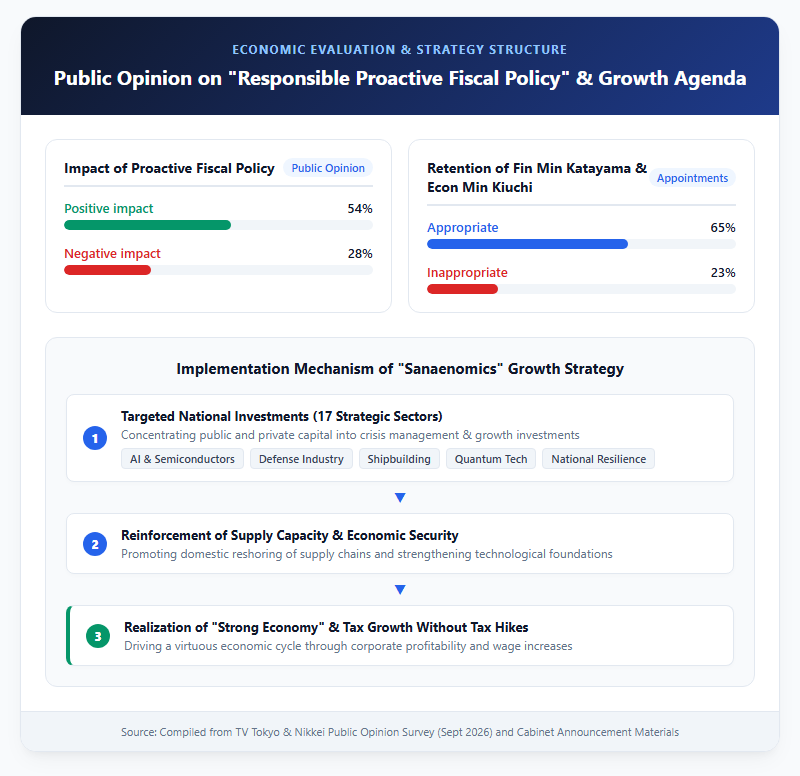
Prime Minister Takaichi’s flagship economic agenda, dubbed “Sanaenomics,” centers on fundamentally strengthening supply capacity and bolstering economic security. Specifically, the administration has designated 17 strategic investment sectors—including AI/semiconductors, defense industries, shipbuilding, quantum technology, and disaster prevention/national resilience—to drive public-private joint investments. This strategy marks a major pivot from the previous focus on a “virtuous cycle of growth and distribution” toward realizing a “strong economy,” prioritizing expansion through crisis management investments. Advocates view this proactive fiscal stance as essential for achieving a complete exit from deflation and reinforcing domestic industrial infrastructure. Nevertheless, concerns persist among some quarters regarding potential government bond overissuance, rising inflation, and future fiscal deterioration, setting the stage for a critical test of the administration’s execution capabilities.
Financial and Market Policy Continuity Brought by Retaining Economic Ministers
In the latest cabinet reshuffle, the retention of Finance Minister Satsuki Katayama and Minister of State for Economic and Fiscal Policy Minoru Kiuchi sent a clear signal to markets that the administration’s economic trajectory remains steadfast. The high approval rate of 65% for these retentions stems from a public desire for policy consistency amid broader market uncertainties.
Reflationist economists advocating fiscal expansion and monetary easing have been appointed to key economic advisory panels and the Japan Growth Strategy Council. Under their influence, the government is pushing investment-led economic stimulus aimed at achieving “tax revenue growth without tax hikes.” Consequently, market expectations generally favor capped interest rate hikes, a sustained weak yen, and continued equity market support. Simultaneously, measures to alleviate cost-of-living pressures—such as fuel subsidy relief and discussions surrounding the trigger clause—are being advanced. The retention of key economic ministers solidifies the predictable, stable management of macroeconomic policy, offering greater clarity for investors and businesses alike.
Political Base and Mid-to-Long-Term Outlook
Party Support Ratings and Coalition vs. Opposition Dynamics
Looking at party support ratings in the September poll, the ruling Liberal Democratic Party (LDP) gained 2 percentage points from the previous month to reach 41%, maintaining a robust base of support. Its coalition partner, Nippon Ishin no Kai, held steady at 4%. Unaffiliated voters accounted for 24%, down 3 percentage points, reflecting a shift back toward the ruling party.
Among opposition forces, Sanseito ticked up to 5% (+1 pt) and the Japanese Communist Party (JCP) to 4% (+1 pt). In contrast, the Democratic Party for the People (DPFP) fell to 4% (-1 pt), the Constitutional Democratic Party of Japan (CDP) to 4% (-1 pt), and Team Mirai to 2% (-1 pt), showing a general struggle for momentum. Other parties remained low, with Komeito at 2%, the Conservative Party of Japan at 2%, and the Centrist Reform Coalition at 1%, while the Social Democratic Party (SDP) stood at 0%. While the LDP enjoys dominant backing, opposition support remains fragmented, underscoring how the lack of a unified opposition block reinforces the ruling party’s advantage.
Administrative Challenges and Future Key Points to Watch
Although the Takaichi Cabinet has enjoyed a strong launch with an approval rating of 62%, several challenges lie ahead for its mid-to-long-term governance. The primary concern remains public resistance to appointing lawmakers connected to past political funding scandals. As 64% of respondents deemed these appointments inappropriate, any failure to ensure transparency or fulfill accountability could trigger a rapid decline in support.
A major key point to watch moving forward is the formulation of the “Public-Private Investment Roadmap” slated for summer 2026, and whether it effectively translates into real economic growth and wage increases. The central question is whether massive investments across the 17 strategic sectors will function as “wise spending” that generates higher tax revenues. Additionally, navigating yen depreciation in foreign exchange markets, long-term interest rate trends, and policy coordination with the Bank of Japan will require careful management. Harnessing high public expectations while mitigating political risks will ultimately determine the true strength and longevity of the Takaichi administration.
References
- [Second Takaichi Cabinet Roster – Prime Minister’s Office of Japan]https://www.kantei.go.jp/jp/105/meibo_a/index.html
[#OpinionPoll #TakaichiCabinet #Sanaenomics #ProactiveFiscalPolicy #PoliticalEconomy #JapaneseEconomy #CabinetReshuffle #PublicOpinion]


コメント