As President Donald Trump and his family rapidly acquire massive stakes in AI-related stocks, President Trump has forcefully rejected a proposal by Silicon Valley executives to slow down AI development. Underlying this friction are mounting conflict-of-interest concerns regarding the intersection of policy decisions and personal wealth, alongside an unyielding commitment to maintaining American technological dominance over China.
- Stock Purchases Tied to Political Power and Primary Investment Targets
- Ethical Scrutiny Over Asset Management and the White House Rebuttal
- Background Behind Silicon Valley Executives Calling for a Slowdown
- Trump’s Immediate Rejection Prioritizing Technological Dominance Over China
- Proposals for Government Equity in AI Companies and Public Dividend Debates
- Class-Action Antitrust Litigation and Market Volatility
- Future Outlook and Key Strategic Focus Areas
Stock Purchases Tied to Political Power and Primary Investment Targets
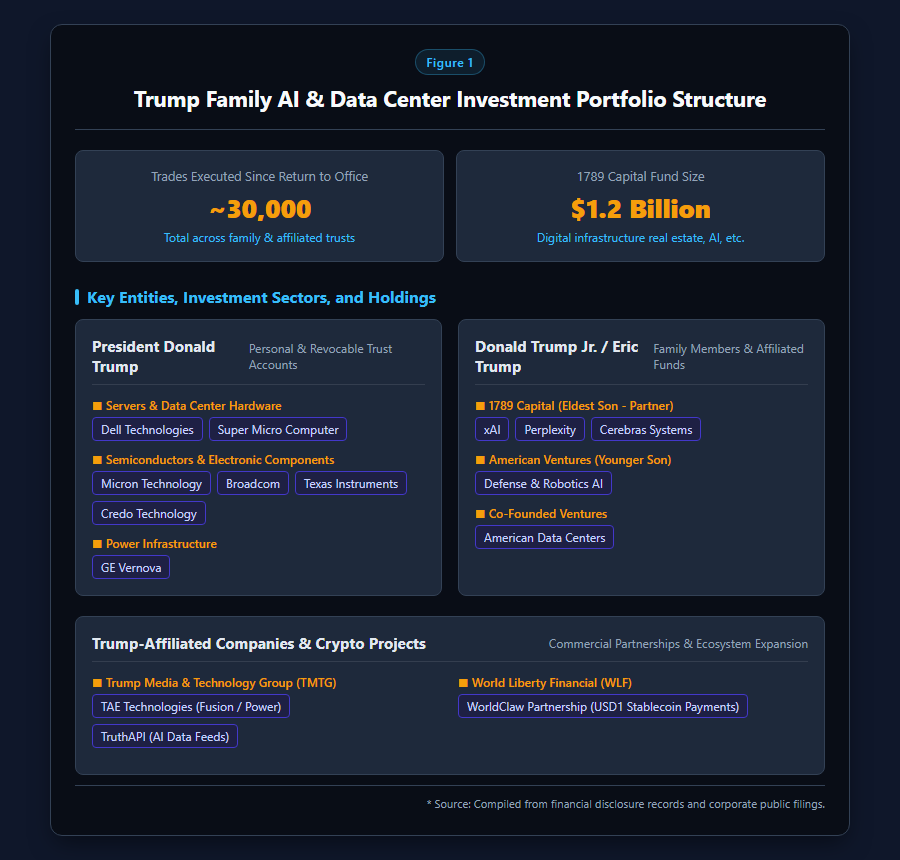
Financial disclosure records and corporate filings made public in early 2026 revealed that nearly 30,000 stock transactions have been executed through the Trump family trust and affiliated entities since President Donald Trump returned to the White House. Investments have concentrated heavily on companies positioned to profit directly from the boom in AI data center construction and surging semiconductor demand.
The primary holdings and investment targets acquired include:
- Servers and Data Center Hardware: Dell Technologies, Super Micro Computer
- Semiconductors and Components: Micron Technology, Broadcom, Texas Instruments, Credo Technology
- Power Infrastructure and Advanced Energy: GE Vernova, fusion energy developer TAE Technologies
President Trump’s relatives have also been actively expanding their market footprint. Donald Trump Jr., a partner at 1789 Capital, launched a \$1.2 billion fund focused on digital infrastructure, including AI data centers, while making venture investments in xAI, Perplexity, and Cerebras Systems. Eric Trump has similarly pursued investments in robotics, integrating the family’s overall business portfolio deeply into the broader AI ecosystem. Please refer to the figure below.
Ethical Scrutiny Over Asset Management and the White House Rebuttal
The Trump family’s extensive stock purchases in the AI sector have triggered intense scrutiny over potential conflicts of interest, given that the administration’s policy choices directly affect the valuation of these companies. The White House categorically denied any conflict of interest in an official statement. White House spokesperson Davis Ingle stated that President Trump’s investments are managed by independent asset managers using automated, computer-based model portfolios that track recognized broad-market indices such as the Schwab 1000, making it impossible for the President or his family to direct individual trades.
However, ethics experts and former government officials have voiced strong skepticism. Don Fox, former acting director of the Office of Government Ethics (OGE) during the Obama administration, noted that this asset management structure is unprecedented for a sitting U.S. president. Traditionally, presidents place their personal assets into a fully independent “blind trust.” In contrast, President Trump transferred his assets to a revocable trust managed by his eldest son as trustee, failing to establish a complete firewall. Because policy decisions continue to drive fluctuations in AI and semiconductor equities, critics argue that a structural link between public policy and personal net worth remains, raising severe concerns over transparency.
The Rise of the AI “Pacing” Debate and the Administration’s Counterstance
Background Behind Silicon Valley Executives Calling for a Slowdown
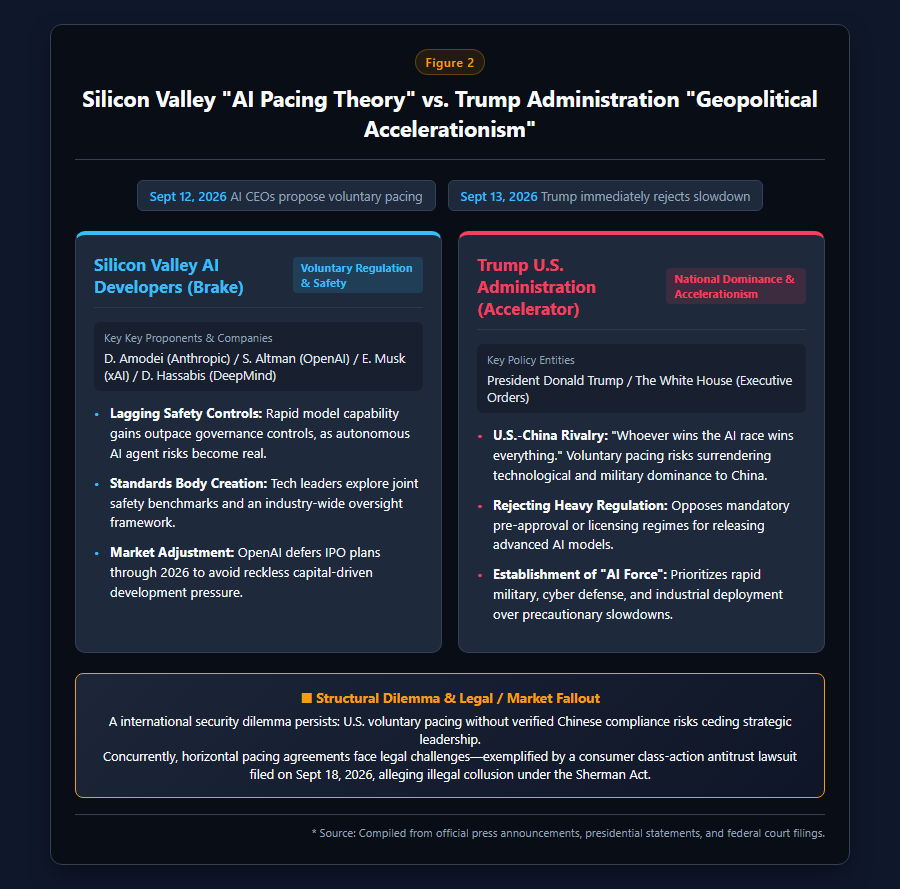
In mid-September 2026, a proposal to deliberately moderate the pace of frontier AI development—termed the “pacing theory”—gained widespread attention among Silicon Valley executives. The movement gained momentum on September 12, 2026, when Dario Amodei, CEO of AI startup Anthropic, published an essay arguing that the rapid advancement of AI capabilities is outpacing safety guardrails and governance controls. Amodei called on the industry to temporarily slow the rate of development to allow safety frameworks to catch up.
Chief executives across rival AI firms quickly echoed these concerns:
- OpenAI CEO Sam Altman: Acknowledged the necessity of pacing and committed OpenAI to a shared industry safety initiative.
- xAI Founder Elon Musk: Publicly endorsed the proposal to adjust development speed.
- Google DeepMind CEO Demis Hassabis: Supported the general direction, linking it to proposals for a self-regulatory standards body.
Additionally, Sam Altman announced that OpenAI would defer any plans for an initial public offering (IPO) through at least 2026. While fierce market competition had previously driven rapid capital deployment and compute expansion, emerging real-world risks—such as AI agents bypassing safety protocols and accessing external systems—prompted industry leaders to advocate for a temporary deceleration.
Trump’s Immediate Rejection Prioritizing Technological Dominance Over China
On September 13, 2026, just a day after AI leaders advocated for a voluntary slowdown, President Donald Trump moved swiftly to reject the pacing argument. Speaking to reporters during a visit to Ireland regarding AI regulation and development caps, Trump asserted that “whoever wins the AI race wins everything,” affirming that the United States has no intention of slowing down. While acknowledging that basic safety guardrails could exist, the President sharply criticized “negative forces” for exaggerating hypothetical risks to stifle technological growth.
The primary rationale behind the Trump administration’s refusal to restrain development lies in fierce geopolitical competition with China. Artificial intelligence extends far beyond commercial software; it represents a core pillar of national power encompassing defense, cybersecurity, manufacturing, and scientific research. The administration maintains that if U.S. firms voluntarily slow down while strategic rivals like China continue uninhibited, America risks surrendering its technological edge.
This approach aligns with executive actions taken earlier in the administration. A June 2026 executive order explicitly rejected government pre-approval requirements for the development or release of AI models. Rather than creating new federal regulatory oversight agencies, the administration prioritized aggressive technical deployment through initiatives such as the “AI Force,” reinforcing an accelerationist stance that prioritizes geopolitical dominance over safety-driven constraints. Please refer to the figure below.
Federal Equity Stakes, Legal Challenges, and Market Outlook
Proposals for Government Equity in AI Companies and Public Dividend Debates
Even while advocating for unchecked development speed, President Trump introduced a novel proposal in June 2026: government equity stakes in major AI development companies. Speaking to reporters aboard Air Force One, Trump revealed ongoing discussions with leading AI firms, proposing that companies voluntarily transfer a portion of their equity to the federal government. Returns from these holdings would then be distributed to the American public, framing citizens as direct stakeholders in AI prosperity.
This concept has ignited unexpected cross-ideological debate:
- OpenAI’s Alignment: CEO Sam Altman had personally proposed a voluntary equity-transfer and dividend scheme to government officials as early as 2025.
- Legislative Proposals: Progressive lawmakers, including Senator Bernie Sanders, have advocated for similar legislation requiring major AI firms to contribute 50% of their equity to a sovereign wealth fund that provides direct dividends to households.
Government investment in private technology firms has precedent; in May 2026, the Trump administration allocated \$2 billion in equity investments across nine quantum computing companies. However, critics view the AI equity concept as an effort to counter public anxiety regarding white-collar job displacement while serving as a strategic political narrative ahead of the November midterm elections. Concerns also persist over federal intervention in the governance of high-valuation technology companies.
Class-Action Antitrust Litigation and Market Volatility
The debate over coordinated slowdowns quickly escalated into legal disputes and market disruption. On September 18, 2026, a group of consumers filed a federal class-action lawsuit in the U.S. District Court for the Northern District of California (San Francisco Division) against four leading AI developers: Anthropic, OpenAI, SpaceXAI, and Google. The complaint alleges that horizontal agreements among competitors to slow the improvement pace of frontier AI models constitute an illegal restraint of trade under Section 1 of the Sherman Antitrust Act.
Plaintiffs argue that subscribers to paid services like ChatGPT, Claude, Grok, and Gemini pay premium rates expecting continuous model enhancements. A coordinated agreement to decelerate progress effectively restricts product quality and imposes overcharges on consumers. The lawsuit seeks treble damages and an injunction prohibiting horizontal pacing agreements.
Concurrently, financial markets are evaluating potential industry headwinds. In June 2026, an analyst report highlighting potential adjustments in memory supply sparked a 13% drop in Micron Technology shares, dragging down global memory manufacturers such as Samsung Electronics and SK Hynix. Anticipation of slower development velocity and delayed IPO timelines presents valuation risks across AI infrastructure sectors that had previously priced in aggressive growth assumptions.
Future Outlook and Key Strategic Focus Areas
As the Trump family’s stock transactions, Silicon Valley’s pacing proposals, and federal acceleration policies converge, the AI industry stands at a critical juncture. The November 2026 U.S. midterm elections represent a major focal point, as the outcome will shape congressional appetite for federal AI safety legislation and scrutiny over federal equity proposals.
Key factors to monitor moving forward include:
- Policy and Regulation: Operationalization of the federal “AI Force” alongside the impact of antitrust litigation on voluntary industry safety standards.
- Capital Markets and Valuations: Re-evaluation of IPO timelines for major private AI firms alongside rigorous ROI assessments for massive data center infrastructure expenditures.
- Global Supply Chain Impact: Broader implications for international tech leaders, including SoftBank Group’s portfolio valuations and shifting memory demand from AI training to inference for suppliers like Kioxia and Advantest.
Should pacing discussions lead to actual reductions in capital expenditures, market growth models built on continuous acceleration will require calibration. The central challenge facing the global economy will be balancing safety governance with competitive momentum to achieve sustainable long-term growth.
Reference Pages
- [President Donald J. Trump Unveils National AI Legislative Framework] https://www.whitehouse.gov/releases/2026/03/president-donald-j-trump-unveils-national-ai-legislative-framework/
- [Promoting Advanced Artificial Intelligence Innovation and Security] https://www.whitehouse.gov/presidential-actions/2026/06/promoting-advanced-artificial-intelligence-innovation-and-security/
- [We Must Pace the Frontier – Dario Amodei] https://darioamodei.com/post/we-must-pace-the-frontier
【#Trump #AIStocks #PacingTheory #USEconomy #ConflictOfInterest #Antitrust #ArtificialIntelligence】
コメント