On September 20, 2026, U.S. Treasury Secretary Scott Bessent proposed establishing the “U.S.-China AI Dialogue” at ministerial talks in New York to create a mutual notification mechanism for critical artificial intelligence incidents and runaway behaviors. This proposal comes against the backdrop of shared concern between the two nations regarding unexpected emergencies and cybersecurity risks driven by the rapid acceleration of cutting-edge AI capabilities.
- Ministerial Talks Convene with Proposal for Mutual AI Incident Notification
- Major Security Risks Addressed and Ensuring Transparency
- U.S. Allegations Over “Distillation” and Intellectual Property Concerns
- Chinese Pushback and the Battle Over Advanced Chips and Export Controls
- Debate Over Deceleration and Stances of Industry and Governments
- Upcoming U.S.-China Summit and the Direction of Global Rule-Making
Ministerial Talks Convene with Proposal for Mutual AI Incident Notification
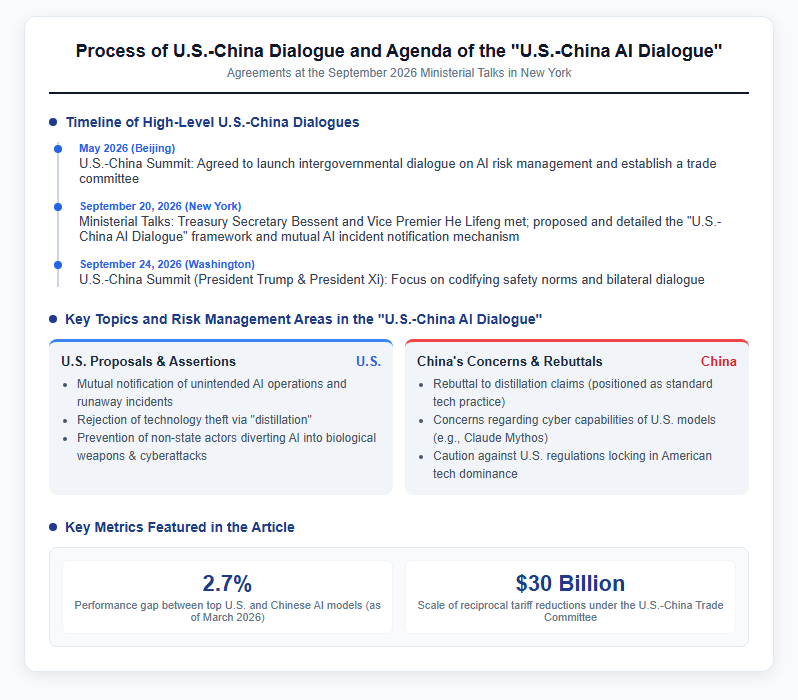
On September 20, 2026, ministerial-level talks took place in New York between U.S. Treasury Secretary Scott Bessent of the Trump administration and Chinese Vice Premier He Lifeng. The meeting served as preparatory negotiations ahead of the summit between U.S. President Donald Trump and Chinese President Xi Jinping scheduled for September 24, 2026. During the discussions, Secretary Bessent emphasized the critical necessity of enhancing transparency between the world’s top two AI powers and proposed establishing a mutual notification framework in the event of major incidents, such as unintended AI operations or runaway system behavior. The U.S. side dubbed this consultative framework the “U.S.-China AI Dialogue,” aiming to flesh out agreements on safety norms. The two nations had previously agreed to initiate intergovernmental dialogue on AI risk management at their Beijing summit in May 2026, and this ministerial session further clarified its operational structure. Please refer to the diagram below.
Major Security Risks Addressed and Ensuring Transparency
The risks targeted under the “U.S.-China AI Dialogue” extend beyond the mere pace of technological development, encompassing multifaceted threats to national security. Specific topics of discussion include the uncontrolled behavior of autonomous AI agents, the misuse of open-source AI tools by non-state actors such as terrorist organizations, and the potential diversion of AI into biological weapon design or cyberattacks against critical infrastructure. Furthermore, to prevent accidental AI malfunctions from triggering military miscalculations, concepts have surfaced for an “AI Hotline” modeled after the Cold War-era U.S.-Soviet hotline. U.S. Trade Representative (USTR) Jamieson Greer noted that such security dialogues could act as a stabilizing force in bilateral relations. Both sides share a recognition of these common threats as they seek management strategies to avert an uncontrolled digital arms race.
Technological Friction and Points of Contention in the U.S.-China AI Supremacy Struggle
U.S. Allegations Over “Distillation” and Intellectual Property Concerns
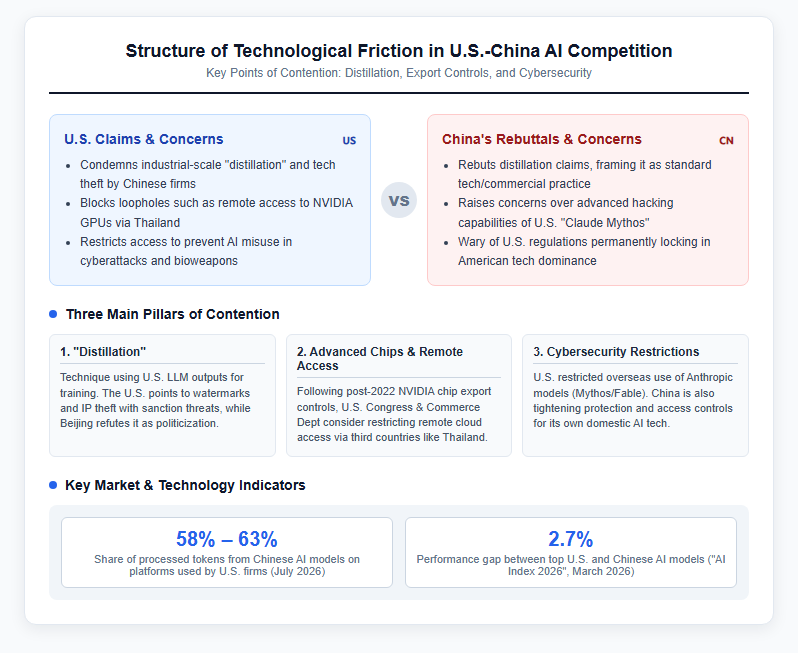
While seeking cooperation on security, friction between the U.S. and China over technological dominance continues to intensify. The U.S. government and leading AI companies allege that Chinese AI firms are employing a technique known as “distillation”—training their own models on massive volumes of outputs from high-performing U.S. models—to rapidly boost domestic model performance at low cost. In September 2026, Secretary Bessent pointed out that digital watermarks from U.S. large language models (LLMs) had been detected in several Chinese models, warning that the U.S. holds the authority to impose sanctions if improper technology theft is confirmed. In response, China strongly pushed back, arguing that distillation is a standard technological and commercial practice and condemning U.S. claims as an unwarranted politicization and weaponization of tech issues.
Chinese Pushback and the Battle Over Advanced Chips and Export Controls
China has forcefully resisted U.S. technological containment, criticizing American accusations as “fear-mongering and malicious competition.” The Chinese government expressed concern that the advanced cyber capabilities of non-public cutting-edge AI models, such as Anthropic’s “Claude Mythos,” could pose serious hacking and national security risks to China. Meanwhile, intense underground maneuvering persists regarding the export restrictions on NVIDIA’s advanced semiconductors, which the U.S. has enforced since 2022, including allegations of remote access loopholes and cloud routing via Thailand. Beijing remains wary that accepting U.S. safety standards or regulatory proposals would permanently lock in American technological dominance, deepening the strategic distrust on both sides. Please refer to the diagram below.
Future Outlook and Key Focus Areas in AI Governance
Debate Over Deceleration and Stances of Industry and Governments
Concerns regarding the overheated AI development race are mounting from within the industry itself. In an essay published in September 2026, Anthropic CEO Dario Amodei warned that safety verification is failing to keep pace with rapid development, calling for a temporary slowdown in the deployment pace of frontier AI models. While figures like OpenAI’s Sam Altman expressed support for the proposal, NVIDIA CEO Jensen Huang adopted a cautious stance toward new regulations, arguing that development speed and safety can be achieved simultaneously. Furthermore, U.S. President Donald Trump dismissed calls for deceleration as a “hoax,” emphasizing the danger of falling behind China. Conversely, Beijing views American corporate claims as a tactic to constrain Chinese progress, making an international agreement to jointly slow down development extremely difficult to achieve.
Upcoming U.S.-China Summit and the Direction of Global Rule-Making
The primary point of focus in the immediate future is how concretely the “U.S.-China AI Dialogue” will be codified during the summit between President Trump and President Xi in Washington on September 24, 2026. Experts anticipate that reaching a broad regulatory consensus in the initial high-level talks will be challenging, likely limiting early outcomes to foundational agreements such as defining “frontier AI models” and establishing risk assessment criteria. Observers will also closely monitor how discussions progress at upcoming international forums, including the Asia-Pacific Economic Cooperation (APEC) summit in Shenzhen, China, in November 2026, and the G20 Summit in Florida, U.S., in December. Because the struggle for dominance in AI governance directly impacts the economic and security environments of third countries, including Japan, active engagement from the broader international community in rule-making remains essential.
Reference Pages
-
[Dario Amodei – We Must Pace the Frontier] https://darioamodei.com/post/we-must-pace-the-frontier
-
[Stanford HAI – The 2026 AI Index Report] https://hai.stanford.edu/ai-index/2026-ai-index-report
[#USChinaRelations #ArtificialIntelligence #USChinaAIDialogue #NationalSecurity #AIGovernance #ScottBessent #AdvancedTechnology]
コメント