As large and powerful Typhoon No. 25 approaches, the Ministry of Land, Infrastructure, Transport and Tourism’s Kanto Regional Development Bureau and major expressway operators have announced potential preemptive traffic restrictions across key roadways in the Kanto region. Driven by the risk of record-breaking torrential rain and violent winds from linear precipitation zones, severe disruptions are anticipated across critical public infrastructure, including planned train suspensions and delivery halts.
- Background and Overview of Preemptive Traffic Restrictions by the Kanto Regional Development Bureau and Highway Operators
- Planned Suspensions in Rail Transport and Ripple Effects on Major Logistics Carriers
- Meteorological Risks and Impact Scope Reflected in Typhoon Hagibis (2019) and Historical Precedents
- Transport Safety Guidelines Under Extreme Weather Issued by the Ministry of Land, Infrastructure, Transport and Tourism
- Transport and Warehouse Terms and Conditions and Damages Liabilities in Natural Disasters
- Reinforcing Disaster Prevention Infrastructure and Future Priorities for Transport and Logistics BCP
Background and Overview of Preemptive Traffic Restrictions by the Kanto Regional Development Bureau and Highway Operators
From September 20 to 21, 2026, the risk of large, strong Typhoon No. 25—accompanied by severe storm zones—approaching the Pacific coast of eastern Japan and directly impacting the Kanto-Koshin region heightened significantly. In response, a joint advisory titled “Possibility of Preemptive Traffic Restrictions on Expressways and National Highways (3rd Report)” was issued by the Kanto Regional Development Bureau, Kanto Transport Bureau, Hokuriku-Shin’etsu Transport Bureau, Tokyo Regional Headquarters of the Japan Meteorological Agency, NEXCO East, NEXCO Central, and Metropolitan Expressway Co., Ltd., calling for widespread vigilance.
According to the official announcement, intense rainfall and gale-force winds associated with the typhoon have already triggered partial closures on key expressways—including the Joban Expressway, Capital Area Outer Loop Expressway (Ken-O Expressway), Tateyama Expressway, Chiba-Togane Road, and Tokyo Bay Aqua-Line—as well as directly managed national highways such as Route 127, with additional preemptive restrictions expected to roll out sequentially. A particularly critical concern highlighted by authorities is the potential simultaneous restriction of the Chuo Expressway—a vital logistics artery connecting Tokyo and Yamanashi Prefecture—and the parallel National Route 20 (including sections around Lake Sagami, Uenohara, and Otarumi Pass). Such dual closures would effectively sever ground transport routes between the Tokyo Metropolitan Area and the Koshin’etsu region, making widespread travel disruption and severe logistics bottlenecks unavoidable. Government agencies and road operators are strongly advising road users to prioritize safety and strictly refrain from non-essential travel.
Planned Suspensions in Rail Transport and Ripple Effects on Major Logistics Carriers
In step with preemptive road restrictions, rail networks initiated extensive planned service suspensions due to the approach of Typhoon No. 25. On September 21, 2026, JR East decided to suspend services and substantially reduce train frequencies across wide areas of the Kanto region. Specifically, all-day operations were halted on the Kururi Line between Kisarazu and Kazusa-Kameyama Stations, while services on the Ome Line between Ome and Okutama Stations were suspended from around 14:00 on September 21 until approximately 10:00 on September 22. Furthermore, service suspensions were phased in from late afternoon into the evening across major routes connecting Chiba Prefecture, the Tama region, Ibaraki Prefecture, and Tochigi Prefecture, including the Hachiko, Joban, Suigun, Mito, Sobu Main, Uchibo, Sotobo, Togane, Kashima, and Narita Lines.
Please refer to the following image.
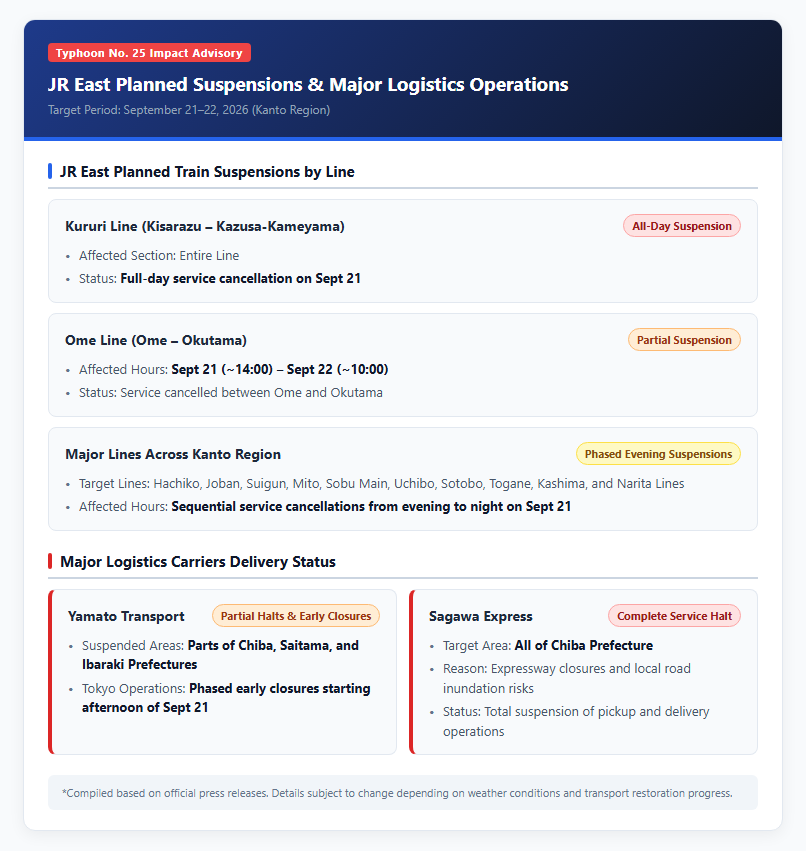
These rapid constraints on transport infrastructure immediately exerted a severe impact on the delivery networks of major private logistics providers. Yamato Transport suspended pickup and delivery operations in parts of Chiba, Saitama, and Ibaraki Prefectures, while also implementing early closures during the afternoon of September 21 within Tokyo. Meanwhile, Sagawa Express completely suspended all pickup and delivery services across Chiba Prefecture, citing highway closures and severe flooding risks on local roads. Cargo delays and delivery suspensions have reverberated across both business-to-business (B2B) supply chains and consumer e-commerce (B2C) parcel deliveries, underscoring an urgent need for advance operational adjustments to mitigate supply chain chaos.
Learning Risks and Standards from Past Torrential Rain and Typhoon Disasters
Meteorological Risks and Impact Scope Reflected in Typhoon Hagibis (2019) and Historical Precedents
According to database analyses by the Storm and Landslide Disaster Reduction Research Division at the National Research Institute for Earth Science and Disaster Resilience (NIED), the projected trajectory of Typhoon No. 25 closely mirrors several historical typhoons that caused unprecedented torrential rain disasters in Japan. Prominent historical precedents include Typhoon Hagibis (Typhoon No. 19 of 2019), as well as Typhoon No. 22 in 2004, Typhoon No. 21 in 2017, Typhoon No. 7 in 2005, and Typhoon No. 26 in 2013. Maintaining significant intensity, all of these storms either made landfall near Tokai, the Izu Peninsula, or the Boso Peninsula, or moved northward off the coast, dumping record-breaking localized rainfall exceeding 300 to 400 millimeters across extensive regions spanning Tokai, Kanto-Koshin, and Tohoku.
Please refer to the following image.
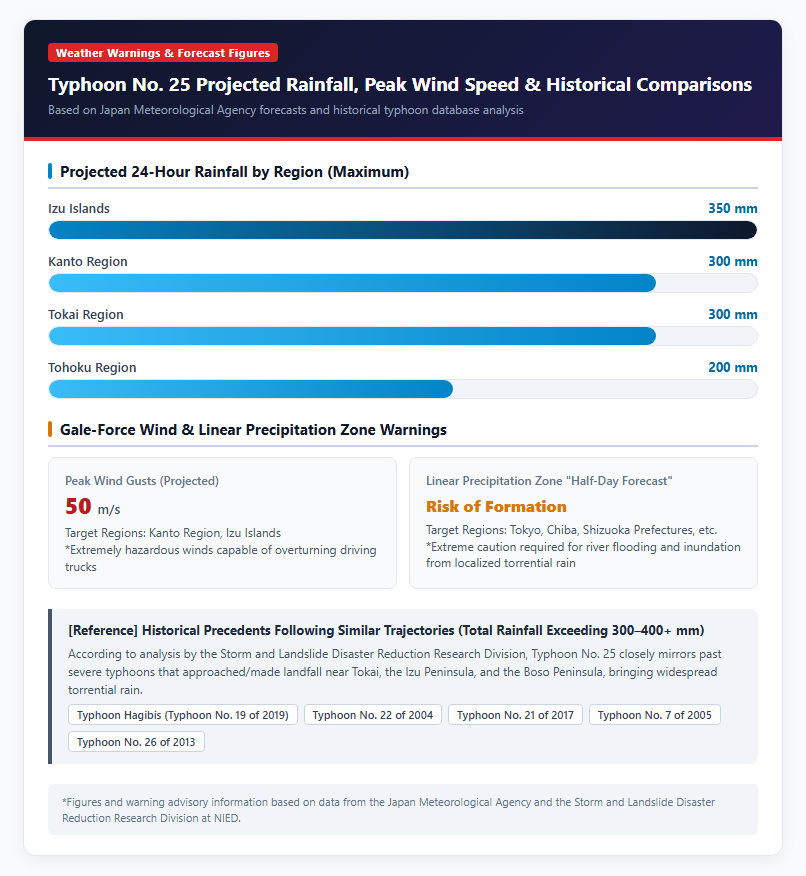
For Typhoon No. 25 as well, the Japan Meteorological Agency issued a “half-day advance forecast” warning of potential “linear precipitation zones” capable of triggering severe weather disasters in Tokyo, Chiba, and Shizuoka Prefectures. Projected 24-hour rainfall totals reached up to 350 millimeters in the Izu Islands, 300 millimeters in the Kanto and Tokai regions, and 200 millimeters in the Tohoku region, with peak wind gusts estimated at a record 50 meters per second across Kanto and the Izu Islands. Historical precedents demonstrate that such extreme events cause not only river flooding and landslides, but also widespread power outages from collapsed transmission towers and utility poles, submerged underpasses, and coastal road destruction from high waves—necessitating comprehensive disaster prevention strategies that extend far beyond routine wind and rain precautions.
Transport Safety Guidelines Under Extreme Weather Issued by the Ministry of Land, Infrastructure, Transport and Tourism
To safeguard truck transport operators during increasingly severe weather disasters, the Ministry of Land, Infrastructure, Transport and Tourism (MLIT) issued an official administrative notice setting “Guidelines for Transport Under Extreme Weather Conditions Such as Typhoons,” following requests from the Japan Trucking Association. This notice established objective criteria empowering trucking operators to appropriately decline or suspend transport during severe weather, reflecting lessons learned from past accidents where trucks overturned or became submerged after shippers forced transport under active weather warnings.
Regarding specific numerical criteria, rainfall intensities of 20 to 30 millimeters per hour necessitate safety measures, while rates of 30 to 50 millimeters per hour increase hazards such as hydroplaning, prompting recommendations to consider suspending operations. At hourly rainfall levels of 50 millimeters or more, driving becomes extremely dangerous, and the guidelines explicitly state that “transporting cargo is not appropriate.” For storm-force winds, wind speeds of 10 to 15 meters per second call for safety precautions, 15 to 20 meters per second warrant heightened caution, 20 to 30 meters per second suggest evaluating operation halts, and speeds of 30 meters per second or higher carry severe rollover risks, explicitly establishing that “transporting cargo is not appropriate.” These objective metrics provide trucking businesses with legal backing to resist unsafe delivery demands from shippers, serving as a critical safeguard to prevent accidents and protect driver lives.
Legal Liabilities in Transportation and Warehousing and Future Disaster Risk Management
Transport and Warehouse Terms and Conditions and Damages Liabilities in Natural Disasters
When client cargo is lost or damaged due to natural disasters such as typhoons or torrential rain, the legal liabilities and financial exposure borne by transport operators and warehouse providers require careful legal structuring. The “Standard Truck Transport Terms and Conditions” and “Standard Warehouse Deposit Terms and Conditions” established by MLIT explicitly govern the handling of losses resulting from force majeure.
Please refer to the following image.
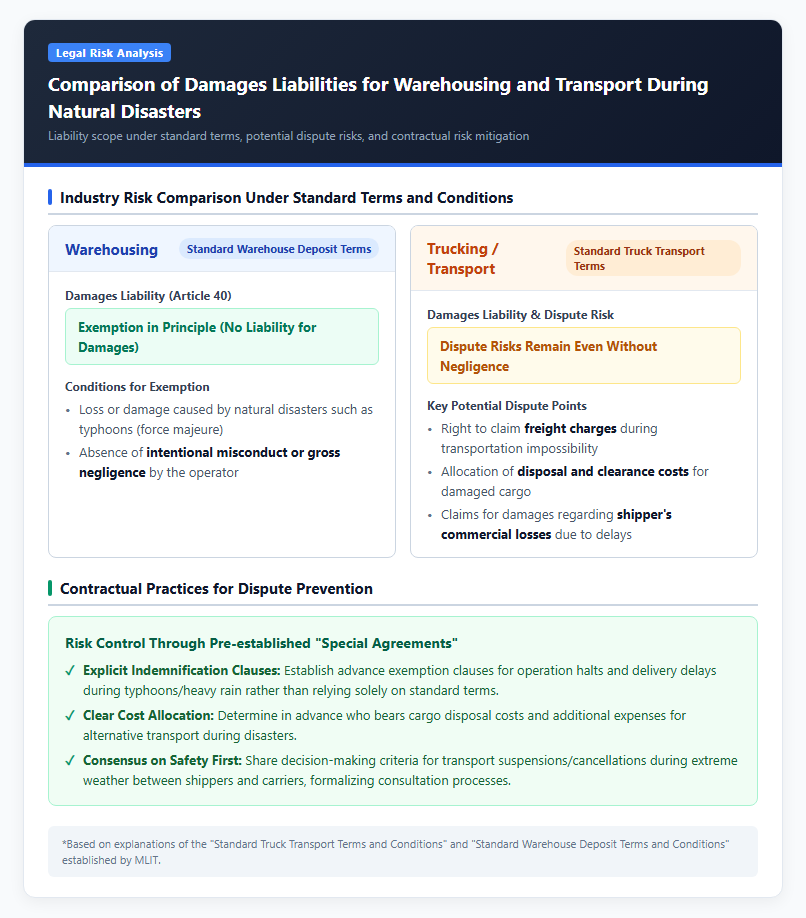
In the warehousing industry, Article 40 of the Standard Warehouse Deposit Terms and Conditions stipulates that if stored goods are lost or damaged due to natural disasters like typhoons, the bailee bears no civil liability for damages unless there is evidence of intentional misconduct or gross negligence. Conversely, in the trucking industry, even when a carrier’s negligence is disproven under standard transport terms, significant risks of dispute remain regarding the right to claim freight charges or the allocation of disposal costs for damaged goods. Furthermore, if shipment delays caused by natural disasters result in commercial losses for shippers, transport providers face potential damages claims in the absence of explicit contractual agreements. To prevent such legal disputes and achieve a “resilient and sustainable logistics network” advocated by the government, businesses must go beyond relying solely on standard terms by proactively executing special bilateral contracts that clearly outline indemnification conditions and cost allocations during disasters.
Reinforcing Disaster Prevention Infrastructure and Future Priorities for Transport and Logistics BCP
The most critical priority for the future transport and logistics sector lies in enhancing infrastructure disaster resilience and ensuring the practical effectiveness of Business Continuity Plans (BCP) against weather extremes rendered routine by global warming. Expressway operators, led by NEXCO East, are accelerating highway renewal projects to overhaul aging infrastructure over 30 years old, while advancing seismic reinforcement and sophisticated maintenance through Smart Maintenance Highway (SMH) systems. These physical infrastructure enhancements serve as the essential bedrock for securing emergency transport routes and enabling rapid recovery following severe disasters.
On the operational side, real-time, accurate information sharing and public-private timeline (preemptive disaster response planning) operations are paramount. Road operators rapidly disseminate road closure predictions via official platforms such as “DraTra (Drive Traffic),” the “Expressway Impact Information Site,” official X (formerly Twitter) accounts, and LINE, enabling fleet managers and drivers to dynamically revise routing and establish detours. Moreover, establishing an industry culture where businesses avoid unrealistic delivery schedules and decide early to suspend transport or advance shipments—guided by tools like half-day weather predictions—remains the key to preventing logistics paralysis and bolstering societal disaster resilience overall.
Reference Pages
- [Storm and Landslide Disaster Reduction Research Division, NIED] https://mizu.bosai.go.jp/key/2019-TY19
- [NEXCO East Official Website] https://www.e-nexco.co.jp/
【#Typhoon25 #PreemptiveTrafficRestrictions #TransportDisruptions #LogisticsBCP #RiskManagement】


コメント