In September 2026, semiconductor giant AMD crossed the \$1 trillion market capitalization milestone for the first time in history. The breakthrough was driven by explosive growth in its data center business amid surging generative AI demand, alongside high market expectations for AMD as a next-generation AI infrastructure provider through strategic deals with tech titans.
- The Headline Event: A Historic Milestone Beyond $1 Trillion
- Robust Earnings Growth and Financial Metrics Supporting the Rally
- Overtaking Intel in Server CPUs Driven by Agentic AI Demand
- ROCm 7 and Helios: Building an Open AI Ecosystem
- Mega-Deals with Anthropic and Meta via Innovative Warrant Structures
- Outlook, Critical Milestones, and Semiconductor Industry Risks
The Headline Event: A Historic Milestone Beyond $1 Trillion
On September 21, 2026, U.S. chipmaker Advanced Micro Devices (AMD) officially surged past the \$1 trillion market cap threshold for the first time in company history. AMD stock jumped approximately 9.6% on the day, touching an all-time intraday high of \$613.31. This makes AMD only the fourth U.S. semiconductor company to eclipse the \$1 trillion valuation mark, following NVIDIA, Broadcom, and Micron.
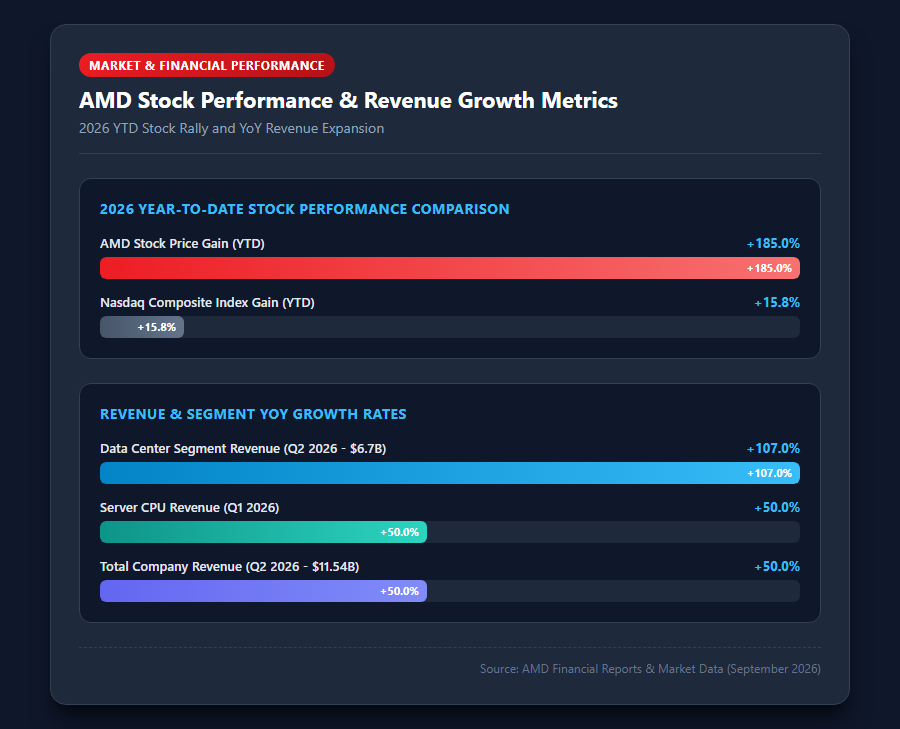
AMD’s stock has surged approximately 185% year-to-date in 2026, significantly outperforming the Nasdaq Composite’s 15.8% gain over the same period. The stock gained nearly 24% in the last five trading days alone, reflecting rapidly escalating growth expectations in equity markets. Key drivers and market catalysts include:
-
Rapidly expanding demand for artificial intelligence (AI) data center chips
-
AMD’s swift emergence as the primary contender to NVIDIA’s dominant market position
-
Accelerating adoption of next-generation AI processors by major hyperscalers
While NVIDIA historically maintained a virtual monopoly over the AI accelerator market, AMD’s aggressive entry and rapid technological iteration are initiating a structural shift in the industry landscape. Please refer to the figure below.
Robust Earnings Growth and Financial Metrics Supporting the Rally
Behind the stock surge lies concrete, rapidly improving financial performance rather than mere market sentiment. According to AMD’s Q2 2026 earnings report, total revenue grew 50% year-over-year to \$11.54 billion, topping Wall Street expectations. Growth was overwhelmingly led by the Data Center segment, where revenue rocketed 107% year-over-year to \$6.7 billion, now accounting for nearly 58% of total revenue.
This expansion trend became strikingly clear in Q1 2026. In the first quarter of 2026 (Jan–Mar), AMD’s data center revenue reached \$5.775 billion, surpassing long-time rival Intel’s \$5.1 billion for the first time in history. According to data from Mercury Research, AMD held a 33.2% unit share of the x86 server CPU market in Q1 2026, while capturing a 46.2% revenue share. This disparity underscores strong preference among major cloud providers and enterprise data centers for AMD’s high-margin, premium EPYC processors.
To solidify its balance sheet and support this rapid expansion, AMD issued \$4.75 billion in senior unsecured notes in August 2026. The proceeds are allocated to securing critical inventory—including substrate components, memory, and rack-scale integration materials—and funding capital expenditures required to fulfill surging customer orders.
Evolution of AI Infrastructure and Dual-Front Technical Strategy
Overtaking Intel in Server CPUs Driven by Agentic AI Demand
A pivotal technological tailwind fueling AMD’s rise is the revaluation of server CPUs driven by shifts in AI workloads. While GPUs have historically stolen the spotlight as the workhorses of AI training and inference, the widespread proliferation of “agentic AI”—which autonomously executes sequential, multi-step workflows—has made general-purpose CPU computing indispensable for orchestration, database lookups, and tool execution.
At an investor conference in June 2026, AMD executives highlighted how the evolution toward agentic AI is accelerating demand for server CPUs. Following a 50%+ year-over-year increase in server CPU sales in Q1 2026, AMD projects server CPU growth to top 70% in Q2. Chief Financial Officer Jean Hu noted that roughly two-thirds of this revenue expansion reflects pure unit volume growth rather than price increases, indicating sustainable, real-world demand.
Consequently, AMD doubled its projected total addressable market (TAM) for server CPUs through 2030 from \$60 billion to over \$120 billion. CEO Lisa Su substantially raised the company’s expected compound annual growth rate from 18% to over 35%. The latest 6th-generation EPYC “Venice” processors have demonstrated superior compute performance in head-to-head benchmarks against rival CPUs.
ROCm 7 and Helios: Building an Open AI Ecosystem
Historically, NVIDIA’s most formidable moat in the semiconductor market lay in its proprietary software stack centered on CUDA. To counter this, AMD has invested heavily in developing “ROCm” (Radeon Open Compute), a 100% open-source GPU programming platform, to cultivate a robust software ecosystem.
The launch of ROCm 7 in September 2025 enabled stable, multi-rack distributed inference and seamless operation across massive GPU clusters. Major open-source AI frameworks—including PyTorch, JAX, vLLM, and SGLang—have natively integrated AMD GPU support directly into their core code repositories with automated continuous testing. Furthermore, ROCm delivers “Day 0 support” for over 2.8 million popular models hosted on Hugging Face on the day of their release. Please refer to the figure below.
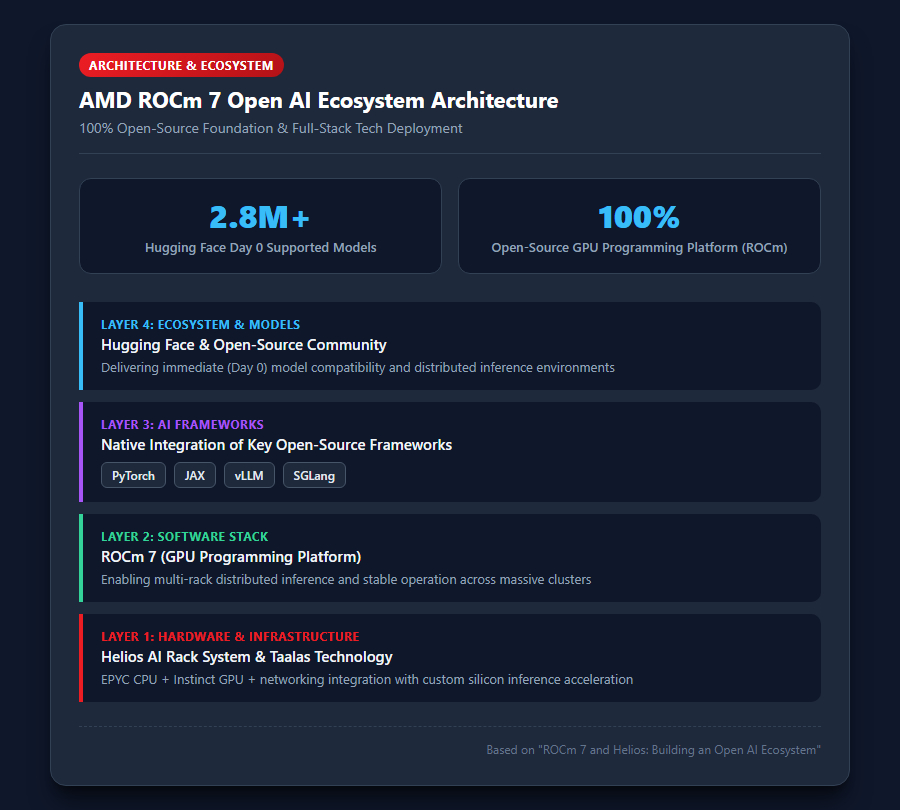
On the hardware front, AMD is deploying “Helios,” a turnkey AI rack system that tightly integrates CPUs, GPUs, and high-speed networking. Additionally, to capitalize on the booming AI inference market, AMD agreed to acquire Taalas, a startup specializing in hardwiring model weights directly onto custom silicon, accelerating its technology stack toward faster, more power-efficient inference execution.
Strategic Partnerships with Tech Giants and Future Outlook
Mega-Deals with Anthropic and Meta via Innovative Warrant Structures
The primary commercial catalyst pushing AMD past the \$1 trillion mark is a series of multi-gigawatt agreements with premier AI labs and tech giants. AI startup Anthropic signed a long-term supply agreement securing 2 gigawatts (GW) of capacity for AMD’s next-generation “MI450” AI GPUs. This massive order substantially validates CEO Lisa Su’s guidance predicting a doubling of data center revenues by 2027.
Equally transformative is AMD’s novel commercial structuring using performance-linked equity warrants. AMD granted performance warrants for up to 160 million shares at an exercise price of \$0.01 per share to OpenAI in October 2025 and to Meta Platforms in February 2026. The vesting of these warrants is tied not only to Instinct GPU purchasing thresholds (up to 6 GW), but the final tranche requires AMD’s stock price to hit \$600 per share.
This mutually reinforcing incentive structure aligns major customers directly with AMD’s equity valuation, giving Meta and OpenAI compelling financial motives to drive AMD’s stock above \$600 through massive, sustained hardware orders. Meta has also established a multi-generational supply agreement pairing 6th-generation EPYC “Venice” CPUs with MI450 GPUs to diversify its core compute infrastructure.
Outlook, Critical Milestones, and Semiconductor Industry Risks
While crossing \$1 trillion represents a landmark achievement, AMD faces critical execution milestones and structural headwinds in sustaining its momentum. Markets are keenly watching the commercial volume rollout of the MI450 series beginning in the second half of 2026, as well as progress toward doubling data center revenues by 2027. Technologically, successful deployment of 72-port direct attach copper (DAC) interconnects on the “MI455X” in 2026 and 256-port co-packaged optics (CPO) on the “MI500X” in 2027 will be vital.
At the same time, investors must weigh several key operational risks. First, U.S. government export restrictions on advanced semiconductors remain an ongoing variable; AMD previously incurred roughly \$800 million in inventory charges due to regulatory restrictions on the “MI308.” Second, supply chain concentration presents a vulnerability, as AMD relies almost entirely on TSMC for leading-edge silicon manufacturing. Third, price volatility in High Bandwidth Memory (HBM) and DRAM could put pressure on gross margins.
Industry analysts project the global AI chip market to grow at a 22% CAGR from 2027 to 2032, with global investments in data center infrastructure expected to exceed \$6.7 trillion by 2030. With NVIDIA currently holding over 70% of the market, AMD’s ability to expand its AI accelerator market share from approximately 13% today to 20–25% will be the ultimate test of whether it can maintain and expand its \$1 trillion valuation.
Reference Pages
-
[AMD IR Press Release] https://ir.amd.com/news-events/press-releases/detail/1296/amd-acquires-taalas-to-advance-compute-solutions-for-rapidly-growing-ai-inference-market
-
[AMD ROCm GitHub Repository] https://github.com/ROCm/ROCm

コメント