On September 15, 2026, Japan’s Ministry of Land, Infrastructure, Transport and Tourism (MLIT) released the 2026 prefectural land prices, showing a 1.5% average year-on-year increase across all land uses nationwide, marking the fifth consecutive year of growth. While a moderate economic recovery and robust inbound tourism demand continue to support land values, a clear polarization across regions and property types, along with structural shifts in growth drivers, has become increasingly evident.
- Overall Picture of the 1.5% National Average Increase and Key Regional Trends
- Property-Type Insights: Key Features of Residential and Commercial Land
- Industrial Land Growth Led by Industrial Infrastructure and Semiconductor Mega-Projects
- Tourism Recovery and Accelerating Market Selectivity in Regional Cities
- Rising Interest Rates, Escalating Construction Costs, and Geopolitical Risks
- Government Policy Responses and Key Real Estate Market Trends to Watch
Overall Picture of the 1.5% National Average Increase and Key Regional Trends
On September 15, 2026, the Ministry of Land, Infrastructure, Transport and Tourism (MLIT) published the prefectural land prices as of July 1, 2026. The national average growth rate across all land uses, including residential and commercial zones, rose by 1.5% year-on-year, maintaining positive growth for the fifth straight year. The land price trends in 2026 reflect sustained, robust demand for real estate amid Japan’s moderate economic recovery.
A closer look at regional performance reveals that the average for all property types in the three major metropolitan areas—Tokyo, Osaka, and Nagoya—grew by 4.4% year-on-year, expanding its growth margin by 0.1 percentage points from 4.3% in the previous year. The Tokyo and Osaka metropolitan areas in particular served as powerful growth engines, propelled by vigorous central redevelopment demand and strong residential interest in highly accessible locations.
On the other hand, regional disparities are becoming more pronounced. Within the three main metropolitan areas, the Nagoya area recorded a 1.9% increase in residential land and a 3.3% increase in commercial land; while positive growth was maintained, the pace of growth slowed compared to the previous year. Meanwhile, non-metropolitan regional areas grew by a modest 0.4% across all land uses, unchanged from the previous year. Furthermore, the four major regional cities—Sapporo, Sendai, Hiroshima, and Fukuoka—also saw a deceleration in overall growth, signalling a transition from broad-based nationwide increases to a phase of localized market selectivity.
Property-Type Insights: Key Features of Residential and Commercial Land
By land use, the national average for residential property rose by 1.0% year-on-year, holding steady at the same growth rate as the previous year. Demand for condominiums in urban centers remains exceptionally strong, driving sustained land price surges in highly convenient areas such as Tokyo’s 23 wards and central Osaka. Additionally, suburban cities featuring a favorable balance between transit access and living environments, as well as municipalities offering robust child-rearing support policies, have experienced steady housing demand backed by net population inflows.
The national average for commercial land grew by 2.9% year-on-year, expanding its upward margin by 0.1 percentage points from 2.8% in the previous year. Driven by the rapid rebound in inbound tourism and rising overseas visitor counts, demand for retail space and hotel development sites in major urban centers and popular tourist destinations has surged dramatically.
The office market also displayed positive signs, with declining vacancy rates and rising rent trends, enhancing property profitability and further bolstering commercial land values. Moreover, areas undergoing large-scale urban redevelopment are benefiting from a virtuous cycle, where high expectations for future vitality and improved infrastructure continue to push land prices upward.
Structural Shift in Land Price Drivers and Regional Polarization
Industrial Land Growth Led by Industrial Infrastructure and Semiconductor Mega-Projects
A particularly prominent feature of this year’s land price report is the performance of industrial land. In addition to expanding e-commerce market demand for large logistics facilities, the establishment and operation of mega semiconductor manufacturing plants are fundamentally reshaping regional land price structures.
In Chitose, Hokkaido, home to Rapidus’s cutting-edge semiconductor plant, and Kikuyo, Kumamoto Prefecture, where Taiwan Semiconductor Manufacturing Company (TSMC) established its facility, demand for corporate offices, supply-chain factories, and employee housing surged rapidly. However, the 2026 survey reveals emerging signs of shift. As residential prices and construction costs escalated in Chitose and Kikuyo, land value growth for residential and commercial zones moderated compared to the previous year, causing housing demand to spill over into surrounding municipalities offering greater affordability.
Please refer to the diagram below.
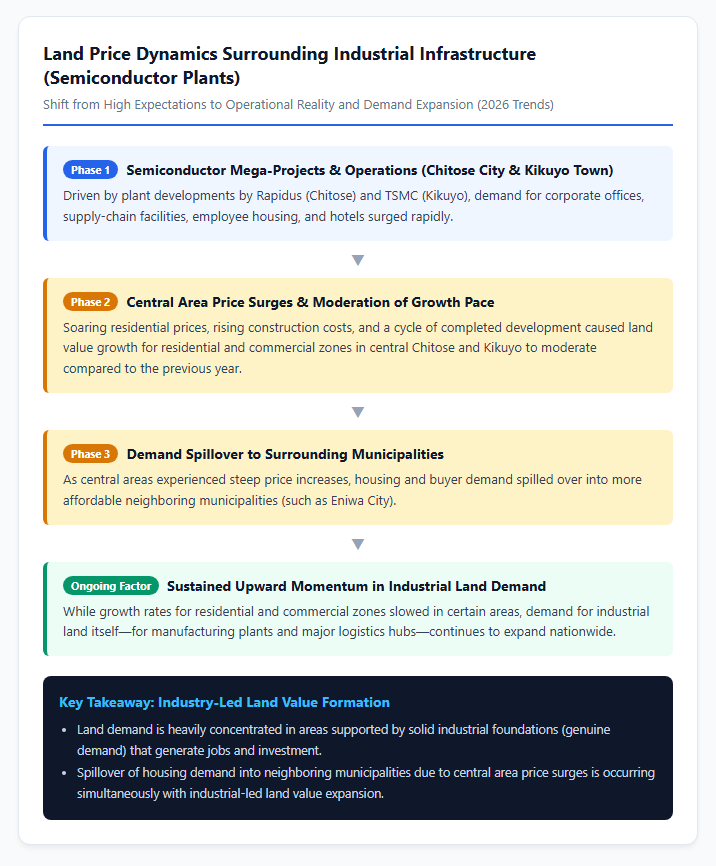
Meanwhile, demand for industrial land itself—both for plant sites and logistics hubs—remains robust, with growth rates for industrial properties continuing an upward trajectory across the country. This highlights a clear trend of industry-led land price formation, where industrial investment generates jobs, which subsequently drives residential and commercial demand.
Tourism Recovery and Accelerating Market Selectivity in Regional Cities
Land price gains in tourist destinations and resort areas vividly illustrate a structural shift driven by genuine end-user demand. A prime example is Hakuba Village in Nagano Prefecture, where a full recovery in inbound travel and record foreign visitor numbers sparked a surge in demand for vacation homes, condominiums, and staff housing, resulting in one of the highest land price growth rates in the nation.
Conversely, key regional hubs and the four major regional cities—which previously recorded steep gains—are showing visible signs of deceleration due to soaring housing prices and a cycle of completed development projects. The phase where land prices rose indiscriminately across entire districts without clear demand drivers is coming to an end.
The market is entering an era of heightened selectivity, where price appreciation will be confined to locations supported either by solid industrial foundations that create jobs or by distinct advantages in capturing end-user consumer demand, such as tourism. In the real estate market, evaluating specific location attributes and verifying genuine demand have become more critical than ever.
Real Estate Market Risk Factors and Future Outlook
Rising Interest Rates, Escalating Construction Costs, and Geopolitical Risks
Forecasting future land price trends requires careful analysis of monetary policy shifts and external risk factors. Following policy interest rate hikes by the Bank of Japan, commercial banks have begun raising mortgage rates in 2026, directly impacting buyers’ financial planning and purchasing power.
Furthermore, prolonged escalation in construction costs—driven by global inflation, rising labor expenses, and elevated raw material prices—has forced an increasing number of developers to revise redevelopment projects or scale back new residential supply.
Please refer to the diagram below.
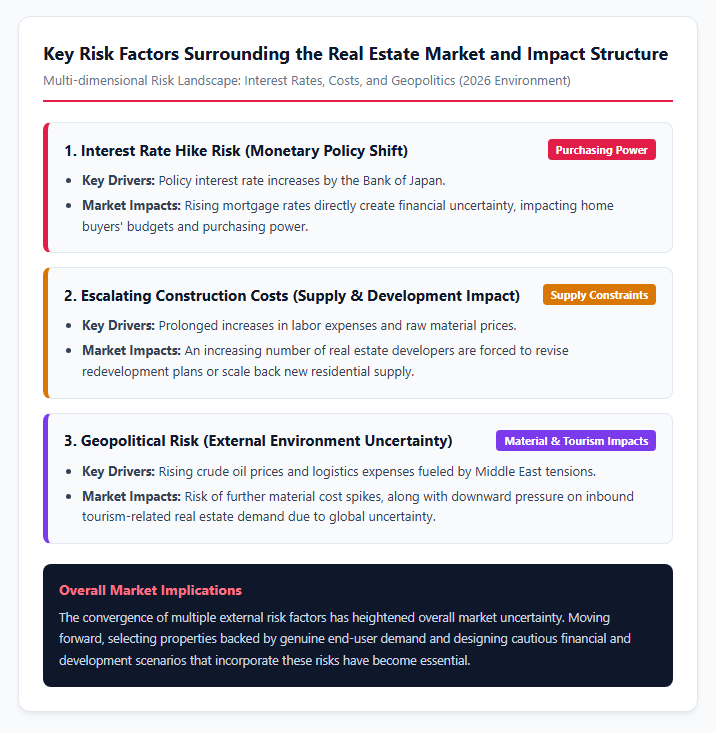
Additionally, geopolitical risks, such as heightened tensions in the Middle East, raise concerns over potential spikes in raw material costs driven by higher crude oil prices and elevated logistics expenses. Global economic uncertainty and prospective disruptions to travel demand could also exert downward pressure on inbound tourism-related real estate demand, which has been a key growth driver.
Government Policy Responses and Key Real Estate Market Trends to Watch
In response to these changing market conditions, the government and relevant ministries are implementing various policy measures. In the 2026 tax reform, measures were introduced to expand the mortgage tax deduction for existing (pre-owned) homes—including extending the maximum deduction period and raising borrowing limits—aimed at supporting home buyers and encouraging the utilization of existing housing stock.
Moreover, to curb non-end-user speculative trading and rapid flipping—concerns particularly associated with large-scale urban condominiums—authorities and industry bodies are evaluating stricter regulations and tax measures to ensure market health. In regional areas, policymakers are exploring measures aligned with local economic realities, such as proposals to extend tax burden adjustment measures to mitigate sharp increases in property taxes.
The publication of the 2026 prefectural land prices signals more than just a continuation of price increases; it marks a transition into a new phase defined by shifting interest rate environments and evolving demand structures. Moving forward, closely monitoring interest rate trends and international developments while identifying high-value property backed by genuine end-user demand will be the cornerstone of successful real estate strategy.
References
- [Overview of the 2026 Land Price Appraisal – Ministry of Land, Infrastructure, Transport and Tourism] https://www.mlit.go.jp/totikensangyo/content/001979232.pdf
【#PrefecturalLandPrices #MLIT #RealEstateMarket #LandPriceTrends #Mortgage #RisingInterestRates #InboundTourism】


コメント