Huawei has unveiled an upgraded version of its “Stellar AI Fabric” networking solution for AI data centers, addressing the steep surge in daily token consumption driven by the rise of AI agents and the urgent need to curb infrastructure communication costs.
- Soaring Token Consumption: The 260x Annual Surge and AI Data Center Challenges
- The Complete Picture of Stellar AI Fabric 2.0 Next-Generation Network Architecture
- Next-Gen Switches Driving a 30% Cost Cut and 11-Microsecond Latency
- 40% Power Reduction and Automated Fault Analysis via AI Agents
- Operational Milestones in Finance and Research with Enhanced Security
- Structural Shifts in the AI Infrastructure Market and Future Focal Points
Soaring Token Consumption: The 260x Annual Surge and AI Data Center Challenges
As artificial intelligence technologies rapidly proliferate through September 2026, global daily token consumption has exploded by approximately 260 times in just a single year. This astronomical surge in computational demand is forcing a fundamental overhaul of traditional data center infrastructure. With the widespread adoption of large language models and autonomous AI agents capable of executing complex tasks, processed data volumes have reached scales far beyond historical projections.
Consequently, data centers are transitioning from simple data repositories into high-throughput computing factories designed to generate tokens efficiently. However, conventional network architectures encounter severe communication bottlenecks when scaling to massive compute clusters, significantly undermining the utilization efficiency of expensive hardware such as GPUs and NPUs. Transmission latency, packet loss, and link flapping with subsequent retransmissions remain primary catalysts for cluster-wide performance degradation and downtime.
Against this backdrop, maximizing compute resource yield while maintaining a stable production network has emerged as a paramount competitive imperative. Organizations face immense pressure to transition toward next-generation network architectures that drastically reduce latency and increase throughput while curbing skyrocketing infrastructure deployment costs and power consumption.
The Complete Picture of Stellar AI Fabric 2.0 Next-Generation Network Architecture
In September 2026, Huawei officially announced an upgraded version of its comprehensive Stellar AI Network solution at its annual flagship event, HUAWEI CONNECT 2026, in Shanghai. This holistic solution spans three core domains: Stellar AI Fabric 2.0 for intra-data center interconnects, Stellar AI WAN for inter-site connectivity, and Stellar AI Campus for enterprise and campus environments.
The following diagram illustrates the fundamental architecture of the network fabric within AI data centers.
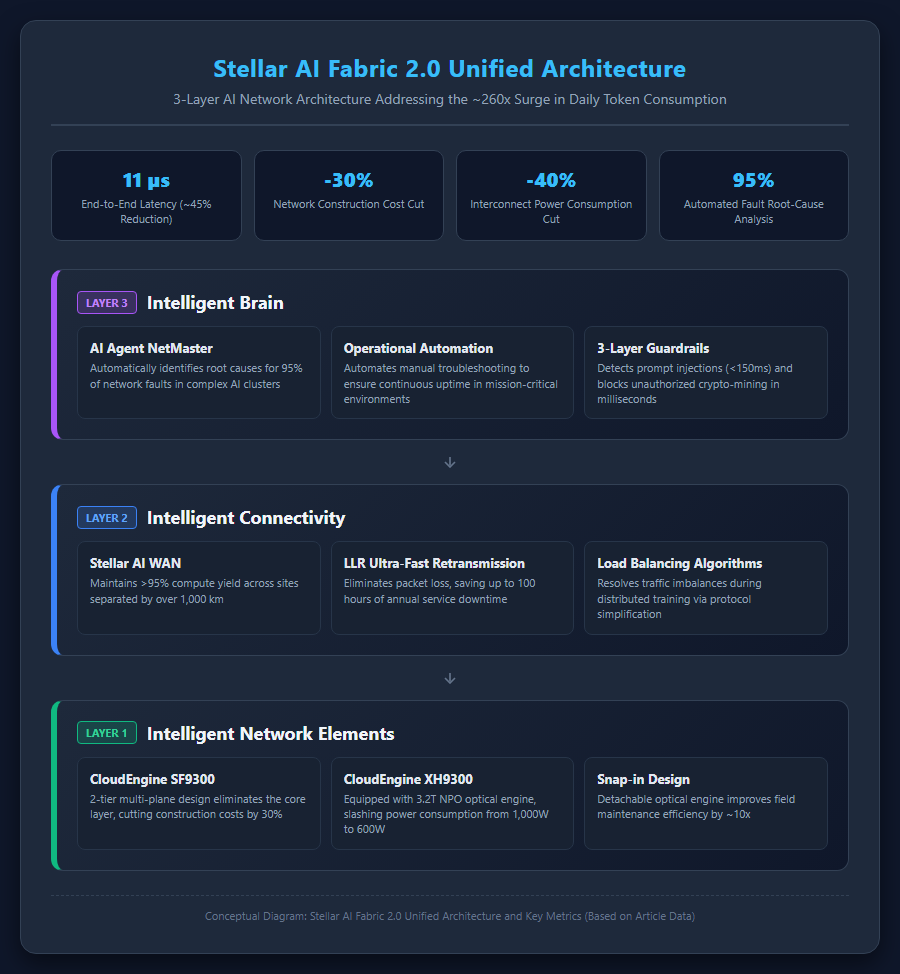
Stellar AI Fabric 2.0 is engineered upon a unified three-layer architecture: Intelligent Brain, Intelligent Connectivity, and Intelligent Network Elements. This design eliminates complex protocol conversions and traffic imbalances inherent in legacy networks, dramatically improving overall cluster compute yield. Furthermore, it offers the architectural flexibility required for distributed AI computing grids spanning distances of over 1,000 kilometers beyond single-site data centers.
Hardware Breakthroughs and Economic Impact of Automated Operations
Next-Gen Switches Driving a 30% Cost Cut and 11-Microsecond Latency
At the hardware core of Stellar AI Fabric 2.0 lies the newly developed “CloudEngine SF9300” series of UBG switches. Optimized for seamless integration with Huawei’s Ascend A5/A6 AI processors, these switches adopt a streamlined two-tier multi-plane architecture. By eliminating the traditional core layer, the architecture reduces network construction costs by approximately 30%.
Through protocol consolidation and simplification, end-to-end transmission latency has been cut nearly in half, dropping by 45% from 20 microseconds down to 11 microseconds. Additionally, the integration of Link-Layer Retransmission (LLR) technology eliminates packet loss caused by link flapping, successfully preventing up to 100 hours of annual cluster service downtime in large-scale deployments.
The diagram below details the mechanics of latency reduction and cost containment enabled by the two-tier switch architecture.
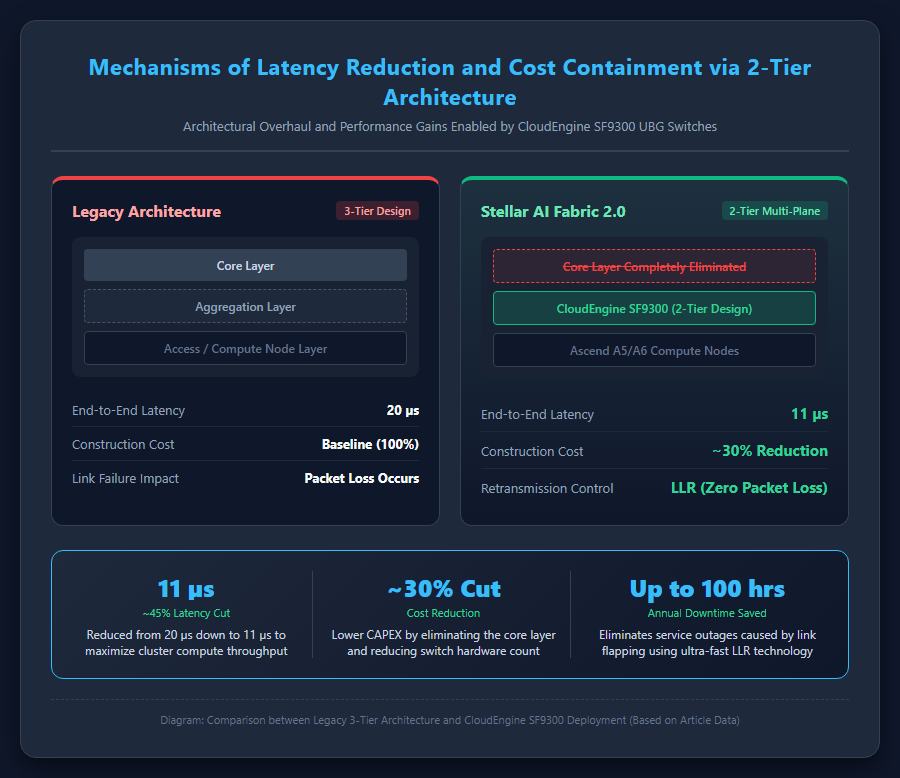
By significantly lowering upfront capital expenditure while maximizing compute throughput during AI training and inference, the SF9300 series delivers a groundbreaking hardware foundation for modern data centers.
40% Power Reduction and Automated Fault Analysis via AI Agents
Significant technological strides have also been achieved in energy efficiency and operational maintenance. Huawei’s self-developed NPO (Near-Packaged Optics) switch series, the “CloudEngine XH9300,” features a centralized light source design and a proprietary 3.2T optical engine. This innovation slashes interconnect power consumption from 1,000W down to 600W per module—a 40% reduction that substantially lowers ongoing data center operating costs. By bypassing optical DSP stages, transmission latency is further reduced by 26%.
Moreover, a snap-in detachable optical engine mechanism reduces field maintenance and module replacement times from days to mere hours, boosting operational efficiency tenfold. On the network management side, the integrated AI agent “NetMaster” plays a central role. NetMaster automatically analyzes and identifies the root cause of 95% of network faults in complex AI clusters within minutes.
By liberating operations teams from manual troubleshooting, NetMaster drastically improves continuous uptime in mission-critical production environments. The seamless convergence of advanced hardware and intelligent software ensures highly reliable, high-efficiency performance for next-generation AI data centers.
Industry Applications and Strategic Outlook
Operational Milestones in Finance and Research with Enhanced Security
The Stellar AI Fabric solution is already demonstrating tangible results across diverse industrial sectors. In the financial domain, 18 prominent enterprises and institutions—including the Beijing FinTech Industry Alliance and Huawei—co-authored and published the “Financial Data Center Network High Availability Technical Specification.” This benchmark defines strict guidelines for redundancy and disaster recovery, offering a secure blueprint for AI infrastructure adoption in banking and finance.
On the scientific research front, the Institute of High Energy Physics (IHEP) at the Chinese Academy of Sciences deployed Stellar AI Fabric, improving computational workload processing efficiency by over 10%. Network-wide load balancing algorithms resolve traffic imbalances during distributed training runs, significantly accelerating the analysis of massive telemetry datasets.
From a cybersecurity standpoint, the framework integrates a comprehensive three-layer defense system featuring Network, Agent, and Host Guardrails. The system blocks unauthorized crypto-mining traffic in milliseconds with 95% accuracy and detects prompt injection attacks in under 150 milliseconds with 95% precision. During initial real-world deployments, the guardrails identified 415 high-risk vulnerabilities and 322 threat events within the first seven days, establishing a highly resilient environment for token production.
Structural Shifts in the AI Infrastructure Market and Future Focal Points
With enterprise AI agent adoption projected to hit nearly 50% by the end of 2026, network infrastructure performance has become a decisive factor in driving digital transformation and computational productivity. Through the Stellar AI WAN solution, organizations can now maintain over 95% compute yield across sites separated by over 1,000 kilometers, making cross-regional compute pooling an operational reality.
In terms of broader market dynamics, end-to-end solution providers like Huawei are expanding their footprint against traditional semiconductor and infrastructure incumbents. The ability to offer a vertically integrated stack—spanning AI processors, optical interconnects, network switches, and management software—presents a compelling value proposition for major operators prioritizing cost control and energy efficiency.
Looking ahead, deployment of AI data centers is expected to accelerate rapidly beyond finance and research into manufacturing, logistics, and broader enterprise sectors. As standardized high-availability frameworks take root, global competition will intensify around building resilient, ultra-low-latency, and highly secure infrastructure capable of powering the next era of intelligent computing.
Reference Pages
- 【Huawei Official Press Release】https://e.huawei.com/jp/news/2026/solutions/enterprise-network/xinghe-intelligent-data-center-network
- 【Kyodo News PR Wire Release】https://kyodonewsprwire.jp/release/202609226370
【#Huawei #StellarAIFabric #AIDataCenter #NetworkSwitch #EnergyEfficiency #DigitalTransformation】
コメント