Polygon is accelerating the development and deployment of dedicated payment channels and protocols optimized for automated transactions and commerce between AI agents. This momentum is driven by the rapid expansion of a machine economy where autonomous AI agents instantly buy and sell services and resources, necessitating ultra-fast, low-cost payment rails that legacy human-oriented payment systems cannot support.
- The Full Scope of Polygon’s AI Agent Payment Rails
- Limitations and Structural Challenges of Legacy Human-Centric Payment Systems
- Technical Foundation Enabling High-Speed Finality and Low Costs
- Integration with Mastercard’s “Agent Pay for Machines” and x402 Synergy
- Business Transformation Driven by Machine-to-Machine (M2M) Commerce
- Challenges and Prospects for the Safe Adoption of Autonomous Ecosystems
The Full Scope of Polygon’s AI Agent Payment Rails
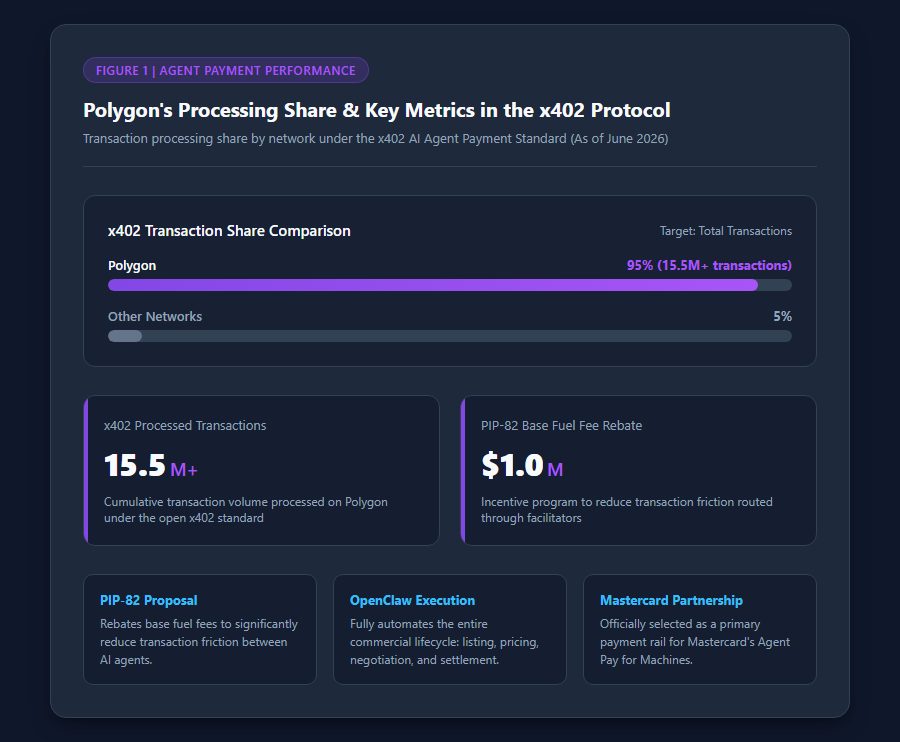
Polygon, an Ethereum Layer 2 scaling solution, is heavily driving the development of payment channels tailored for agentic commerce—where autonomous AI agents conduct commercial transactions without human intervention. Through its PIP-82 proposal, Polygon introduced a mechanism to rebate up to \$1 million in base fuel fees routed through facilitators, dramatically lowering transaction costs between AI agents. Fully automated agent-to-agent transactions are already operational via OpenClaw, automating the entire commercial lifecycle from product listing and pricing to negotiation and settlement. As of June 2026, over 15.5 million transactions—representing 95% of all activity on x402, an open standard enabling AI payments over the HTTP protocol—have been processed on the Polygon network. Please refer to the diagram below.
On the back of these achievements, Polygon was selected as a key partner for Mastercard’s newly unveiled machine payment platform, cementing its position as the de facto standard for machine-to-machine payments in the Web3 space.
Limitations and Structural Challenges of Legacy Human-Centric Payment Systems
Existing internet payment infrastructure has fundamentally been designed for human operation. Credit cards, bank transfers, and major payment gateways rely on government-issued ID verification, manual approval steps, and business-hour restrictions—all of which pose severe bottlenecks for autonomous AI operating 24/7 on a millisecond scale. The mismatch in fee structures is particularly critical. Conventional payment services incur a fixed fee of around \$0.30 per transaction. Paying a \$0.10 API fee 1,000 times would result in \$300 in transaction fees on just \$100 worth of transferred value, rendering microtransactions economically unviable. Furthermore, bank transfer settlements take anywhere from one to five business days, falling far behind the workflow speed of AI agents that require instant confirmation before executing subsequent tasks. Overcoming these structural hurdles required dedicated, programmatically controllable payment rails.
Technical Architecture and Mastercard Partnership Structure
Technical Foundation Enabling High-Speed Finality and Low Costs
The primary reason behind Polygon’s overwhelming dominance in AI agent payments lies in its rapid transaction finality and extremely low network fees. Through the Heimdall v2 upgrade, which overhauled the consensus layer, transaction finality was slashed from 1–2 minutes down to approximately 5 seconds. This drastically reduces double-spending and chain reorg risks, creating an environment capable of real-time everyday payments and tokenized asset settlements. Furthermore, the Bhilai hard fork expanded network throughput to over 1,000 TPS while adding support for account abstraction via EIP-7702. By leveraging Polygon’s comprehensive stablecoin framework, Open Money Stack, transactions can be settled at ultra-low fees of under \$0.01 per transaction. Please refer to the diagram below.
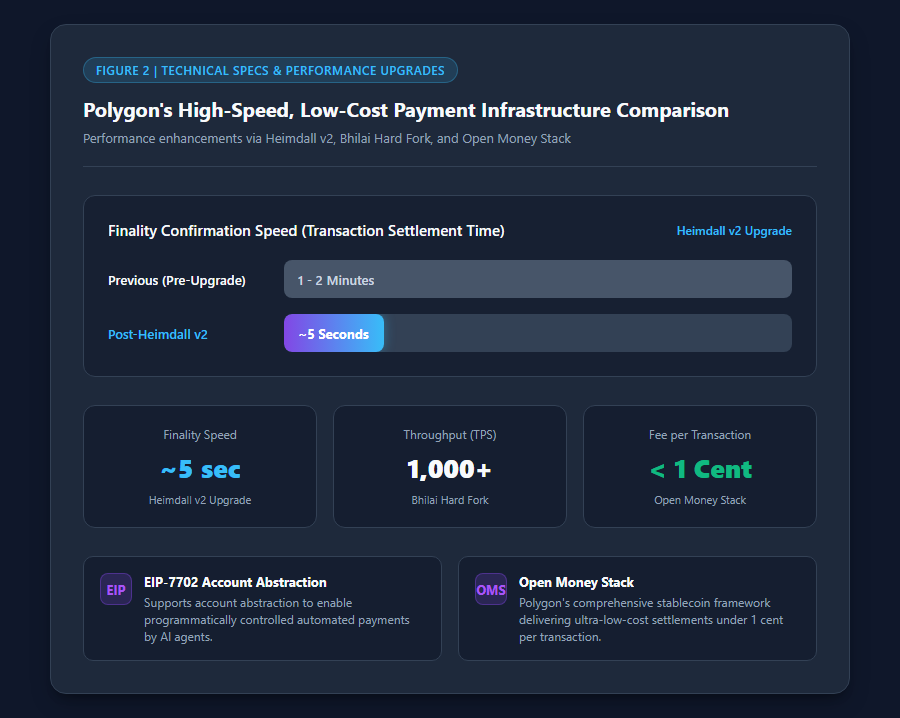
This ultra-low-cost structure makes hundreds of thousands of automated micro-payments economically practical.
Integration with Mastercard’s “Agent Pay for Machines” and x402 Synergy
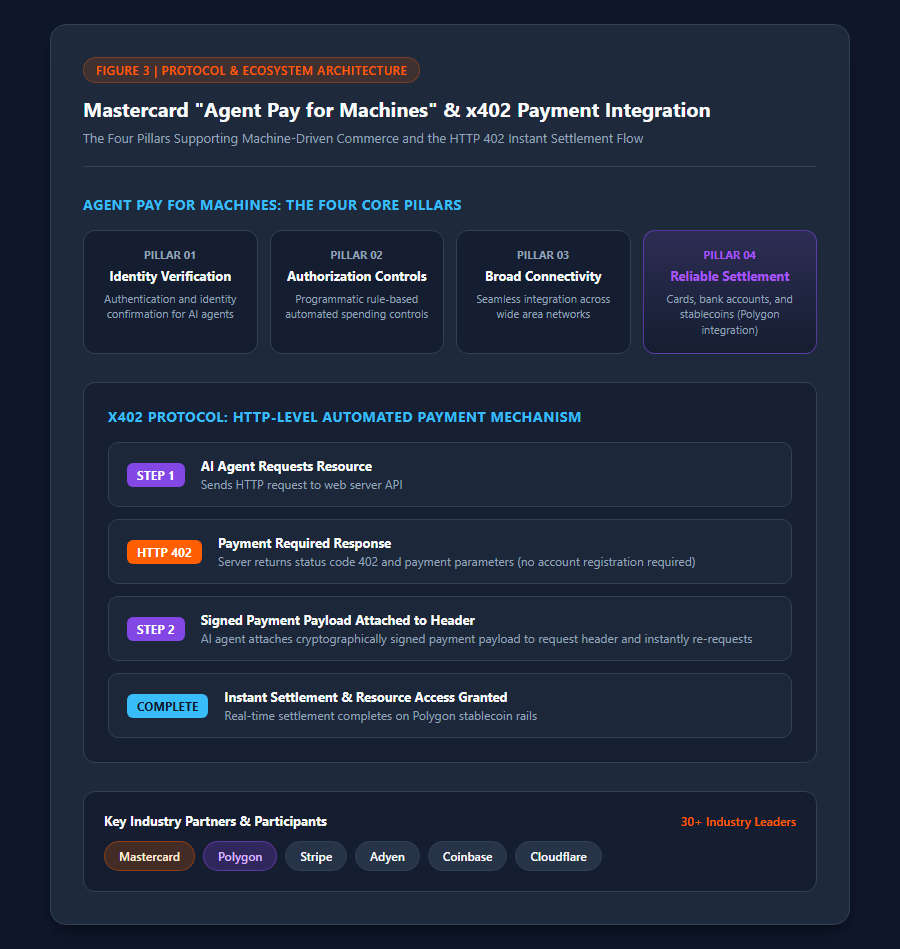
In June 2026, Mastercard unveiled Agent Pay for Machines, a new platform designed for machine-driven commerce, selecting Polygon as an initial partner to provide an open stablecoin payment rail. The framework rests on four core pillars: agent identity verification, programmatic rule-based authorization, broad network connectivity, and reliable settlement across cards, accounts, and stablecoins. Alongside over 30 industry leaders including Adyen, Stripe, Coinbase, and Cloudflare, a resilient machine-to-machine payment ecosystem is taking shape. The technical centerpiece, the x402 protocol, is an open standard that revitalizes the HTTP status code 402 Payment Required—dormant since the HTTP specification was established in 1997. When a web server returns a 402 code, an AI agent can attach cryptographically signed payment payload data directly to the request headers without needing API keys or account registration, granting immediate resource access. Please refer to the diagram below.
Social Impact and Future Outlook of the Machine-Driven Economy
Business Transformation Driven by Machine-to-Machine (M2M) Commerce
The proliferation of payment rails for AI agents has the potential to fundamentally revolutionize monetization models across the digital economy. It enables a shift from traditional ad-supported models and flat monthly subscriptions to granular pay-per-use micropayments—such as \$0.001 per API call or \$0.05 per article view. In real-world business applications, scenarios are coming to life where logistics AI agents automatically handle truck freight payments, loading bay reservations, and sensor telemetry data purchases in tandem with cargo movement, or where startup assistant AIs autonomously purchase domains, hosting contracts, and stock imagery within preset budget constraints. The US agentic commerce market is projected to reach \$261 billion by 2030, with annual stablecoin transaction volumes expected to expand into the tens of trillions of dollars. Human-independent machine-to-machine transactions are rapidly becoming a major engine of economic growth.
Challenges and Prospects for the Safe Adoption of Autonomous Ecosystems
At the same time, granting spending authority to AI agents presents notable technical and regulatory hurdles. Risks include software bugs or misjudgments causing AI agents to get trapped in infinite loops, triggering massive API calls and exorbitant bills, as well as prompt injection attacks leading to unauthorized fund drainages. To counter these vulnerabilities, governance mechanisms are actively being established, including policy-based spending limits, automated kill switches, and cryptographically signed delegation credentials. On the regulatory front, establishing standardized frameworks regarding liability for erroneous AI-driven transactions, as well as AML and KYC compliance, remains an urgent priority. Moving forward, Polygon plans to integrate cross-chain liquidity via Agglayer and introduce single-block instant finality. By providing a secure and scalable infrastructure, Polygon aims to underpin the healthy development of an autonomous machine economy.
References
-
[Mastercard Official Press Release: Agent Pay for Machines] https://www.mastercard.com/global/en/news-and-trends/press/2026/june/mastercard-launches-agent-pay-for-machines.html
-
[Polygon Official Blog: Fast Finality in Heimdall v2 Upgrade] https://polygon.technology/blog/polygon-5-second-fast-finality-upgrade
-
[x402 Protocol Official Documentation] https://docs.cdp.coinbase.com/x402/welcome
[#Polygon #AIAgents #AgenticCommerce #Crypto #Blockchain #Mastercard #x402]
コメント