
On July 10, 2026, the Japanese government officially decided on a revision of the “Second Phase Basic Plan for Artificial Intelligence,” which aims to make the development and implementation of “vertical AI” specialized for specific industries and business domains a pillar of its national strategy. The background to this policy is to fundamentally strengthen industrial competitiveness by leveraging Japan’s strength, on-site data, to compete with US and Chinese companies leading in the field of general-purpose AI.
- Official Decision on the Second Phase Basic Plan for Artificial Intelligence
- Aiming for Concentrated Public-Private Investment and Securing AI Sovereignty
- The value brought by vertical AI that can be used in the workplace
- The Rise of Agent-Based AI Autonomously Performing Tasks
- Promoting AX in major industries such as manufacturing, healthcare, and agriculture
- Strategic AI Utilization to Support Firefighting, Defense, and Disaster Prevention
- Increasing Complexity of Risks and Responsible Agile Governance
- Developing Human Resources and Enhancing Human Capabilities to Support the AI Era
- Outlook toward 2030 and the future of international competitiveness
- A new industrial structure through integration with physical AI
Official Decision on the Second Phase Basic Plan for Artificial Intelligence
On July 10, 2026, the Japanese government held a meeting of the Artificial Intelligence Strategy Headquarters at the Prime Minister’s Office, attended by all ministers, and decided on a revised plan for a new basic plan aimed at promoting AI utilization and ensuring safety. At this meeting, Prime Minister Sanae Takaichi announced the intention to formulate strategies by region and implement concentrated investment by both public and private sectors. The most notable feature of this revision is that it goes a step beyond conventional support for general AI research and development, positioning “Vertical AI (domain-specific AI)” as a strategic focus, enabling Japan to demonstrate international competitiveness.
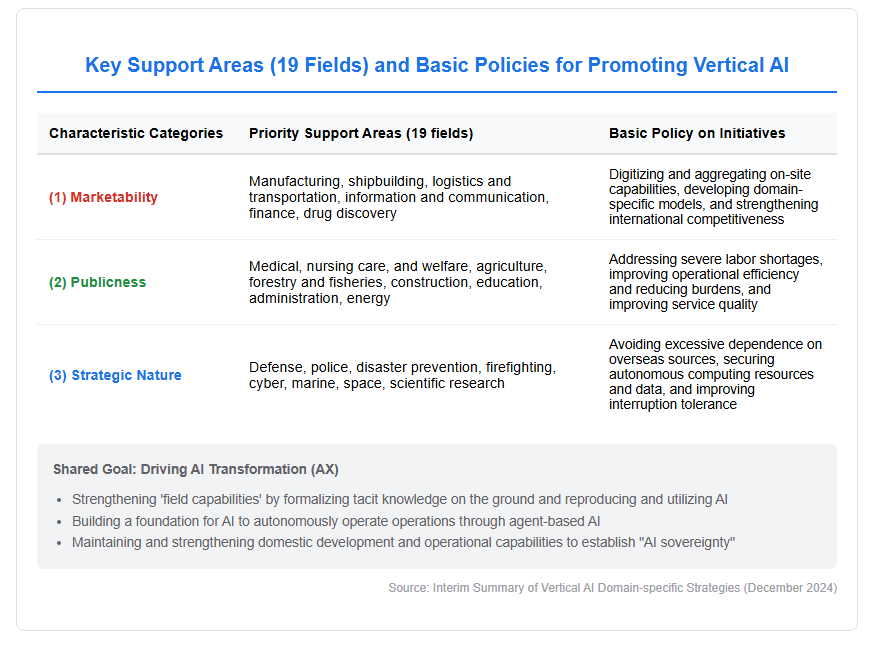
Specifically, 19 priority support areas were established, including manufacturing, healthcare, agriculture, finance, and government, and roadmaps for promoting AX (AI Transformation) were presented in each area. Given that AI is evolving from merely a business support tool into an autonomous entity responsible for decision-making and execution, the government aims to restructure systems and policies based on AI-based premise. Please refer to the diagram below.
Aiming for Concentrated Public-Private Investment and Securing AI Sovereignty
The government’s focus on vertical AI is driven by a strong sense of crisis regarding economic security. Currently, many cloud and foundational models are oligopolized by overseas companies, and excessive dependence on overseas markets carries the risk of data leakage abroad and the expansion of digital deficits. Maintaining the capability to develop and operate Japan’s unique vertical AI for field data domestically is considered an essential step to ensure strategic autonomy and indispensability, and to establish open “AI sovereignty.”
The domestic market size for vertical AI is projected to reach about 3 trillion yen by 2030, and by intensively investing limited public and private resources, the company is poised to take the lead in this growth market. By actively generating initial demand through government procurement and institutional reforms, and building an ecosystem that induces private investment, the strategy aims to grow Japan into one of the world’s leading hubs for vertical AI.
The Core of Next-Generation AI: ‘Vertical’ and ‘Agent’
The value brought by vertical AI that can be used in the workplace
Vertical AI refers to a system specialized for specific industries or job types, vertically integrating domain-specific data, AI models, and applications. Unlike conventional general-purpose AI (horizontal AI), which provides “common functions usable in any industry,” vertical AI is optimized by delving into the unique workflows, business practices, regulations, and data structures of each industry, which is a major difference.
In Japanese manufacturing sites, there is a wealth of ‘tacit knowledge’ that has not yet been put into words, such as the experience and intuition of skilled workers. Vertical AI enables highly specialized decision-making and work support by accumulating and learning from such on-site data, becoming truly “AI that can be used in the field.” As seen in the case where Canary Inc. raised about 4 billion yen in December 2025 to evolve into a real estate-specialized AI, the private sector is also accelerating its shift to vertically integrated business models.
The Rise of Agent-Based AI Autonomously Performing Tasks
Alongside vertical AI, “Agentic AI” is being emphasized in this revised basic plan. Agent-type AI refers to AI that can autonomously complete tasks through to the end by independently planning according to user instructions and using multiple tools. Unlike traditional generative AI that only responded in a question-and-answer format, AI agents independently organize and repeatedly execute the steps to achieve their goals.
Gartner predicts that by 2026, 40% of enterprise apps will be equipped with task-specific AI agents, and SaaS (Software as a Service) is transforming from “tools operated by people” to “entities that handle the business itself.” The Japanese government positions this agent-based AI as a foundation for autonomously operating in a wide range of fields, including industry and security, and is aiming to lead structural reforms in administrative operations through integration into government AI “Gennai.”
Priority Support Areas and Specific Measures in 19 Fields
Promoting AX in major industries such as manufacturing, healthcare, and agriculture
Among the 19 priority areas designated by the government, the manufacturing sector, which is considered highly marketable, urgently addresses challenges such as declining skilled workers and aging legacy equipment, making it urgent to refine on-site data and develop domain-specific models. Aiming for 2030, we plan to develop a “multimodal platform model” that integrates and handles audio, images, sensor data, and more, and to realize AI robotics and autonomous factory control, significantly improving productivity compared to conventional models.
In the medical and nursing care fields, to support sites facing severe labor shortages, standards are being developed to automate physician record-keeping tasks and to enable integration between electronic medical records and AI agents. In the agricultural sector, AI analyzes data obtained from drones and sensors to predict pests and diseases and enable automated operations, aiming to transform into a resilient industrial model that maintains high-quality food supply even as labor is declining.
Strategic AI Utilization to Support Firefighting, Defense, and Disaster Prevention
Even in fields with high public and strategic significance, the implementation of vertical AI is becoming concrete. In the fire protection sector, we aim to roll out an “automatic response and conversation analysis system” nationwide, where AI instantly analyzes the contents of 119 calls to assist in determining urgency, address, and vehicle selection. As of 2026, demonstration studies are underway in some municipalities such as Matsudo City to advance command operations, and nationwide implementation by 2030 has been included in the roadmap.
In the defense domain, we are urgently building systems that utilize AI for command and control, as well as information collection and analysis, enabling swift and accurate decision-making. In particular, through the development of hybrid clouds, we organically link sensitive multi-domain data, building a foundation for AI to support strategic decision-making. In the disaster prevention field, the development of a “disaster victim support AI platform” that proposes optimal evacuation behaviors according to the attributes of victims is underway, aiming to crystallize Japan’s expertise as a disaster-prone country through AI.
Challenges hindering social implementation and frameworks for building trust
Increasing Complexity of Risks and Responsible Agile Governance
As AI becomes more sophisticated, addressing new risks has become an urgent issue. Because AI agents are highly autonomous, they face unique security risks such as “hallucination,” which generates information unbased on facts as if it were true, uncontrollable runaways, and unintended leaks of confidential information. In 2026, OWASP released the “OWASP Top 10 for Agentic Applications,” highlighting major risks such as privilege takeover and tool misuse, sounding the alarm.
The government advocates for “responsible agile governance,” which proactively and continuously reviews the legal system to address these risks. To clarify responsibility for AI-made decisions, the policy is to emphasize the principle of “Human-in-the-loop,” where humans are involved in the final decision, while advancing integrated technical and organizational management measures. Furthermore, to counter the threat of AI being misused in cyberattacks, the high-performance AI-powered defense package “Project YATA-Shield” is being promoted.
Developing Human Resources and Enhancing Human Capabilities to Support the AI Era
To operate vertical AI safely and effectively, securing “AI implementation personnel” who possess both AI mechanisms and domain knowledge of each industry is indispensable, but currently, both the quality and quantity of these are insufficient. The government plans to fundamentally improve citizens’ AI literacy from elementary and secondary education levels, including training for 3,000 teachers and staff during fiscal year 2026.
At the same time, in an era where AI replaces many routine tasks, enhancing “human initiative” such as creativity, critical thinking, and responsibility for judgment is being emphasized. Cultivating the ability not only to master AI tools but also to properly evaluate AI outputs and take control of decision-making is key to realizing a prosperous society where AI and humans collaborate. Through reskilling support, it also includes creating an environment where existing workers can leverage AI to transition to higher value-added tasks.
Future Developments and Highlights
Outlook toward 2030 and the future of international competitiveness
The future focus is on the steady implementation of the government’s roadmap to 2030 and how much private investment can be drawn. The domestic market for vertical AI is expected to grow to about 3 trillion yen, supported by Japan’s strength in on-site data and the strengthening of domestic AI infrastructure (data centers, computing infrastructure, semiconductors) that processes it. The government aims to enhance the academic information network by fiscal year 2028 and increase shared computing resources more than tenfold by fiscal year 2030.
Additionally, deploying successful vertical AI models cultivated domestically overseas is also an important strategy. Through international frameworks such as the Hiroshima AI process, Japan-led AI governance will be spread worldwide, and by exporting Japanese AI systems in collaboration with ASEAN countries and others, we aim to eliminate digital deficits and realize a “strong economy.”
A new industrial structure through integration with physical AI
Looking further ahead, the on-site implementation of vertical AI will accelerate the evolution of “physical AI,” where AI-equipped robots act autonomously in the real world. The multipurpose robot market, including AI robotics, is projected to reach about 60 trillion yen by 2040, and the on-site knowledge accumulated through vertical AI will be directly utilized as intelligence for robots.
The government is promoting a strategy aimed at the early practical implementation of solutions that highly integrate AI as software and robotics technology as hardware, with a vision for deploying 10 million robots by 2040. In every field—manufacturing, logistics, construction, and caregiving—a new social structure where humans and AI robots can work together safely is beginning to begin. The success or failure of this transformation will determine Japan’s future national strength.
[#バーティカルAI #エージェント型AI #第II Basic Plan for Artificial Intelligence #AI主権 #AX #AIガバナンス #フィジカルAI #国家戦略]


コメント