The Bank of Japan raised its policy interest rate to 1.25% at its September 2026 Monetary Policy Meeting, signaling a clear acceleration in the pace of rate hikes. Amid growing upside inflation risks driven by Middle East geopolitical oil shocks and sustained wage gains, market expectations are rapidly emerging that the terminal rate could reach as high as 2.5%.
- Raising the Policy Rate to 1.25% and Accelerating the Tightening Pace
- Shift in Policy Phase and the Rationale Behind the 2.5% Terminal Rate Forecast
- Impact on Corporate Management and Funding Costs Across Sectors
- Environmental Changes in Mortgages, Personal Assets, and the J-REIT Market
- Fiscal Sustainability and Risks of Rising Debt Servicing Costs
- Key Focus Areas and Prospects for Future Rate Hike Scenarios
Raising the Policy Rate to 1.25% and Accelerating the Tightening Pace
At its Monetary Policy Meeting held on September 17–18, 2026, the Bank of Japan decided to raise its target for the uncollateralized overnight call rate by 0.25 percentage points to around 1.25%. Coming just three months after the previous hike in June 2026, this move represents a clear acceleration from the market’s prior expectation of rate increases every six months. The 1.25% policy rate marks the highest level in approximately 31 years, dating back to 1995. The decision was approved by a 7–2 majority vote, with Policy Board members Toichiro Asada and Ayano Sato dissenting in favor of keeping rates unchanged based on current inflation rates and economic trends. In its official statement, the BOJ confirmed that Japan’s economy and price trends are moving generally in line with its projections and that employment and income conditions continue to improve. Furthermore, the central bank maintained its outlook that monetary conditions remain accommodative even after this hike, emphasizing the importance of stabilizing underlying inflation around its 2% target. While the rate hike itself matched market expectations, the shortened interval between hikes left a strong impression on market participants regarding the BOJ’s proactive stance.
The diagram below illustrates the changes in the monetary policy stance decided at the September 2026 meeting.
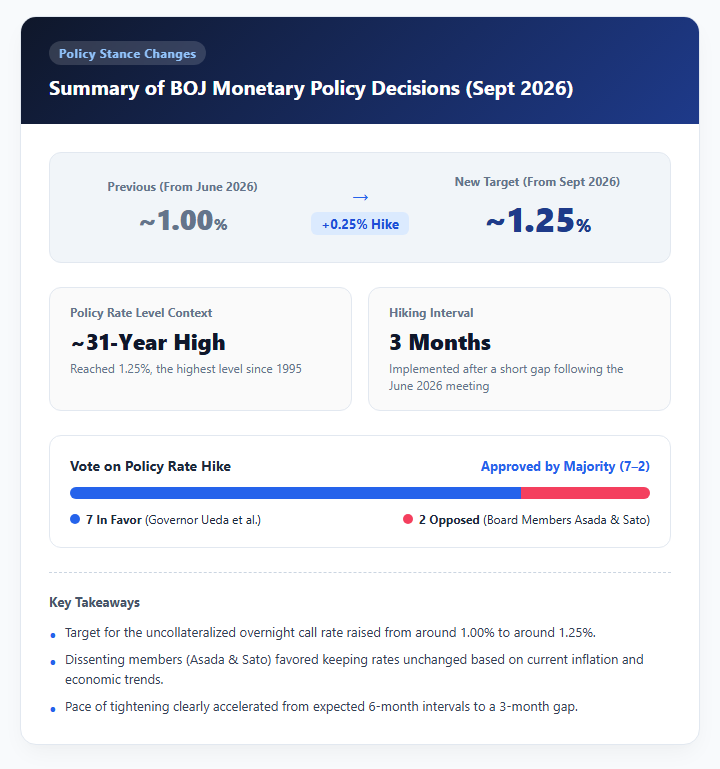
- Target Policy Rate: Raised by 0.25% from around 1.00% to around 1.25%
- Voting Result: 7 in favor, 2 opposed (Dissenting votes by Board Members Asada and Sato)
- Hiking Interval: Implemented after a short 3-month gap following the June 2026 meeting
Shift in Policy Phase and the Rationale Behind the 2.5% Terminal Rate Forecast
During the post-meeting press conference, Governor Kazuo Ueda made a pivotal statement declaring that “the policy phase has changed.” He explained that while the central bank’s primary goal previously focused on boosting underlying inflation toward the 2% threshold, underlying price growth is now approaching 2%, shifting the main objective toward anchoring inflation around 2% to prevent overheating and adverse economic fallout. This shift is driven by the emergence of upside inflation risks, including surging crude oil procurement costs stemming from Middle East tensions, expanding AI-related demand, and persistent yen weakness in foreign exchange markets. Import prices for crude oil have jumped by 70% to 80% compared to levels prior to the escalation, leading some analysts to project that the headline Consumer Price Index (CPI) could exceed 3% from late 2026 through fiscal year 2027. In response to these mounting inflationary pressures, a scenario where the BOJ implements sequential 0.25% hikes every three months has rapidly gained credibility among economists and market strategists. Specifically, forecasts now suggest rates could reach 1.5% in December 2026 and 1.75% by spring 2027, with the terminal policy rate ultimately rising into the 2.5% range.
- Primary Upside Inflation Risks: Rising crude oil procurement costs, sustained high wage hikes, yen depreciation, and expanding AI demand
- Expert Rate Outlook: 1.5% in December 2026, 1.75% by spring 2027, and a terminal rate in the 2.5% range
- Inflation Projections: Nationwide headline CPI potentially exceeding 3% between late 2026 and fiscal year-end
Specific Impacts Across Industry, Financial Markets, and Households
Impact on Corporate Management and Funding Costs Across Sectors
The full-fledged transition into a rising interest rate environment is directly impacting Japanese corporate funding environments and earnings structures. According to a survey conducted by Teikoku Databank covering approximately 168,000 businesses nationwide, if borrowing rates rise by 0.25% following the policy rate hike to 1.25%, the average annual interest payment burden per company will increase by 460,000 yen. This represents an impact equivalent to reducing overall ordinary profits by an average of 1.9%, pushing approximately 2,700 companies (1.6% of surveyed firms) into net recurring deficits. If rate hikes accelerate and borrowing costs increase by 0.50% (corresponding to a policy rate around 1.50%), the annual interest burden will rise by 920,000 yen (a 3.8% drag on ordinary profits); a 1.00% rise would result in an annual burden of 1,858,000 yen (a 7.7% drag), creating a severe scenario where around 10,000 companies fall into the red. Sector-wise, the real estate industry, which carries high levels of interest-bearing debt, faces the most pronounced impact, with a 0.25% rate increase leading to an average annual burden increase of 2.3 million yen per company (a 5.4% drop in ordinary profits). In contrast, the construction sector sees a relatively smaller impact, with an annual increase of 160,000 yen (a 1.4% drop in ordinary profits). On the other hand, rising rates are not entirely negative for all corporate entities; for financial institutions such as banks and insurance firms, higher rates act as a positive factor by widening lending margins and improving investment returns.
- Corporate Impact of a 0.25% Rate Hike: Average annual interest burden increase of 460,000 yen per company, reducing ordinary profits by 1.9%
- Companies Falling into Deficit: Approximately 2,700 firms (1.6%) at a 0.25% hike; roughly 5,500 firms (3.3%) at a 0.50% hike
- Most Affected Sector: Real Estate (average annual burden increase of 2.3 million yen per company, ordinary profits down 5.4%)
Environmental Changes in Mortgages, Personal Assets, and the J-REIT Market
Rising interest rates are bringing significant shifts to household loan repayments, personal asset management, and the real estate investment trust market. In the mortgage market, the short-term prime rate—a key benchmark for variable-rate mortgages—reached 2.375% as of August 2026 and is widely expected to rise further following the September rate hike. While households with variable-rate loans face concerns over higher monthly repayments, fixed borrowing rates for new loans also remain elevated, with Flat 35 rates standing around 3.46%. Conversely, higher interest rates serve as a tailwind for individuals holding cash savings and low-risk assets. Ordinary deposit rates at major banks have been raised to 0.4% per annum, and time deposit products offering rates around 2% have begun to appear. Furthermore, principal-guaranteed Japanese Government Bonds (JGBs) for individual investors offered annual yields of 1.96% for 3-year fixed, 2.24% for 5-year fixed, and 1.95% for 10-year floating (September 2026 issue), ushering in an environment where investors can achieve risk-free yields exceeding 2%. Meanwhile, in the Japanese Real Estate Investment Trust (J-REIT) market, despite concerns over rising funding costs due to higher borrowing rates, distribution yields remain supported by rental income increases that pass through inflation costs alongside a recovery in office demand, leading to a re-evaluation of J-REITs as attractive inflation-hedge assets.
The chart below shows the yield levels of major individual financial assets in a rising rate environment.
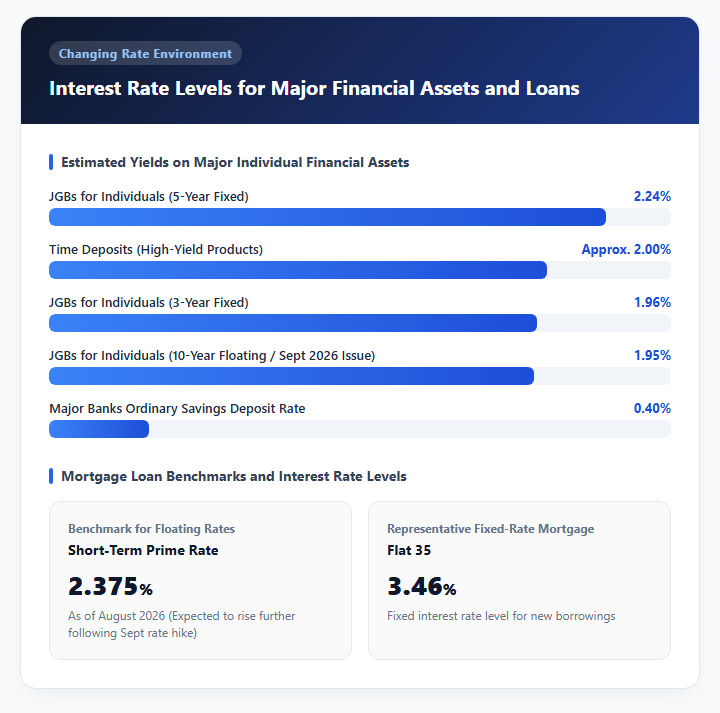
- Mortgage Rate Trends: Short-term prime rate rising beyond 2.375%; Flat 35 exceeding 3.46%
- Yields on Individual Financial Assets: Ordinary deposits at 0.4%, time deposits around 2%, 5-year fixed JGBs for individuals at 2.24%
- J-REIT Market Fundamentals: Higher capital costs offset by rent revisions and increases driven by inflation
Future Monetary Policy Outlook and Challenges for the Japanese Economy
Fiscal Sustainability and Risks of Rising Debt Servicing Costs
With the Bank of Japan accelerating its tightening cycle, concerns regarding Japan’s massive national debt and fiscal sustainability are mounting rapidly. Japan’s gross government debt-to-GDP ratio remains the highest among OECD member nations, and its net debt ratio after deducting financial assets is also exceptionally elevated. Fiscal simulations conducted by institutions such as UBS indicate that assuming nominal GDP growth remains around 2% per year, the debt-to-GDP ratio will gradually decline and improve if the policy rate stays between 1.0% and 1.25%. However, under a risk scenario where the policy rate rises past 1.5% toward 2.0%, debt servicing costs on Japanese government bonds will surge, creating a hazard where the debt-to-GDP ratio diverges upward again into the late 2030s. Because the average maturity of outstanding JGBs is approximately 9 years and 4 months, there is a time lag before higher policy rates fully impact actual government interest expenses. Nevertheless, if high interest rates persist over the medium to long term, they will squeeze fiscal budgets, potentially leading to sovereign credit rating downgrades and eroding fiscal flexibility during future economic crises. Consequently, finding a balance between inflation dynamics, economic growth, government interest burdens, and fiscal discipline is viewed as a paramount challenge in the BOJ’s rate normalization process.
- Japan’s Fiscal Position: Sovereign net debt-to-GDP ratio remains among the highest in the OECD
- Interest Rate Scenarios and Fiscal Forecasts: Debt ratio contracts at policy rates of 1.0%–1.25%, but stabilizes or expands above 1.5%
- Pass-Through Speed to Interest Expenses: Gradual impact over time due to average JGB maturity of 9 years and 4 months
Key Focus Areas and Prospects for Future Rate Hike Scenarios
Market attention is intensely focused on how far the Bank of Japan will ultimately push its policy rate. Governor Ueda has emphasized that the central bank is not adhering to a predetermined timeline for future hikes, stating that “decisions will be made on a meeting-by-meeting basis after assessing economic data, inflation trends, and risk factors.” He has also indicated that the BOJ retains the flexibility to bring hikes forward or implement adjustments larger than 0.25% depending on developments. A primary benchmark for future policy moves will be the sustainability of wage increases during the 2027 Shunto (spring wage negotiations) and their spillover effects on prices. If robust wage gains persist amid solid corporate earnings and labor shortages, confidence in anchoring underlying inflation at 2% will solidify, bolstering the case for further rate increases. On the other hand, political caution regarding rate hikes and coordination with the Takaichi administration’s expansionary fiscal policies remain factors to watch, though alignment between the government and the BOJ is being sought to prevent excessive yen depreciation. Amid ongoing external uncertainties, such as Middle Eastern geopolitical tensions and monetary policy paths in major foreign economies, the central focus for Japan will be whether its economy can successfully adapt to a “world with interest rates” and sustain a long-term growth trajectory.
- Key Upcoming Benchmarks: Wage growth levels in the 2027 spring negotiations; nationwide CPI and underlying inflation trends
- Policy Decision Flexibility: Meeting-by-meeting deliberations with options kept open for larger or faster hikes
- External and Political Factors: Fiscal stance of the Takaichi administration, FX yen trends, Middle East risks, and crude oil prices
References
- [Bank of Japan] Monetary Policy Meeting Decisions and Releases
ホーム : 日本銀行 Bank of Japanwww.boj.or.jp - [Financial Services Agency] Publications on Financial Administration and Systems
金融庁金融庁の公式ウェブサイトです。現在、「金融庁職員」や著名人を装った詐欺等が多発しています。くれぐれもご注意ください。金融庁の組織、報道発表、政策・審議会等、所管法令等に関する情報、広報誌「アクセスFSA」などを掲載しています。www.fsa.go.jp


【#BOJ #PolicyRate #InterestRates #TerminalRate #JapaneseEconomy #Inflation #Mortgages #BankOfJapan】


コメント