As the second reshuffled Takaichi Cabinet officially launches, Eriko Imai has been appointed Senior Vice-Minister of the Cabinet Office as part of the new sub-cabinet lineup. Prime Minister Takaichi aims to ensure policy continuity by retaining key economic ministers while driving administrative restructuring and regulatory reform to adapt to a changing era.
- Key Sub-Cabinet Appointments and the Background Behind Eriko Imai’s Selection
- Maintaining the Core Framework and Prioritizing Pragmatism
- Streamlining Functions, Consolidating Digital & Disaster Management, and Introducing New Roles
- Ishin’s First Cabinet Appointment and Strengthening Coalition Policy Coordination
- Retention of Economic Ministers and Market Reactions Amid Rising Interest Rates
- Funding Tax Cuts vs. Growth Policies: Navigating the Economic Tug-of-War
Key Sub-Cabinet Appointments and the Background Behind Eriko Imai’s Selection
On September 18, 2026, appointments for Senior Vice-Ministers and Parliamentary Vice-Ministers in the second reshuffled Takaichi Cabinet were finalized, completing the new executive lineup of the administration. Notable appointments include House of Councillors member Eriko Imai as Senior Vice-Minister of the Cabinet Office, alongside Akiko Ikuina and Chisato Morishita as Parliamentary Vice-Ministers, drawing widespread attention to the promotion of diverse talent. Imai, who has previously engaged in various party and governmental activities, sparked significant discussion on social media and beyond, stirring both praise and criticism over her promotion. Meanwhile, Prime Minister Sanae Takaichi placed tremendous emphasis on practical competence and policy motivation in finalizing these appointments, even introducing an advance preference questionnaire. Additionally, key young pragmatists known within the ruling party as the “Secretariat Director Trio”—Akihisa Shiozaki (appointed Senior Vice-Minister for Digital Transformation and Senior Vice-Minister of the Cabinet Office), Eikei Suzuki (Senior Vice-Minister for Internal Affairs and Communications and Senior Vice-Minister of the Cabinet Office), and Taku Nemoto (Parliamentary Vice-Minister of the Cabinet Office)—were given prominent roles. The heavy reliance on these young practical policy experts is seen as a strategic move to reinforce the administration’s political foundation while significantly bolstering its execution capabilities. The details of the main appointments are as follows:
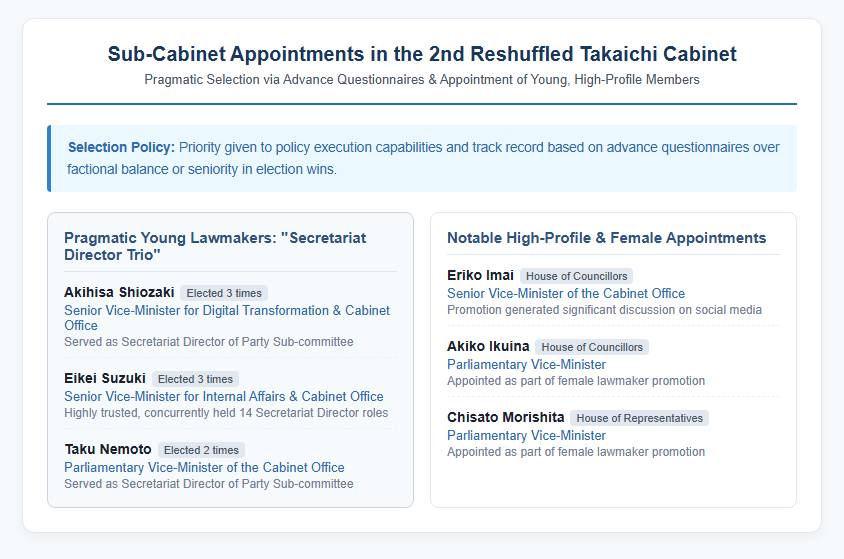
- Eriko Imai: Appointed Senior Vice-Minister of the Cabinet Office
- Akihisa Shiozaki: Appointed Senior Vice-Minister for Digital Transformation & Senior Vice-Minister of the Cabinet Office
- Eikei Suzuki: Appointed Senior Vice-Minister for Internal Affairs and Communications & Senior Vice-Minister of the Cabinet Office
- Taku Nemoto: Appointed Parliamentary Vice-Minister of the Cabinet Office
Maintaining the Core Framework and Prioritizing Pragmatism
In terms of the main cabinet ministers, the administration clearly signaled a policy of preserving its core framework. Major cabinet members retained their positions, including Minister of Finance Satsuki Katayama, Minister of Economy, Trade and Industry Ryosei Akazawa, Minister for Economic Revitalization Minoru Kiuchi, Chief Cabinet Secretary Minoru Kihara, Minister for Foreign Affairs Toshimitsu Motegi, and Minister of Defense Shinjiro Koizumi. This ensures seamless continuity across foreign affairs, national security, and economic and fiscal policies. Prime Minister Takaichi’s decision to retain key cabinet figures stems from her intent to efficiently manage policy implementation, such as executing large-scale economic packages and passing critical legislation without disruption. Moving away from traditional political distribution based on factional balance and seniority in terms of election wins, the administration prioritized individuals with bureaucracy backgrounds and hands-on administrative experience. Furthermore, Yoshihiro Seki was appointed Minister of Education, Culture, Sports, Science and Technology, and Kazuo Yana was appointed Minister of Agriculture, Forestry and Fisheries as first-time cabinet ministers; both had previously faced party disciplinary measures regarding unreported funds from political fundraising parties. Prime Minister Takaichi had consistently discussed the role of these lawmakers since winning the party presidential election, deciding to utilize their policy expertise after they served party penalties and regained voter mandates through elections. While this focus on practical capability accelerates policy execution, it also exposes the administration to strict public scrutiny.
Administrative Restructuring and Policy “Scrap and Build” for a New Era
Streamlining Functions, Consolidating Digital & Disaster Management, and Introducing New Roles
A defining feature of the second reshuffled Takaichi Cabinet is an unprecedented administrative reorganization and a policy of “scrap and build” tailored to contemporary challenges. Previously, the Minister of State for Special Missions in the Cabinet Office held up to 12 diverse portfolios, leading to severe operational overload. To resolve this, portfolios were consolidated and reassessed. Specifically, responsibility for AI strategy, cyber security, and advanced technology—previously handled by the Minister for Economic Security—has been consolidated under the Minister for Digital Transformation. This enables the Economic Security Minister to focus exclusively on strengthening supply chain resilience, while the Digital Minister drives both AI utilization and risk management in an integrated manner. Furthermore, in light of frequent natural disasters and looking ahead to the establishment of the Disaster Management Agency in November 2026, the portfolios of Disaster Management and Reconstruction have been unified under a single minister. An overview of the administrative restructuring under the new Cabinet is outlined below:
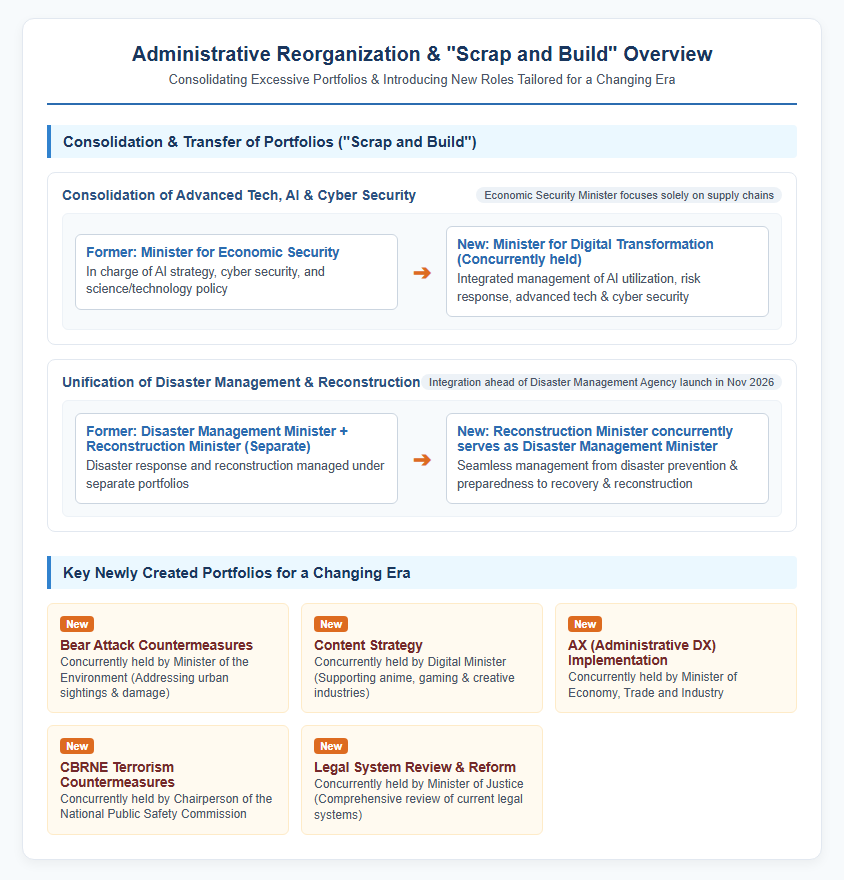
- AI Strategy, Advanced Tech & Cyber Security: Consolidated under the Minister for Digital Transformation
- Disaster Management & Reconstruction: Unified in preparation for the launch of the Disaster Management Agency in November
- Newly Created Portfolios: Bear Attack Countermeasures, Content Strategy, AX (Administrative DX) Implementation, CBRNE Terrorism Countermeasures, and Legal System Review & Reform
These fundamental revisions aim to break down administrative silos and enhance the command center function needed to respond swiftly to emerging social issues.
Ishin’s First Cabinet Appointment and Strengthening Coalition Policy Coordination
In a strategic political move to broaden the government’s base and drive structural reform, a cabinet post was granted to Japan Innovation Party (Nippon Ishin no Kai). Under the coalition agreement, Hiroshi Nakatsuka, former Secretary-General of Ishin, joined the Cabinet for the first time as Minister for Regulatory Reform. Ishin’s transition from confidence-and-supply support to full cabinet participation serves as a powerful catalyst for the regulatory and administrative reforms championed by the Takaichi administration. The coalition agreement between the Liberal Democratic Party (LDP) and Ishin encompasses a wide array of areas, including inflation relief measures, social security reform, energy policy, and foreign affairs and national security. Securing the Regulatory Reform portfolio paves the way for concrete structural reforms in digital transformation (DX), healthcare and long-term care restructuring, and regional infrastructure development. Conversely, Ishin’s cabinet entry stirs complex feelings among traditional LDP faction members and senior lawmakers awaiting ministerial posts, testing the Prime Minister’s management of parliamentary operations and intra-party dynamics. With Ishin lawmakers also expected to fill senior vice-ministerial and parliamentary vice-ministerial roles, the depth of practical policy coordination between the coalition partners will be a pivotal factor shaping future political developments.
Impact on Japanese Stock Markets and Economic Outlook
Retention of Economic Ministers and Market Reactions Amid Rising Interest Rates
Following the launch of the second reshuffled Takaichi Cabinet, financial and equity markets have welcomed the confirmation of policy continuity. With key economic ministers—Finance Minister Katayama, METI Minister Akazawa, and Economic Revitalization Minister Kiuchi—retained in their posts, market participants view the risk of a sudden pivot in economic policy as effectively averted. However, investors are focusing far more on macroeconomic conditions, such as interest rate trends and foreign exchange movements, than on cabinet appointments alone. On September 15, 2026, Japan’s 10-year government bond yield briefly rose to 3.035%, marking a high not seen in roughly 30 years. Meanwhile, market expectations are growing that the Bank of Japan (BOJ) will raise its policy rate to 1.25%, raising caution over the broader impact of rising interest rates on the stock market.
- Policy Continuity: Retaining Finance Minister Katayama, METI Minister Akazawa, and Economic Revitalization Minister Kiuchi
- 10-Year JGB Yield: Spiked briefly to 3.035% on September 15, 2026 (a ~30-year high)
- BOJ Policy Rate: Growing expectations of an additional rate hike to 1.25%
While rising interest rates pose headwinds for high-PER growth stocks and real estate equities sensitive to financing costs, they act as a positive catalyst for defense, semiconductor, and infrastructure-related stocks linked to clear policy initiatives, highlighting an increasing polarization across industry sectors.
Funding Tax Cuts vs. Growth Policies: Navigating the Economic Tug-of-War
The overarching challenge for the Takaichi administration moving forward will be managing the balance between growth-oriented policies and fiscal concerns driven by rising interest rates. Inflation relief measures, such as reducing the consumption tax rate on food products, are expected to boost household disposable income and support domestic demand recovery. However, annual tax revenue losses from these cuts are estimated at approximately 5 trillion yen. In the government bond market, persistent skepticism remains regarding reliance on deficit-financing bonds, placing pressure on the Ministry of Finance to present concrete revenue sources. If fiscal expansion concerns prompt sell-offs in government bonds and push long-term interest rates higher, corporate funding costs could rise and equity valuations could be compressed, potentially offsetting the benefits of economic stimulus. The long-term trajectory of the Japanese economy hinges on whether the Takaichi Cabinet can successfully reconcile aggressive growth investments with sustainable fiscal discipline. Markets will scrutinize the specific economic packages, their financial backing, and the Bank of Japan’s monetary policy steering in the period ahead.
Reference Page
- [Members of the Second Reshuffled Takaichi Cabinet] https://www.nippon.com/ja/japan-data/h02906/
【#TakaichiCabinet #ErikoImai #CabinetOffice #JapaneseEconomy #RegulatoryReform #LongTermInterestRates】
コメント