UK-based autonomous driving startup Wayve and Mercedes-Benz have signed a landmark production agreement to integrate the Wayve AI Driver into future series-production vehicles. Targeting market availability within two years, this partnership marks a historic turning point as mapless “embodied AI” enters the premium automotive market.
- Full Details of the Definitive Production Agreement Targeting Launch Within Two Years
- A Deepening Partnership: From Series D Funding to Commercial Production
- Versatility Driven by End-to-End Learning and Multi-Sensor Fusion
- Mercedes’ Multi-Stack Strategy and Competitive Positioning
- US DOT National Strategy and Evolving Global Regulations
- Commercial Robotaxi Deployment and Key Milestones Ahead
Full Details of the Definitive Production Agreement Targeting Launch Within Two Years
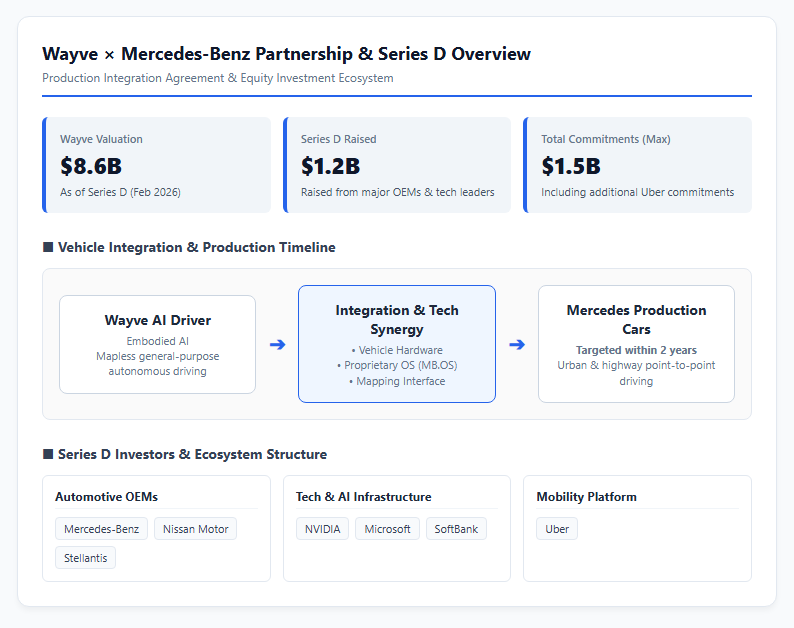
On September 22, 2026, London-based autonomous driving AI developer Wayve and German luxury automotive leader Mercedes-Benz announced a definitive production agreement to integrate Wayve’s autonomous driving technology, the “Wayve AI Driver,” into future Mercedes vehicles. Through this collaboration, passengers will gain access to advanced point-to-point driving assistance features across urban environments and highways within the next two years. Specifically, the Wayve AI Driver will be natively integrated into Mercedes-specific vehicle hardware, its proprietary operating system MB.OS, and mapping interfaces. Jörg Burzer, Chief Technology Officer at Mercedes-Benz, emphasized that integrating the Wayve AI Driver into the premium segment represents a world first and establishes a strong foundation for deploying this technology globally. Similarly, Alex Kendall, co-founder and CEO of Wayve, highlighted the significance of fusing Wayve’s embodied AI technology with Mercedes’ renowned vehicle engineering and safety expertise.
A Deepening Partnership: From Series D Funding to Commercial Production
This production agreement culminates years of technical collaboration and follows Mercedes’ strategic investment in Wayve’s Series D funding round, which closed in February 2026. Wayve raised \$1.2 billion in Series D funding at an \$8.6 billion valuation, with total capital commitments reaching up to \$1.5 billion including additional investment commitments from Uber. In addition to Mercedes-Benz, major global automakers such as Nissan Motor and Stellantis participated in the round alongside technology leaders NVIDIA, Microsoft, SoftBank, and Uber. Rather than acting merely as technology evaluators, these major OEMs have aligned as direct equity shareholders to accelerate the commercialization of next-generation mobility. Transitioning to a definitive production agreement signifies that the companies have moved past proof-of-concept (PoC) trials into full-scale mass production processes focused on manufacturing line integration and rigorous safety validation.
The Breakthrough of AV2.0 Architecture: Achieving “Mapless AI”
Versatility Driven by End-to-End Learning and Multi-Sensor Fusion
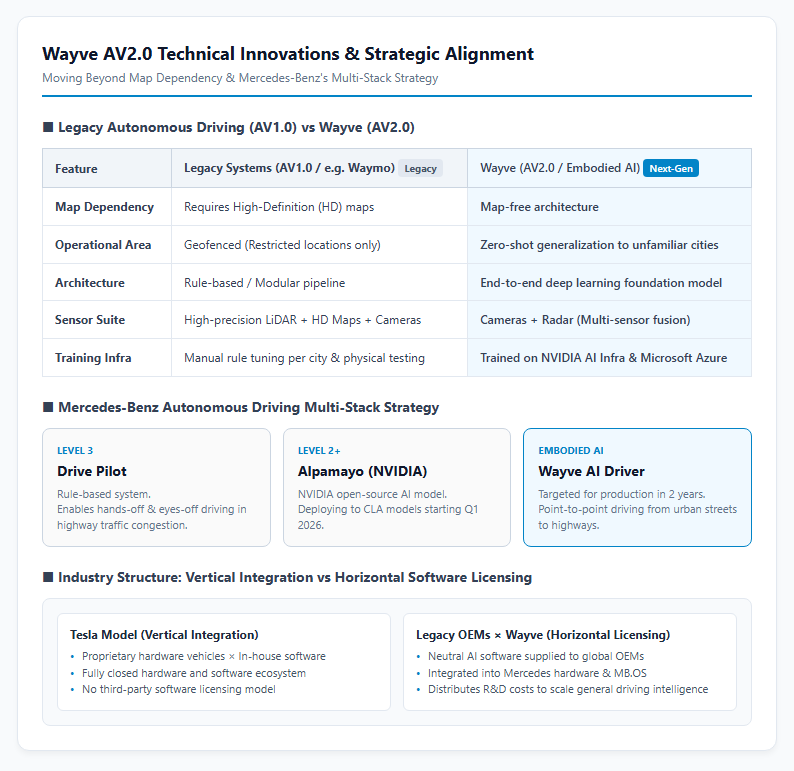
Wayve’s “AV2.0” architecture represents a fundamental departure from conventional autonomous driving systems. While legacy systems—such as those developed by Waymo—depend heavily on pre-built high-definition (HD) maps and geographic restrictions (geofencing), Wayve employs an end-to-end deep learning foundation model that learns how to drive directly from data, much like a human driver. This architecture enables flexible adaptation to unfamiliar cities and complex street layouts without requiring city-specific retraining or prior mapping (zero-shot generalization). Furthermore, Wayve’s sensor suite reinforces safety by combining camera feeds with radar. Utilizing an AI Driver trained on NVIDIA’s AI infrastructure and Microsoft Azure, the development team has successfully conducted real-world drives from city streets to highways across Stuttgart, London, and San Francisco, proving the system’s exceptional versatility.
Mercedes’ Multi-Stack Strategy and Competitive Positioning
Rather than relying on a single autonomous driving stack, Mercedes-Benz is pursuing a “multi-stack strategy,” operating multiple technical solutions in parallel. The company already offers “Drive Pilot,” a rule-based Level 3 system that enables hands-off and eyes-off driving during highway traffic congestion. In the first quarter of 2026, Mercedes also introduced NVIDIA’s open-source AI model “Alpamayo” as an L2+ feature in its CLA model. By adding Wayve’s Embodied AI to this portfolio, Mercedes secures a multi-layered suite of options ranging from localized Level 3 features to scalable point-to-point driving capabilities. In contrast to Tesla’s tight vertical integration of proprietary hardware and software, legacy automakers are increasingly licensing advanced driving intelligence from neutral AI providers like Wayve and NVIDIA. Wayve positions itself as a vehicle-agnostic software layer designed for broad industry adoption.
Structural Shifts in the Automotive Industry and Future Outlook
US DOT National Strategy and Evolving Global Regulations
As the commercialization of autonomous vehicle technology accelerates, governments and regulatory authorities worldwide are rapidly refining safety frameworks. The U.S. Department of Transportation (DOT) unveiled its national roadmap, “America Leads: DOT’S National Strategy for Automated Vehicles,” covering fiscal years 2026 through 2030, which establishes safety assurance and the modernization of Federal Motor Vehicle Safety Standards (FMVSS) as top priorities. The National Highway Traffic Safety Administration (NHTSA) is working to adapt regulations for vehicles without manual controls and establish performance criteria for Automated Driving Systems (ADS), while simultaneously harmonizing international technical rules through the United Nations Economic Commission for Europe (UNECE). Global regulatory alignment under UN-agreed technical standards is providing legal momentum for the worldwide deployment of advanced automated features in passenger cars. Meanwhile, for end-to-end models that can act as “black boxes,” safety verification techniques utilizing explainability tools (such as LINGO) and world models (such as GAIA) are drawing significant scrutiny and focus.
Commercial Robotaxi Deployment and Key Milestones Ahead
In addition to licensing software for consumer vehicles, Wayve is simultaneously expanding robotaxi operations through ride-hailing platform partnerships. In September 2026, Wayve launched a safety-driver-assisted autonomous ride-hailing service in London alongside Uber, with plans to initiate service in Tokyo before the end of the year. Moving forward, a key focal point will be whether production integration into Mercedes vehicles proceeds according to the two-year timeline, as well as how commercial rollout plans unfold with other partner OEMs such as Stellantis and Nissan. As the industry shifts from hand-coded rule bases to large-scale data-driven AI, overcoming the challenges of transitioning from research prototypes to meeting stringent automotive-grade manufacturing quality and low-latency targets will be the decisive factor in realizing an autonomous driving society.
Reference Pages
- [Wayve and Mercedes-Benz Partner to Bring the Wayve AI Driver to Future Mercedes-Benz Vehicles] https://wayve.ai/press/wayve-mercedes-benz-announce-production-agreement/
[#AutonomousDriving #Wayve #MercedesBenz #AI #EmbodiedAI #Mobility]

コメント