Google has announced its next-generation AI model, “Gemini 4 Argon,” and has begun providing early access to select partners. Behind this move is an effort to bounce back from development delays and intensifying competition in the market for autonomous AI capable of handling complex tasks.
- Key point of the event: The new AI model unveiled after months of delays
- The Aim of Security-Focused Supply Strategies and Phased Deployment
- The Gap Between Benchmark Scores and Evaluations in Actual Business Operations
- Thinking Modes and Technical Approaches Supporting Complex Reasoning
- Reorganization of the Organizational Structure and Intensification of the AI Development Competition
- Future Outlook and Key Focus Areas: Effectiveness in the Autonomous Agent Market
Key point of the event: The new AI model unveiled after months of delays
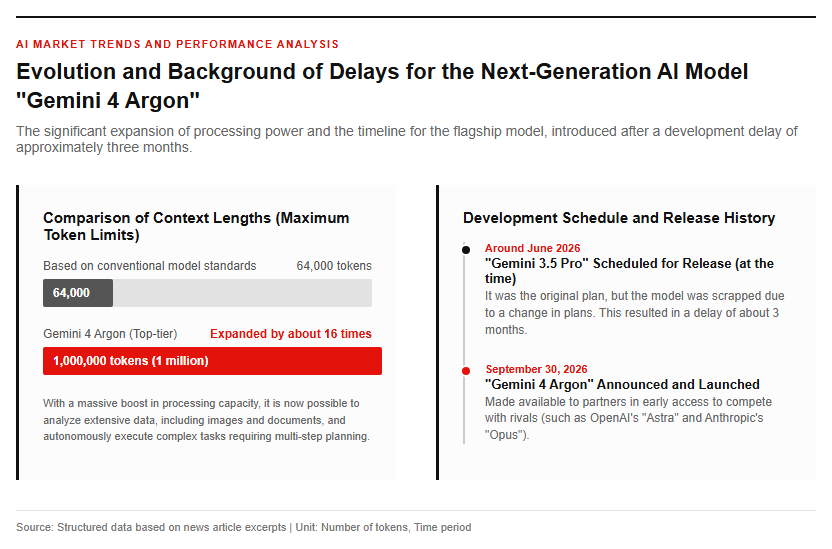
On September 30, 2026, Alphabet’s Google announced “Gemini 4 Argon,” the first flagship model in its next-generation series of artificial intelligence models, and began a phased rollout to select partners. Originally, the company had planned to release “Gemini 3.5 Pro” in June 2026, but due to changes in its development roadmap, that model was scrapped, resulting in a delay of more than three months in the launch of the next-generation model. Positioned as the largest and highest-performing AI model the company has ever developed, Argon was introduced to compete with leading models from competitors, such as OpenAI’s “Astra” and Anthropic’s “Opus.” Featuring a dramatic boost in processing power, the upper limit for tokens that can be handled at one time has been significantly expanded from the conventional 64,000 tokens to 1 million tokens—roughly a 16-fold increase. This enables the analysis of massive amounts of data, including images and documents, and the execution of complex tasks requiring multi-step planning.
Following this announcement, the stock market also reacted, with the company’s shares attracting strong interest, rising about 2.2 percent in pre-market trading.
The Aim of Security-Focused Supply Strategies and Phased Deployment
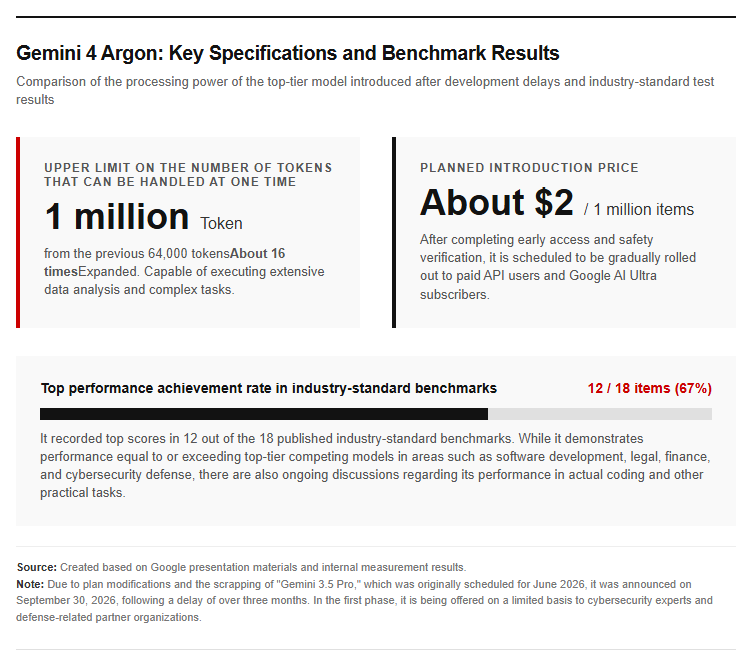
In releasing Gemini 4 Argon, Google has adopted a phased rollout strategy rather than immediately opening it up broadly to the general public. As a first step, access to the model is being granted on a limited basis through the company’s “Fairwind Program” to trusted cybersecurity experts and select defense-affiliated partners. This prioritizes safety verification to prevent the risk of AI models with advanced reasoning capabilities being abused for malicious hacking or cyberattacks. Argon incorporates an advanced safety mechanism that automatically interrupts operations if it detects behavior outside the boundaries of user-set instructions, ensuring strict operational safety. Following verification through the early access period, availability is planned to be progressively expanded to paid API users and Google AI Ultra subscribers at an introductory price of approximately $2 per 1 million input tokens. This phased deployment procedure is drawing attention as a model case for the safe social implementation of cutting-edge AI equipped with advanced capabilities.
New Technical Challenges Seen in Performance Evaluation and Internal Discussions
The Gap Between Benchmark Scores and Evaluations in Actual Business Operations
According to Google’s internal measurement results, Gemini 4 Argon achieved top scores in 12 out of 18 published industry-standard benchmark metrics, demonstrating performance on par with or exceeding top competing models in areas such as software development, legal and financial workflows, and cybersecurity defense. However, debates surrounding its performance also erupted immediately after its release. According to reports by Bloomberg and others, insiders within Google pointed out that “although the numbers in various tests are high, it does not deliver the expected capabilities in actual coding tasks or frontend development for creating app screens.” In response, Google immediately countered that it has passed rigorous internal testing and that claims of poor coding capabilities are inaccurate.
The gap between benchmark test scores and the practical performance required in actual, complex field operations has become a common challenge in the development of cutting-edge AI models, and real-world effectiveness will hold the key to their future adoption.
Thinking Modes and Technical Approaches Supporting Complex Reasoning
Behind the high performance of Gemini 4 Argon lies the evolution of its thinking mode, in which the model repeatedly performs internal reasoning before generating answers. Exposed through features such as the Interactions API, this mechanism records and processes the model’s internal reasoning process step-by-step, contributing to higher accuracy in advanced mathematical calculations, complex programming, and multi-step business planning. The thought process is managed via encrypted signatures, with a design that maintains reasoning continuity even across multi-turn interactions. Furthermore, the concept of thinking levels has been introduced to control reasoning resources across low, medium, and high tiers depending on task complexity, making it possible to optimize token consumption for applications ranging from simple fact retrieval to advanced decision-making. Through the fusion of this internal reasoning and a vast context window, the foundation has been established for AI agents that go beyond mere text generation to autonomously think and solve problems.
The Industry Landscape and Outlook for the Era of Autonomous AI Agents
Reorganization of the Organizational Structure and Intensification of the AI Development Competition
Behind the introduction of this new model lies a large-scale internal reorganization within Google and the intensifying AI development race among Big Tech companies. Although Google integrated its two main research divisions, DeepMind and Google Brain, to launch Google DeepMind in 2023, concerns had been raised over power struggles between the London hub and U.S. headquarters, as well as talent flight. In 2026, a management reshuffle took place: founder Demis Hassabis stepped back from day-to-day leadership to become chairman and chief scientist at Alphabet, and Jeff Dean, who had been with the company for 27 years, departed to launch a new startup. Overcoming such internal turmoil and months of model development delays, Argon is positioned as a high-stakes move to recapture the leadership wrested by OpenAI and Anthropic. Including securing demand for its custom AI chips, the TPUs, the company is accelerating its initiatives to boost the performance of its foundation models.
Future Outlook and Key Focus Areas: Effectiveness in the Autonomous Agent Market
The main battleground in the AI industry is shifting from simple chatbots that answer questions to AI agent platforms that autonomously complete tasks within enterprises. Companies are successively introducing agent management platforms, such as Microsoft’s Agent 365, OpenAI’s Workspace agents, and Google’s Gemini Enterprise Agent Platform. These platforms integrate access control, security monitoring, and human-in-the-loop approval workflows to provide an environment where multiple AIs can operate safely within an organization. Going forward, the focus will be on how well cutting-edge models like Gemini 4 Argon can adapt to actual business operations as the brains of autonomous agents. In particular, increasing automation rates in specialized fields such as programming, cybersecurity, and advanced data analysis, alongside overcoming malfunctions and security risks, holds the key to practical implementation. The point to watch in the future is not just the intelligence of the models, but how they can revolutionize entire corporate business processes.
Reference Page
- 【Gemini API Documentation】https://ai.google.dev/gemini-api/docs/thinking
- 【Google Official Blog】https://blog.google/intl/ja-jp/google-io-2026/
[#Google #Gemini4Argon #GenerativeAI #AIModel #Cybersecurity #ArtificialIntelligence #ITNews]

コメント