Gartner Japan has released the 2026 Hype Cycle for Cloud and AI in Japan, showing that five technologies—including frontier AI and agentic AI—have reached the Peak of Inflated Expectations. This is driven by a structural shift in generative AI’s focus from mere model performance to reliability, cost control, and the AI-driven cloud.
- Key point of the event: Cutting-edge technology positioned in the peak period
- Practical Technologies Transitioning into the Trough of Disillusionment and the Operational Barrier
- A Paradigm Shift from Mere Computing Infrastructure to Autonomous Execution Infrastructure
- Governance and Visualization Shape Corporate Competitiveness
- Personnel and Organizational Capabilities Inseparable from Cloud Strategy
- Future Outlook and Key Highlights: The Future of Open Architecture and Autonomy
Key point of the event: Cutting-edge technology positioned in the peak period
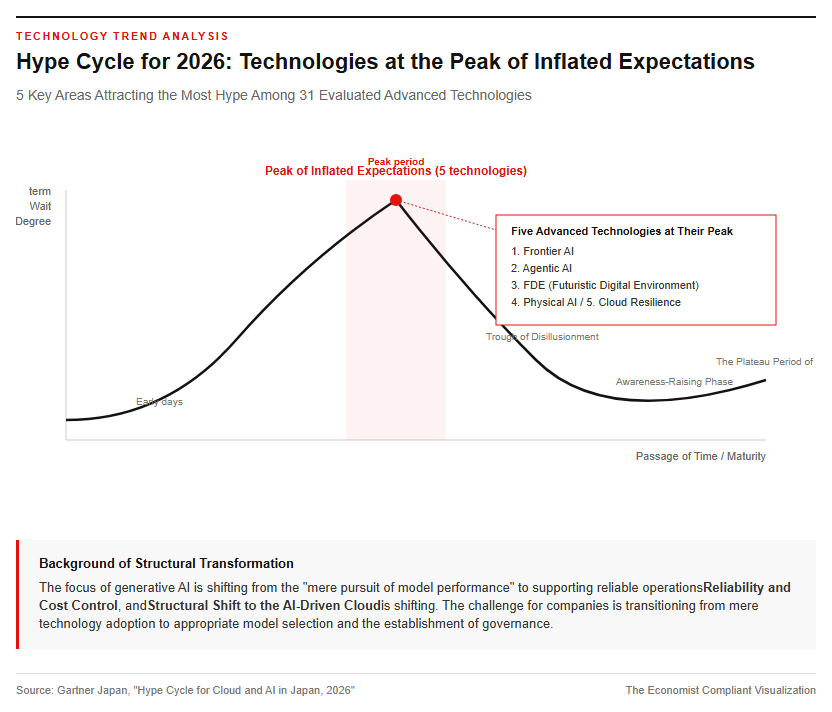
On September 28, 2026, Gartner Japan Inc. released the “Hype Cycle for Cloud and AI in Japan, 2026,” which comprehensively analyzes the maturity of cloud computing and artificial intelligence in Japan. Among the 31 emerging technologies evaluated, five items were positioned at the Peak of Inflated Expectations: frontier AI, FDE (Futuristic Digital Environment), agentic AI, physical AI, and cloud resilience. Currently, major global vendors such as OpenAI, Anthropic, Google, and SpaceXAI are rapidly accelerating the development race for frontier AI, which is equipped with advanced reasoning functions and autonomous task-processing capabilities. Tadaaki Mata, Distinguished Vice President Analyst at Gartner Japan, points out that frontier AI will serve as the foundational intelligence for all AI services and agents. For enterprises, it is no longer simply a matter of whether to adopt it, but rather which models to select and under what governance to operate them, making this a critical management challenge.
Practical Technologies Transitioning into the Trough of Disillusionment and the Operational Barrier
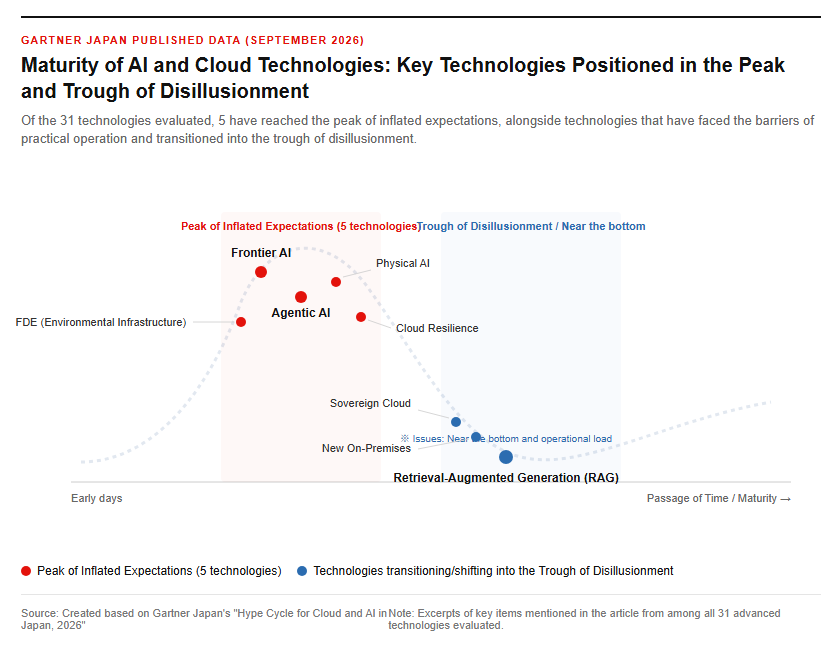
According to Gartner Japan’s 2026 analysis, technologies that have been implemented ahead of others in practical applications are seeing a cooling of overhyped expectations and a notable shift toward confronting the barriers of realistic operations. In particular, Retrieval-Augmented Generation (RAG), which has seen successive corporate adoptions, has reached near the trough of disillusionment, with the operational burden of maintaining response accuracy, suppressing hallucinations, and performing real-time updates of internal data emerging as major bottlenecks. Furthermore, areas such as sovereign clouds and “new on-premises” aimed at ensuring data confidentiality and national data sovereignty are also transitioning into the Trough of Disillusionment. It has become clear that traditional IT infrastructure systems and operational cost structures cannot keep pace with data protection laws, regulations, and management requirements. We have entered a rigorous phase where improvements in model performance alone do not directly translate to business results, and projects lacking the preparation of foundational data management infrastructure or clear verification of ROI (Return on Investment) are being forced to stall or undergo revision at the practical application stage.
The Transition to AI-Driven Cloud and the Importance of Governance
A Paradigm Shift from Mere Computing Infrastructure to Autonomous Execution Infrastructure
Approximately 20 years after the advent of hyperscalers, the role of the cloud in enterprise IT has undergone a dramatic transformation. While the traditional cloud functioned merely as infrastructure providing computing resources and storage, it has now evolved into an “AI-driven cloud” designed and operated with AI models at its core. Along with this change, the rapid surge in infrastructure costs due to the bloating of large language models and the explosive increase in inference processing is putting pressure on corporate management. Therefore, in cloud operations, it has become essential to establish control mechanisms ranging from single computing resource management to the introduction of AI model routers that route processing to the optimal model based on usage conditions, and FinOps for real-time cost control. The cloud is transforming into a strategic platform where groups of AI agents collaborate with each other to autonomously execute business operations.
Governance and Visualization Shape Corporate Competitiveness
As the scale of AI adoption expands, corporate priorities are shifting from model development capabilities to “accountability and control”—proving how systems behave and how much they cost. According to Gartner research, while only 17% of organizations are currently utilizing AI agents in full production, more than 60% of companies plan to adopt them within the next two years. On the other hand, it is predicted that over 40% of agentic AI projects will be canceled by the end of 2027 due to a lack of clear ROI, inadequate risk management, and uncontrolled cost increases. In AI operations, proactively establishing governance foundations—such as building AI observability to pre-detect flaws and misuse, and AI Governance TRiSM (Trust, Risk and Security Management), which comprehensively covers AI ethics, security, and risk management—has become an absolute prerequisite for sustainable value creation.
Restructuring Organizational and HR Strategies and Future Outlook
Personnel and Organizational Capabilities Inseparable from Cloud Strategy
To successfully transition to an AI-driven cloud, companies must not only adopt cutting-edge technology but also develop organization-wide capabilities and rebuild their talent strategies. As Gartner’s Tadaaki Mata points out, modern cloud strategy is essentially talent strategy itself. Top-down, centralized command structures and approaches that rely solely on appointing a CAIO (Chief AI Officer) easily diverge from on-the-ground operational realities, which is a major factor in why many AI projects ultimately fail. What is truly required is the promotion of platform engineering led by developers and infrastructure administrators who deeply understand operational business processes. Moreover, while avoiding excessive reliance on external vendors, the development of advanced IT talent capable of incorporating multi-AI model strategies and sovereign AI into in-house architectures has become the key to corporate survival.
Future Outlook and Key Highlights: The Future of Open Architecture and Autonomy
In future system strategies, avoiding vendor lock-in and building a flexible foundation that leverages an open ecosystem will be crucial. As standardized specifications such as MCP (Model Context Protocol) and A2A (Agent-to-Agent) protocols—which enable autonomous collaboration among AI agents—become more widespread, enterprises will be able to freely switch to the optimal model for their specific use cases. Furthermore, the criteria for evaluating investment justification will shift from single-response accuracy to the balance between “the autonomous completion rate of multi-step tasks” and inference costs. Key leading indicators that companies should monitor include trends in data sovereignty regulations across countries, supply price trends for inference-optimized hardware, and the proportion of inference operation costs within total IT budgets. Establishing a robust autonomous infrastructure that achieves both governance and cost control, unswayed by rapid technological innovation, will secure future market competitiveness.
Reference Page
- 【Gartner Press Release: Gartner Unveils the 2026 Hype Cycle for Cloud and AI in Japan】https://www.gartner.co.jp/ja/newsroom/press-releases/2026-09-28-gartner-unveils-the-2026-hype-cycle-for-cloud-and-ai-in-japan
[#Gartner #HypeCycle2026 #AIDrivenCloud #AgenticAI #FrontierAI #Governance]

コメント