On October 2, 2026, Keizai Doyukai released a comprehensive reform proposal centered on the creation of a “Worker Burden Relief Benefit” aimed at easing the financial burden on low- and middle-income households and promoting employment, alongside strengthening financial income taxation as a permanent funding source for the initiative. This stems from a call for secured financial backing and an equitable system design for the benefit system currently under consideration by the government.
- Establishment of the Subsidy for Reducing Workers’ Burden and Benefit Design for Middle- and Low-Income Households
- Advancing Income Redistribution and Eliminating Disincentives to Work Through a Three-Pronged Approach
- Exclusion from NISA and Increase in the Financial Income Tax Rate to 17.25%
- Establishment of Permanent Funding Sources Through Deduction Reviews and Revenue and Expenditure Reform
- Centralized Execution by the National Government and the Establishment of a Digital Benefit Infrastructure
- Income Capture and Future Roadmap Toward the 2034 Final Form
Establishment of the Subsidy for Reducing Workers’ Burden and Benefit Design for Middle- and Low-Income Households
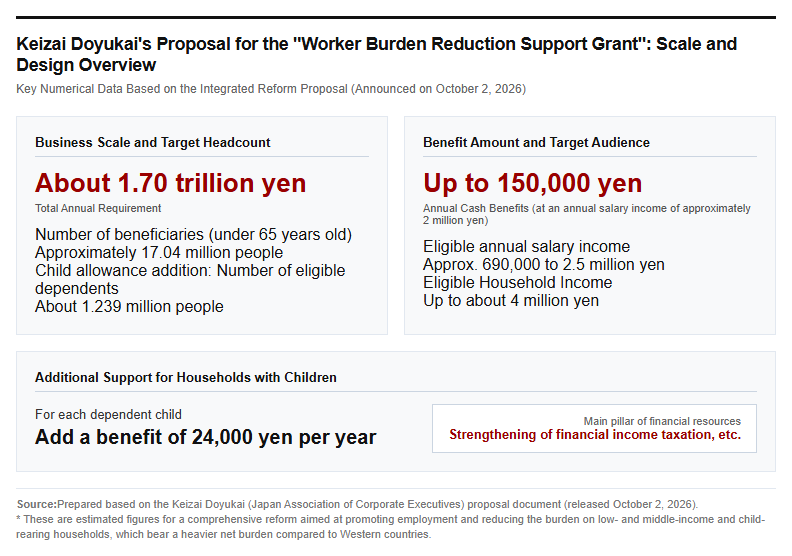
On October 2, 2026, Keizai Doyukai released a policy proposal aimed at reducing the financial burden on low- and middle-income earners and improving their motivation to work. In response to the “General Outline Concerning the Temporary Reduction of the Consumption Tax Rate on Food and Beverages and the Introduction of Support Grants to Alleviate the Burden on Workers” approved by the Cabinet on September 15, 2026, the proposal presents concrete solutions to challenges regarding financial resources and institutional operation. The support grants primarily target working low- and middle-income earners with annual salary incomes ranging from approximately 690,000 yen to 2.5 million yen (with household incomes up to about 4 million yen). The scheme is designed to distribute benefits intensively to segments that bear a heavy net burden of taxes and social insurance contributions, particularly in comparison to Western nations.
Specifically, a cash benefit of up to 150,000 yen per year will be provided to workers with a salary income of approximately 2 million yen (an income of 1.32 million yen). Furthermore, to strengthen support for child-rearing households, it is proposed to provide an additional 24,000 yen per year for each dependent child. The number of eligible recipients is estimated to reach approximately 17.04 million people under the age of 65, with approximately 1.239 million eligible dependents for the child addition, and the total required amount is estimated at about 1.70 trillion yen annually. Regarding the benefit structure, the following features have been incorporated.
- A system in which the support amount increases progressively in stages according to salary income, starting from an income of over 0 yen.
- Designed to taper off gradually once income exceeds a certain threshold, preventing the creation of new barriers to employment.
- Streamline into a system of cash payments for the un-deductible portion to minimize administrative costs.
Advancing Income Redistribution and Eliminating Disincentives to Work Through a Three-Pronged Approach
The most notable aspect of this latest proposal is that, rather than stopping at mere benefit payments, it is presented as a “three-in-one reform” that simultaneously advances tax and social security system reforms. Under Japan’s current tax and social insurance systems, there is the “annual income barrier”—where take-home pay decreases once a certain annual income is exceeded—which has been a major factor causing part-time workers to adjust their working hours and dampening their motivation to work. Keizai Doyukai strongly advocates for resolving this structural challenge and revamping the system into a fair framework where take-home pay increases the more people work.
As a pillar of the reform, in addition to the establishment of support funds, the plan includes the abolition of the spousal deduction and special spousal deduction, as well as the abolition of the Category III insured person system under the public pension scheme. Regarding the Category III insured person system, a roadmap has been set out to suspend new enrollment and application starting from fiscal 2029 and completely abolish it by fiscal 2033 after a five-year transition period. The main policy effects expected through these institutional reforms are as follows.
- Easing Labor Supply Constraints and Enhancing Corporate Productivity Through the Correction of Employment Adjustments
- Optimize the net burden rate structure—which is high for low-income brackets and low for high-income brackets—to levels comparable to major countries.
- Revitalization of personal consumption through increased take-home pay for low- and middle-income households and contribution to measures against the declining birthrate
Strengthening Financial Income Taxation and Measures to Secure 1.70 Trillion Yen in Revenue
Exclusion from NISA and Increase in the Financial Income Tax Rate to 17.25%
Regarding the approximately 1.70 trillion yen in permanent financial resources required to establish the support subsidy for reducing the worker burden, Keizai Doyukai (Japan Association of Corporate Executives) argues that these funds should be secured through tax reform and revenue and expenditure reforms, rather than relying on the easy issuance of government bonds. Proposed as the core of this funding measure is the strengthening of financial income taxation. Specifically, the association proposed a phased increase in the national tax rate on interest, dividends, and capital gains from stocks and other assets from the current 15% to 17.25%. When combined with local taxes and the special reconstruction income tax, the effective tax rate would increase from 20.315% to 22.565%.
Of critical importance in this tax increase measure is the consideration given to the treatment of the Nippon Individual Savings Account (NISA) system. From the perspective of promoting Japan as an asset-management nation, profits generated within NISA accounts are completely excluded from the scope, creating a design that is considerate of ordinary retail investors and asset-building generations. The expected effects and background of strengthening financial income taxation are as follows.
- To be implemented in phases starting in fiscal 2029, with an expected increase in tax revenue of approximately 380 billion yen by fiscal 2034.
- Addressing the “100 million yen barrier” issue where the effective tax rate drops when income exceeds 100 million yen
- Maintaining international levels that remain lower than France’s 31.4% and Germany’s 26.375% even after the tax hike
Establishment of Permanent Funding Sources Through Deduction Reviews and Revenue and Expenditure Reform
In addition to strengthening taxation on financial income, a combination of various tax system reviews and revenue and expenditure reforms has been put in place to secure 1.70 trillion yen in permanent financial resources. First, on the tax front, the spouse deduction and special spouse deduction will be phased down and abolished starting in fiscal 2029, generating approximately 450 billion yen in financial resources by fiscal 2034. Furthermore, there is a plan to transition from current “income deductions” such as the basic exemption and dependent exemption to a “tax credit” (equivalent to 10% of the deduction amount) that subtracts a fixed amount regardless of income, thereby securing approximately 540 billion yen.
Furthermore, as part of expenditure and revenue reforms, a zero-base review of programs whose policy effects cannot be sufficiently confirmed was proposed. Citing the fact that wage hikes are taking root against the backdrop of labor shortages, the tax credit for promoting wage increases for small and medium-sized enterprises will be abolished starting in fiscal 2027, freeing up approximately 330 billion yen. The breakdown of the financial resources secured through these measures is as follows.
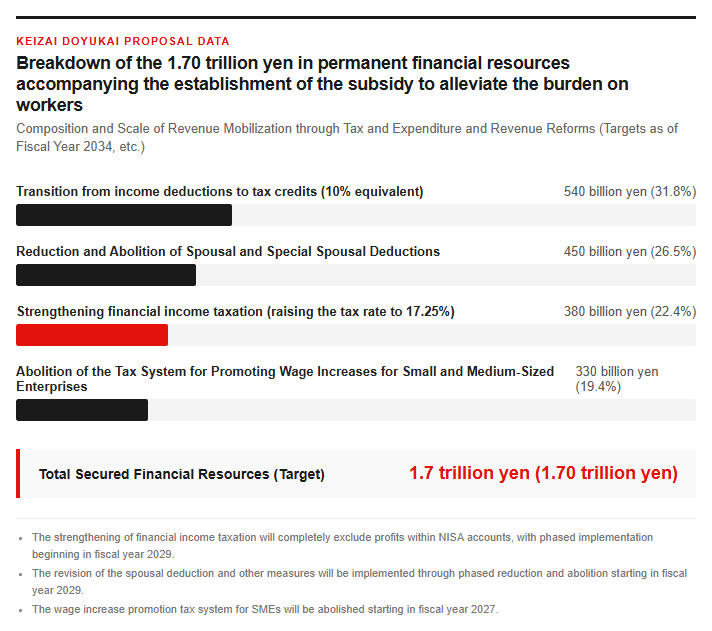
- Abolition of the wage increase promotion tax system for small and medium-sized enterprises: Approx. 330 billion yen (national tax basis)
- Gradual abolition of the spouse deduction and special spouse deduction: Approx. 450 billion yen (national tax base)
- Conversion of basic and dependent exemptions into tax credits: Approx. 540 billion yen (national tax base)
- Tightening of financial income taxation excluding NISA (tax rate: 17.25%): Approx. 380 billion yen (national tax base)
Digitization of System Operations and Future Key Points
Centralized Execution by the National Government and the Establishment of a Digital Benefit Infrastructure
Regarding the operational aspects of the system, Keizai Doyukai (Japan Association of Corporate Executives) has raised clear objections to the government’s outline policy. While the government outline plans to make the administration of benefit payments a legally mandated task delegated to municipalities, the proposal strongly calls for centralized execution by the national government. This is because decentralizing the administrative work to local governments—which face limitations in human resources and system infrastructure—would result in increased administrative costs and disparities in burdens among municipalities. The establishment of a system leveraging digital technology to evaluate and disburse payments under nationwide uniform rules was proposed.
For the early pilot implementation period from fiscal year 2027 to 2028—the initial stage of the system rollout—municipalities will be provisionally allowed to handle administrative operations, with a planned transition to a centrally operated national system during the full-scale rollout in fiscal year 2029. The establishment of a centralized management infrastructure by the national government offers the following significant benefits:
- Automating Eligibility Determinations Significantly Reduces Local Governments’ Manual Workload and Redundant Costs
- Establishment of a swift and reliable benefit delivery route utilizing My Number and public funds receiving accounts
- Completion of a permanent infrastructure capable of immediately providing livelihood support funds even in times of emergencies such as disasters and infectious diseases
Income Capture and Future Roadmap Toward the 2034 Final Form
The most anticipated future development of the reform is the improvement of income capture accuracy to achieve fair taxation and benefits. During the initial implementation period (fiscal 2027–2028), flat-rate support will remain in place for those at or below the resident tax-exempt threshold for administrative reasons. However, Keizai Doyukai (Japan Association of Corporate Executives) is demanding that the government not make this permanent, but rather establish data-matching technology utilizing My Number and systems for cross-checking third-party payment information by fiscal 2033.
By advancing preparations to accurately grasp the income of self-employed individuals, spot workers working on multiple platforms, or stock interest and dividend income, arrangements are in place to transition to the “final form of the system” starting in fiscal 2034. In the final form, a fair mechanism will be completed in which benefit amounts smoothly increase or decrease in accordance with earned income starting from an income of over 0 yen. The future discussions and challenges for companies and the government are as follows.
- Progress on funding discussions in the extraordinary Diet session and among ruling and opposition parties toward full-scale implementation starting in fiscal 2029.
- Corporate cooperation in the digitization of payroll data and a review of annual income limits for family allowances, etc.
- Examination of the fiscal sustainability of the country as a whole, including the consideration of establishing an independent fiscal institution (IFI)
Reference page
- [Japan Association of Corporate Executives Policy Proposal] https://www.doyukai.or.jp/policyproposals/2026/261002.html
【#KeizaiDoyukai #FinancialIncomeTaxation #WorkerBurdenReductionSupportGrant #100MillionYenBarrier #TaxReform #IntegratedSocialSecurityReform #IncomeRedistribution】


コメント