At its Monetary Policy Meeting on September 18, 2026, the Bank of Japan decided on operational revisions, such as changing the lending rate for fund-provisioning operations to support climate change initiatives to a variable rate and setting a total lending cap of 50 trillion yen. The move aims to stably support private-sector decarbonization efforts while facilitating smooth market operations amid a phase of rising interest rates.
- Revision of Basic Guidelines for Climate Change Response Operations, etc., and Key Points of Events
- Specific Changes in the System Revision and Setting of Loan Limits
- Optimization of Market Operation Functions in a Monetary Tightening Phase
- Consistency with related systems such as disaster area support operations and common collateral operations
- Funding Costs for Private Financial Institutions and the Impact of Transitional Measures
- Continuity of Decarbonization Investment and Future Developments/Key Focal Points
Revision of Basic Guidelines for Climate Change Response Operations, etc., and Key Points of Events
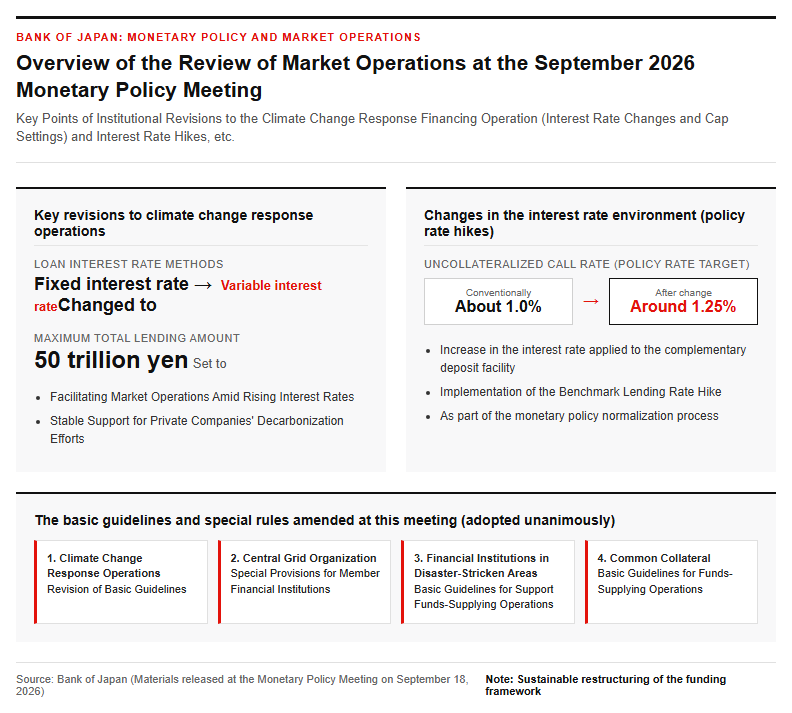
At the Monetary Policy Meeting held on September 17 and 18, 2026, the Bank of Japan decided to change the guideline for money market operations and revise the operations of multiple fund-provisioning facilities, including the fund-provisioning operation to support climate change responses. At this meeting, it was decided by a majority vote to raise the target for the uncollateralized overnight call rate from the previous level of around 1.0 percent to around 1.25 percent. Along with this, the interest rate applied to the complementary deposit facility and the basic loan rate will be raised, but what also drew attention at the same time was the revision of the systems for various special operations. From the perspective of ensuring the smooth operation of market adjustments while stably supporting important private-sector initiatives such as climate change responses, the Bank of Japan unanimously adopted the restructuring of lending conditions. The specific targets of this review are four: the basic directive for the climate change response financing operation, the special provisions for member financial institutions of cooperative central organizations, the basic directive for fund-provisioning operations to support financial institutions in disaster-stricken areas, and the basic directive for the pooled collateral fund-provisioning operation. This revision is part of the monetary policy normalization process promoted by the Bank of Japan, and marks an important milestone in reorganizing the central bank’s fund-provisioning framework into a sustainable form under the new interest rate environment of rising short-term interest rates. As shown in the schematic diagram below, the transition from the conventional framework is progressing.
Specific Changes in the System Revision and Setting of Loan Limits
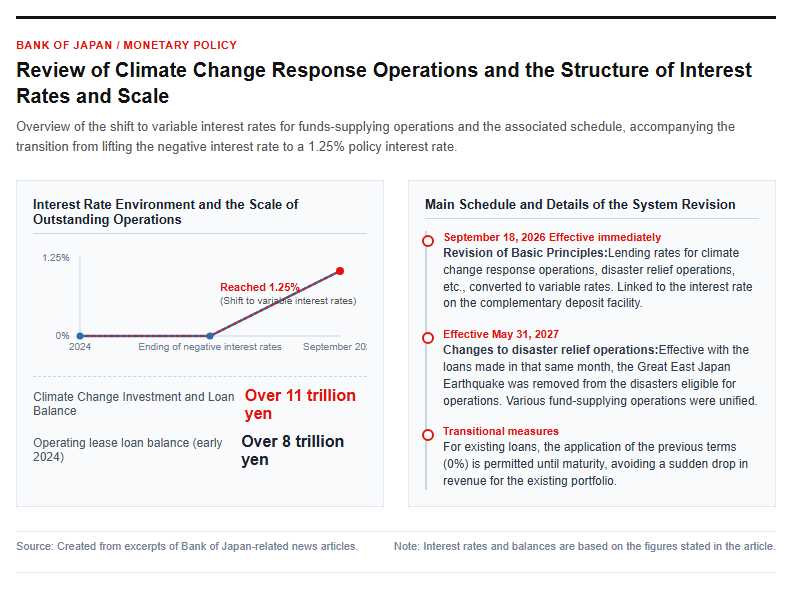
The most significant change in the recently decided revision of the climate change response operations is the method for setting the lending interest rate. It has been changed from the conventional fixed interest rate of 0 percent to a floating interest rate system that applies the average of the interest rate applied to the complementary deposit facility during the lending period. This creates a mechanism where the lending rate of the operations naturally rises in conjunction with hikes in the policy interest rate. Furthermore, to prevent the unlimited expansion of the system and avoid obstacles to monetary control, a cap was placed on the overall scale of fund supply. The upper limit for the total amount of loans through the operations was set at 50 trillion yen, and the lending limit for each individual financial institution receiving loans was also restricted to the equivalent of the outstanding balance of eligible climate change-responding investments and loans, up to a maximum of 10 trillion yen. The conditions for eligible investments and loans have also been clarified, limiting them to those with a remaining maturity of one year or more. These revisions were implemented immediately, in principle, starting September 18, 2026. However, transitional measures were established stating that for existing loans already executed based on the old guidelines, the previous loan conditions will continue to apply as they are until the repayment due date arrives. This consideration makes it possible for private financial institutions, which are the borrowing entities, to proceed with preparations for the transition to the new system without being forced into sudden changes in their cash management.
Background of the Revision of Market Operations and Its Monetary Policy Significance Amid Interest Rate Hikes
Optimization of Market Operation Functions in a Monetary Tightening Phase
When the climate-change response financing operation was introduced in 2021, under the negative interest rate policy and yield curve control, a 0 percent lending rate was applied as a strong incentive to back financial institutions’ decarbonization investment and financing. However, following the lifting of negative interest rates in 2024, the policy rate was raised in stages, reaching around 1.25 percent in September 2026, which resulted in a significant divergence between the conventional fixed 0 percent loans and market interest rates. As policy rates rise, the central bank’s continued supply of funds to specific sectors at fixed low interest rates functions effectively as a powerful subsidy, carrying the risk of distorting the market’s interest rate formation mechanism. Furthermore, concerns had emerged that this would create distortions, such as financial institutions earning an arbitrage margin by depositing funds procured cheaply through the operation into Bank of Japan current accounts. In response to these challenges, the Bank of Japan revised the lending rate to a variable rate, shifting to a mechanism where adjustments are made in line with prevailing market interest rates. This has made it possible to consistently reconcile the overarching direction of monetary policy—appropriately adjusting the degree of monetary easing—with the specific policy objective of supporting the long-term supply of funds to the climate change response sector without contradiction.
Consistency with related systems such as disaster area support operations and common collateral operations
It is also important to note that this operational review extends beyond the climate change response operations to encompass the entirety of other lending support frameworks provided by the Bank of Japan. The funding provision operations to support financial institutions in disaster-stricken areas and the pooled collateral funding provision operations also underwent similar lending rate revisions, introducing a floating-rate system linked to the interest rate applied to the complementary deposit facility. Furthermore, regarding the operations to support financial institutions in disaster-stricken areas, given that a long period has elapsed since the Great East Japan Earthquake and utilization has recently stabilized, it was decided that the Great East Japan Earthquake will be removed as a target disaster for the operations with the loans executed in May 2027. Consideration was also given to practical operations regarding the effective dates, with a phased schedule established in which amendments concerning basic principles take effect immediately on September 18, 2026, while specific revision clauses, such as the lifting of the disaster designation for disaster area operations, take effect on May 31, 2027. In this way, by centrally linking the interest rate systems of diverse fund-supplying instruments to the complementary deposit facility interest rate, the transparency and consistency of the central bank’s overall operational structure have been dramatically enhanced. It can be said that an environment has been comprehensively established to allow the effectiveness of market operations centered around the policy interest rate to permeate down to the very end.
Impact on Financial Institutions and the Outlook for Sustainable Finance
Funding Costs for Private Financial Institutions and the Impact of Transitional Measures
This institutional revision will have a significant impact on the fundraising practices of private financial institutions, including major banks, regional banks, and the central institutions of shinkin banks. Up until now, the Climate Response Financing Operations allowed institutions to raise funds for up to one year at an interest rate of 0 percent, and has been utilized as a convenient form of back-finance that could be repeatedly used in principle until fiscal 2030. The loan balance through these operations exceeded 8 trillion yen as of early 2024, and the eligible climate change investment and loan balance had also expanded to over 11 trillion yen. With this revision, a floating interest rate of around 1.25 percent will be applied to new borrowings and renewals, reliably increasing funding costs from the central bank for financial institutions. However, because the Bank of Japan established a transitional measure allowing the application of the old conditions until maturity for existing loans, a sudden drop in revenue for the existing portfolios held by financial institutions was avoided. Moving forward, financial institutions will be required to review the interest rate levels of green loans and sustainability-linked loans set for borrower companies, while also advancing appropriate risk management and securing profit margins. Along with the structural changes in the fund-supplying operations, the investment and financing strategies of financial institutions are also entering a new phase.
Continuity of Decarbonization Investment and Future Developments/Key Focal Points
With the goal of achieving carbon neutrality by 2050, the Japanese government aims to mobilize over 150 trillion yen in public-private GX (Green Transformation) investment over the next decade, and climate change response operations play an extremely vital role in financially underpinning this effort. Although lending rates have been converted to variable rates, the newly specified massive cap of 50 trillion yen on total lending is seen as a demonstration of the Bank of Japan’s strong, ongoing commitment to providing long-term and stable support for private-sector decarbonization initiatives. The focal point of future developments will be whether private companies and financial institutions maintain their appetite for decarbonization investment even in a rising interest rate environment. As procurement costs for green bonds and transition finance increase, companies are challenged to achieve emission reduction targets that encompass not only Scope 1 and Scope 2, but also Scope 3. Furthermore, as the tightening of sustainability information disclosure based on TCFD and SSBJ standards progresses, whether a broad-based decarbonization support framework—including regional banks and small and medium-sized enterprises—can be maintained will also be an important monitoring point. As the Bank of Japan enters a phase of raising policy interest rates, close attention must be paid to future market trends regarding how the dual objectives of price stability and support for climate change responses will be achieved.
Reference Page
- [Bank of Japan] https://www.boj.or.jp/
【#BankOfJapan #MonetaryPolicy #ClimateChangeOperations #SustainableFinance #InterestRateHike #MarketOperations #Decarbonization】


コメント