US President Donald Trump and Russian President Vladimir Putin held a telephone conversation and agreed to ease and immediately lift export restrictions on Russian gas oil (diesel). Against the backdrop of soaring global fuel prices and tight supplies, the move is aimed at cooling the energy market and easing economic uncertainty.
- Key point of the event: Agreement on immediate supply of over 300,000 tons
- Behind the Supply Restrictions: Refinery Attacks and Domestic Protection
- Surging Diesel Prices and Stagflation Concerns
- The Spillover of Middle East Risks and the Trump Administration’s Impatience
- Behind the US-Russia Economic Talks and Energy Asset Transactions
- The Effectiveness of Sanctions and Ukraine’s Backlash
- Future Outlook and Key Points: Cooling Market Prices and Supply Risks
Key point of the event: Agreement on immediate supply of over 300,000 tons
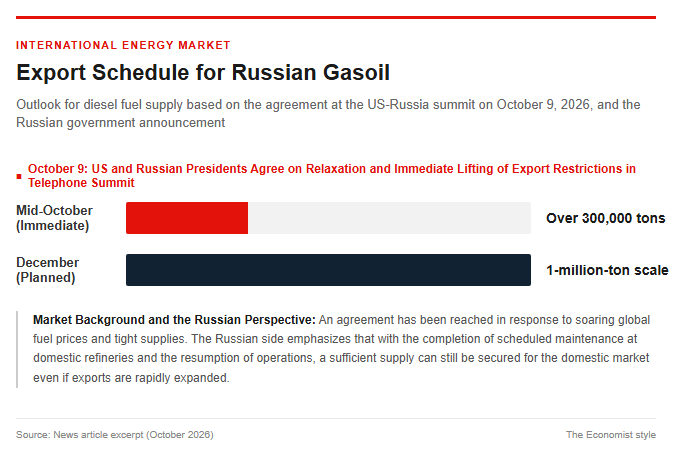
On October 9, 2026, a telephone summit was held between U.S. President Trump and Russian President Putin, during which the two countries agreed to ease export restrictions on Russian gas oil destined for the U.S. and global markets, effectively lifting the export ban with immediate effect. Following the call, President Trump announced that he had secured an immediate supply of over 300,000 tons of diesel fuel from Russia. In response, Russian Deputy Prime Minister Alexander Novak stated that same night that he intends to expand exports to 300,000 tons within this month, scaling up to 1 million tons in December. The Russian side emphasized that, with the resumption of operations at domestic refineries that have finished scheduled maintenance, they can ensure an adequate supply to the domestic market even with a rapid expansion of exports. President Putin also stated in a statement that the easing of sanctions and the resumption of fuel supplies will have a positive impact on the global economy as a whole. This agreement is expected to act as a powerful cooling measure for the tense international energy market. The overall picture of the agreement reached at the summit and the supply plan are as follows.
Behind the Supply Restrictions: Refinery Attacks and Domestic Protection
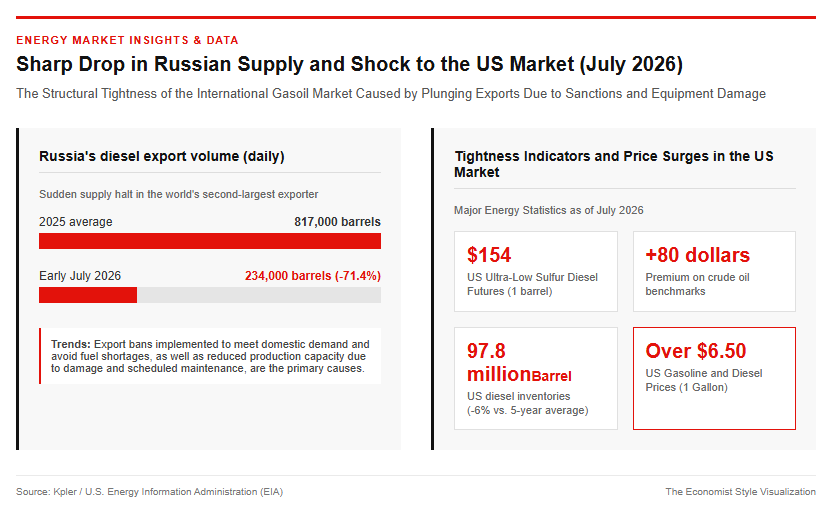
Behind the decision to lift the export ban was severe disruption in Russia’s domestic fuel supply and demand. In 2026, Ukrainian drone attacks directly hit refineries and petroleum-related infrastructure across Russia, leading to a series of damages to refining facilities. To prioritize meeting domestic market demand and avoiding fuel shortages, the Russian government had enacted a ban on diesel exports in July 2026. According to data from the research firm Kpler, Russia’s diesel exports, which stood at 817,000 barrels per day in 2025, plummeted to 234,000 barrels per day by early July 2026. The supply suspension by Russia, the world’s second-largest diesel exporter, had further fueled supply tightness in the international market. However, as production capacity recovered due to the prompt repair of facilities through protective measures, the establishment of defense systems, and the completion of scheduled refinery maintenance, the Russian government shifted course to a decision to redirect excess production toward exports.
The Global Energy Crisis and the U.S. Political Situation
Surging Diesel Prices and Stagflation Concerns
Russian export restrictions and surging global demand have triggered a sharp spike in diesel prices in Western markets. Because diesel fuel is widely used in industrial machinery, agricultural tractors, long-haul trucks, and various power generation facilities, its price surge directly translates to rising prices across all industrial activities. In July 2026, U.S. ultra-low sulfur diesel futures prices reached $154 per barrel, with the premium over the crude oil benchmark leaping to $80. Furthermore, according to an announcement by the U.S. Energy Information Administration (EIA), U.S. diesel inventories had dramatically decreased to 97.8 million barrels, 6% below the five-year average. The severe shortage of diesel supply significantly drove up production costs in the agricultural sector—which was facing the planting season in the Southern Hemisphere and the harvest season in the Northern Hemisphere—and shook stock and financial markets worldwide as a risk of global stagflation (the simultaneous progression of high inflation and economic recession).
The Spillover of Middle East Risks and the Trump Administration’s Impatience
Worsening the energy market further was the surge in geopolitical risks in the Middle East. The conflict surrounding Iran that broke out in 2026 and the de facto closure of the Strait of Hormuz forced major oil-producing countries such as Saudi Arabia and Kuwait to cut oil production. Brent crude futures, the benchmark for international oil prices, temporarily soared to nearly $120 a barrel, recording their largest single-day percentage gain since April 2020. In the United States, gasoline and diesel prices hit record highs exceeding $6.50 per gallon, directly impacting the daily lives of citizens. For the Trump administration, with the November midterm elections looming, skyrocketing fuel prices posed a severe political blow. President Trump was driven into a situation where he had no choice but to make the pragmatic decision of temporarily easing sanctions on Russian oil and lifting supply restrictions immediately, as curbing inflation and calming market panic became urgent priorities.
Geopolitical Tectonic Shifts and the Future Landscape of Markets
Behind the US-Russia Economic Talks and Energy Asset Transactions
Behind the recent agreement to lift the ban on diesel lies a series of multifaceted diplomatic negotiations and massive economic deals between the US and Russia. In parallel with ceasefire talks for the Ukraine conflict, negotiating teams from the US Department of State and the Department of the Treasury have been advancing discussions regarding multi-billion-dollar overseas energy asset transactions held by Russia’s major oil company LUKOIL. This includes the transfer of rights to overseas oil fields, refineries, and gas station networks. The US Department of the Treasury has already issued general licenses (General Licenses 134 and 134B) permitting the purchase of Russian crude oil and petroleum products located at sea, thereby continuing temporary sanctions exemptions. Both the US and Russia are seeking to align their mutual economic interests through the resumption of energy trade, exploring geopolitical relationship improvements that extend far beyond a simple fuel supply agreement. The overall market supply-demand structure and trading conditions are illustrated as follows.
The Effectiveness of Sanctions and Ukraine’s Backlash
In response to the U.S. stance on easing sanctions, strong concerns and backlash have emerged from Ukraine and some European countries. Although the United States designated major Russian oil companies as Specially Designated Nationals (SDNs), the effectiveness of the sanctions against Russia was hollowed out as countless intermediary crude oil traders emerged and continued exports through disguised origins of production. Furthermore, this temporary lifting of sanctions by the United States has resulted in maintaining valuable war revenue for Russia. In response, the Ukrainian side has intensified drone attacks and maritime enforcement actions against Russia’s “shadow fleet” of oil and LNG tankers navigating the Black Sea and the Mediterranean, as well as oil export infrastructure such as the port of Novorossiysk on the Black Sea coast. Physical military risks still persistently accompany Russia’s reliability as an energy exporter and the security of its transport routes.
Future Outlook and Key Points: Cooling Market Prices and Supply Risks
The biggest point of focus moving forward is to what extent the influx of Russian gasoil into the market can calm global fuel prices. Gasoil supplies from Russia, on a scale of 300,000 to 1 million tons per month, are expected in the short term to push down the geopolitical risk premium and exert a certain cooling effect to curb the overheated price surge. However, if the turmoil in the Middle East and navigation disruptions in the Strait of Hormuz are prolonged, it will not fundamentally resolve the structural energy supply shortage. Furthermore, the risk of military attacks by Ukraine on domestic Russian facilities and tankers, as well as the possibility of Western countries re-imposing secondary sanctions against Russia, remain uncertain factors. Whether the global economy can avoid stagflation depends heavily on the trends surrounding the extension of temporary US-Russia measures, the outcome of the US midterm elections in November, and the oil inventory levels in Europe and the US leading into the winter demand season.
Reference Page
- 【Japan Organization for Metals and Energy Security (JOGMEC)】[suspicious link removed]
[#USRussiaSummit #RussianDiesel #CrudeOilPrices #PresidentTrump #EnergyPolicy #GeopoliticalRisk #Stagflation]


コメント