
The Immigration Services Agency of Japan, in coordination with the Ministry of Land, Infrastructure, Transport and Tourism and other relevant authorities, has finalized plans to launch joint on-site inspections at demolition and construction sites. The initiative aims to curb the growing issue of illegal employment among foreign workers and establish a compliant, fair labor environment.
- Overview of Field Patrols in Collaboration with MLIT
- The Reality of Illegal Employment at Demolition Sites and Scrap Yards
- Enhanced Penalties and Dual Liability Coming into Force in April 2027
- Negligence Penalties and Employer Due Diligence Obligations
- Abolition of Technical Intern Training and the Launch of the Training and Employment System
- Structural Challenges in Construction and Key Focus Areas Ahead
Overview of Field Patrols in Collaboration with MLIT
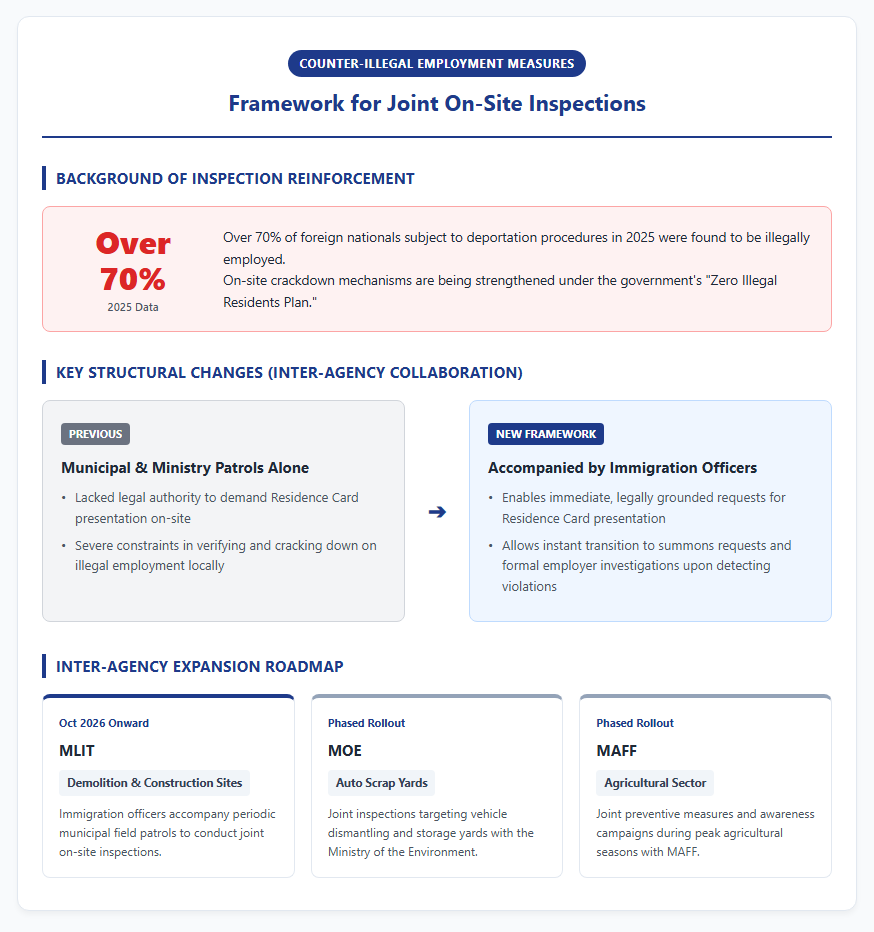
The Immigration Services Agency (ISA) of Japan has finalized plans to significantly scale up inter-agency cooperation to strengthen crackdowns on illegal foreign employment. As early as October 2026, immigration control officers will accompany periodic field patrols conducted by the Ministry of Land, Infrastructure, Transport and Tourism (MLIT) through local municipalities at demolition and construction sites to carry out joint inspections. Previously, municipal and MLIT officials lacked the legal authority to demand the presentation of Residence Cards on-site, severely limiting their ability to verify lawful employment status. The presence of ISA officers will enable immediate presentation requests and real-time verification of legal working status on location.
This initiative forms a core part of Japan’s broader measures against illegal staying, prompted by data showing that over 70% of foreign nationals subject to deportation procedures in 2025 were found to be illegally employed. Aligned with the government’s “Zero Illegal Residents Plan,” the scope of these joint inspections is expected to expand beyond demolition sites. Future operations will include joint inspections with the Ministry of the Environment at auto scrap yards used for dismantling and storing vehicles, as well as awareness campaigns with the Ministry of Agriculture, Forestry and Fisheries to prevent illegal hiring during peak agricultural seasons.
The Reality of Illegal Employment at Demolition Sites and Scrap Yards
Construction and demolition sites, alongside auto scrap yards, face structural vulnerabilities that make them prone to illegal employment due to severe domestic labor shortages. In January 2026, a demolition company in Yokohama, Kanagawa Prefecture, was raided, leading to arrests and charges for illegally employing four Vietnamese workers whose period of stay had expired. The demolition sector suffers from high physical demands, making it difficult to attract younger workers and causing acute labor shortages that tempt businesses into improper hiring practices.
Moreover, illicit broker networks have increasingly emerged across social media platforms like Facebook, facilitating the illegal placement of overstaying foreign nationals with employers. Because these transactions take place within closed online communities, regulatory oversight remains exceptionally challenging. If workers suspected of illegal employment are identified during joint inspections, the ISA will issue summonses for questioning and launch formal investigations into the employing companies, aiming to disrupt the root causes of illegal hiring through heightened field surveillance.
Stricter Penalties Under Amended Immigration Law
Enhanced Penalties and Dual Liability Coming into Force in April 2027
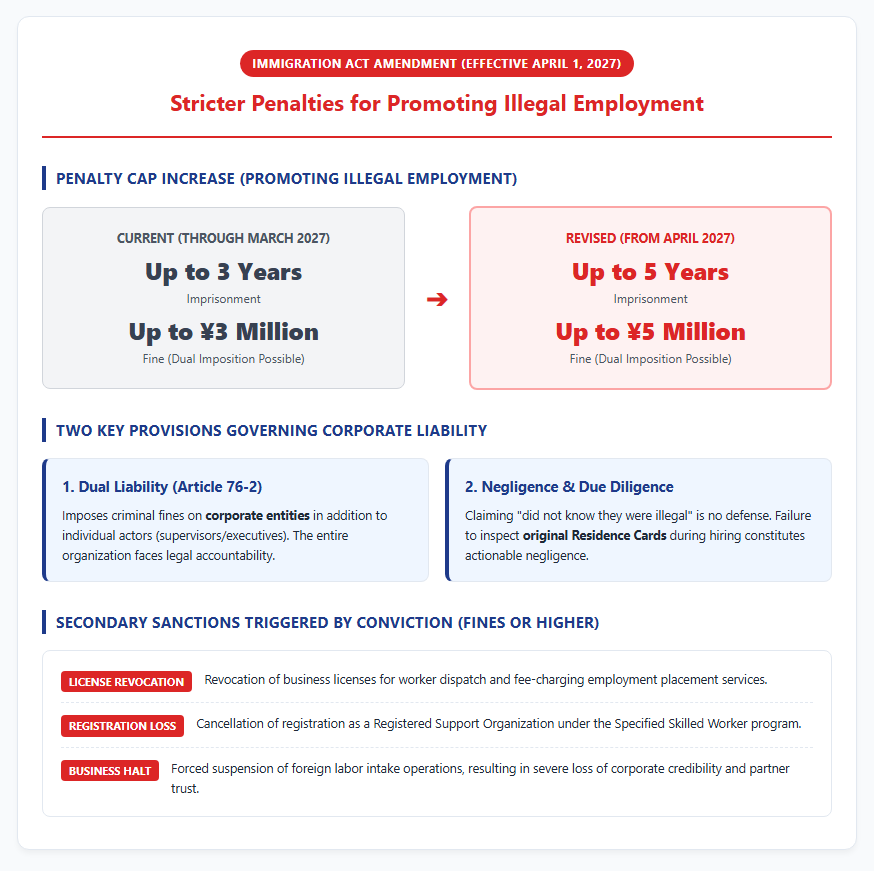
Under Article 73-2 of the Immigration Control and Refugee Recognition Act, the offense of Promoting Illegal Employment penalizes employers who hire illegal residents or individuals working outside the scope of their visa status, as well as brokers who facilitate such illegal employment. Under the revised Immigration Control Act passed in June 2024, penalties for this offense will be significantly escalated starting April 1, 2027. The maximum sentence will increase from the current “imprisonment for up to 3 years or a fine of up to 3 million yen (or both)” to “imprisonment for up to 5 years or a fine of up to 5 million yen (or both),” signaling a clear shift toward zero-tolerance enforcement by the state.
Crucially, this revision enforces “dual liability” under Article 76-2 of the Immigration Control Act, imposing criminal fines on corporations in addition to individual punishments for managers or supervisors. Because legal responsibility extends to the corporate entity as a whole, illegal employment now poses a catastrophic threat to business continuity that corporate executives cannot afford to overlook.
Negligence Penalties and Employer Due Diligence Obligations
The most critical aspect for corporations regarding the enforcement of the offense of Promoting Illegal Employment is the legal mechanism of negligence liability. Pursuant to Article 73-2, Paragraph 2 of the Act, claiming ignorance of a worker’s illegal status does not exempt an employer from criminal liability if the business failed to perform due diligence during hiring and employment management. Verbal assurances such as “the applicant claimed they were authorized to work” or “the individual spoke fluent Japanese” offer no legal defense. Employers are legally obligated to inspect original Residence Cards to verify visa category, expiration date, and work restriction details.
If a company is convicted and fined for promoting illegal employment, the consequences extend far beyond monetary penalties. The business faces severe administrative sanctions, including the revocation of licenses for worker dispatch and fee-charging employment placement services, as well as the cancellation of registration as a Specified Skilled Worker Registered Support Organization. Such penalties can force the complete shutdown of foreign labor operations and inflict irreparable damage on corporate reputation and commercial partnerships.
Reform of Foreign Labor Systems and Future Outlook
Abolition of Technical Intern Training and the Launch of the Training and Employment System
Japan’s framework for receiving foreign labor is undergoing a historic transformation. The long-standing Technical Intern Training Program will be abolished and replaced by the newly established “Training and Employment System” (Ikusei Shuro) on April 1, 2027. While the legacy internship program officially aimed at international technology transfer but faced widespread criticism for low wages and worker disappearances, the new system explicitly prioritizes “human resource development and labor supply.” It is designed to train foreign workers over a three-year period to reach the job-ready standards of “Specified Skilled Worker Category 1.”
The Training and Employment System introduces clear Japanese language proficiency requirements: equivalent to A1 level prior to entry and A2 level (equivalent to JLPT N4) upon completion. A defining feature of the new system is that workers who have served at the same organization for over one year, passed required skill and language tests, and meet specific criteria—such as transferring to a certified good-standing employer—will be permitted to change employers within the same job category based on their own preference.
Structural Challenges in Construction and Key Focus Areas Ahead
The utilization of foreign talent in the construction and demolition sectors is deeply intertwined with industry-specific structural issues. According to MLIT surveys, sub-subcontractors at the third tier or below account for 68.9% of building construction projects, with fourth-tier (21.5%) and fifth-tier or lower (9.7%) subcontracts demonstrating extreme multi-layered structures. Amid long-standing concerns regarding inadequate compensation under subcontracting agreements, many firms limit direct hires to cope with seasonal demand swings, creating a heavy reliance on outsourcing and temporary foreign labor.
In April 2027, the stricter penalties for promoting illegal employment and the implementation of the Training and Employment System will take effect simultaneously. Businesses must pivot away from viewing foreign workers as short-term labor stopgaps. Corporate compliance now requires systematic verification tools—such as Residence Card scanning apps—automated tracking of visa expiration dates, and rigorous due diligence across supply chain partners. Establishing a fully compliant and equitable employment environment is the only sustainable path for companies to attract foreign talent and ensure long-term business viability.
Reference Pages
- [Number of Illegal Residents in Japan (Immigration Services Agency)] https://www.moj.go.jp/isa/publications/press/13_00058.html
- [About the Training and Employment System (Immigration Services Agency)] https://www.moj.go.jp/isa/policies/trainee/page21_00001.html
- [Immigration Control and Refugee Recognition Act (e-Gov Legal Search)] https://laws.e-gov.go.jp/law/326CO0000000319
- [System Regarding Specified Skilled Worker Status in the Construction Sector (MLIT)] https://www.mlit.go.jp/totikensangyo/const/1_6_bt_000167.html
【#IllegalEmployment #ImmigrationServicesAgency #MLIT #PromotingIllegalEmployment #TrainingAndEmploymentSystem #Compliance】


コメント