Ibaraki City, Osaka Prefecture, and NTT West have launched a demonstration experiment utilizing a homegrown large language model for administrative tasks at elementary and junior high schools. Behind this initiative lie two major challenges: the need to reduce teachers’ workloads and the secure management of confidential information handled in school environments.
- Overview of the Verification Utilizing Japan’s First Purely Domestic LLM, “tsuzumi 2”
- Advanced Security Enabled by On-Premises Environments and Access Control
- Teachers’ Increasing Workloads and Generative AI Adoption Reaching a Majority
- The High Hurdle of Protecting Confidential Information and Ensuring Security
- Reducing Paperwork and Creating Time for Teachers to Focus on Students
- Evaluation Metrics for Demonstration Results and Key Points for Expansion to Other Municipalities
Overview of the Verification Utilizing Japan’s First Purely Domestic LLM, “tsuzumi 2”
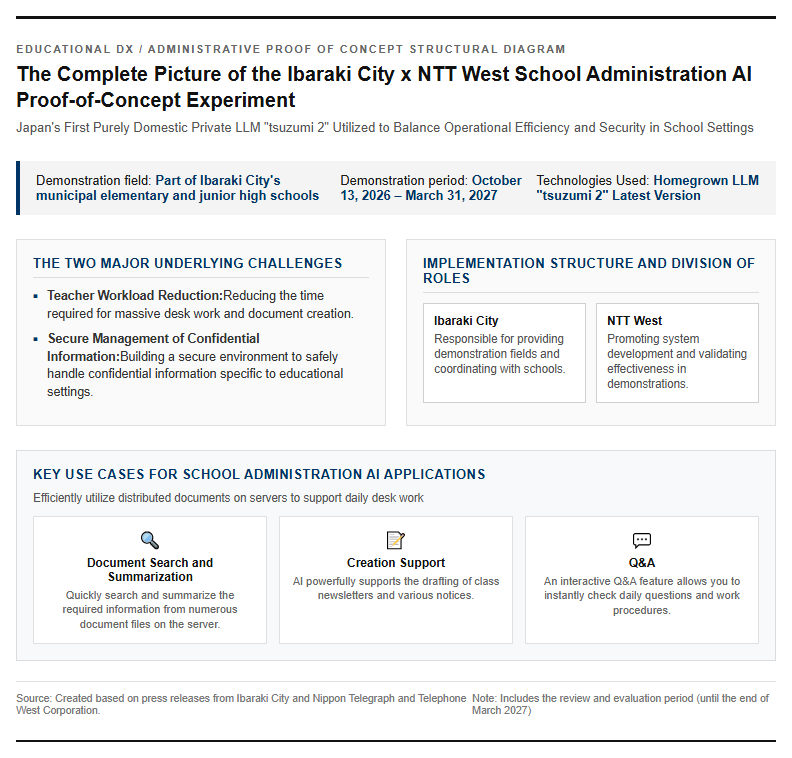
Ibaraki City, Osaka Prefecture, and NTT West started a demonstration experiment of generative AI on October 13, 2026, at selected municipal elementary and junior high schools, aimed at supporting teachers and staff with administrative duties. This initiative marks the first time in Japan that a homegrown private Large Language Model (LLM) is being utilized in the school environment of elementary and junior high schools. The demonstration period runs until March 31, 2027, including review and evaluation periods. For this demonstration, an application adopting the latest version of “tsuzumi 2″—a proprietary Large Language Model with exceptional Japanese language processing capabilities independently developed by NTT—has been introduced. Ibaraki City is responsible for providing the demonstration field and coordinating with the schools, while NTT West is driving system development and effectiveness verification. In school administration settings, the AI will be used primarily for routine document creation tasks, such as searching and summarizing numerous document files scattered across servers, and assisting in the creation of class newsletters and various notices. It is also equipped with an interactive question-and-answer function, aiming to streamline desk work that has traditionally consumed a massive amount of time. The diagram below illustrates the usage concept of the school administration AI application in school settings.
Advanced Security Enabled by On-Premises Environments and Access Control
In the field of school education, highly confidential data such as student academic records, personal information, and guidance logs are handled on a daily basis. Therefore, careful discussions have been required regarding the direct use of standard, general-purpose external cloud-based generative AI services. The key feature of this demonstration experiment in Ibaraki City is that it operates in an on-premises environment that does not transmit data to external services. Relatively low-cost GPU (graphics processing unit) servers are installed within the organization to run the LLM in a closed network environment. Furthermore, it implements strict access control features based on the roles and permissions of faculty and staff. This design restricts AI access to specific confidential documents for which users lack viewing rights, fundamentally eliminating the risks of data leaks and unauthorized access. It is attracting strong interest from boards of education nationwide as a technical approach that verifies the balance between safety and practicality tailored specifically to educational environments, rather than merely pursuing convenience.
Current Status and Background of Generative AI Adoption in Educational Settings
Teachers’ Increasing Workloads and Generative AI Adoption Reaching a Majority
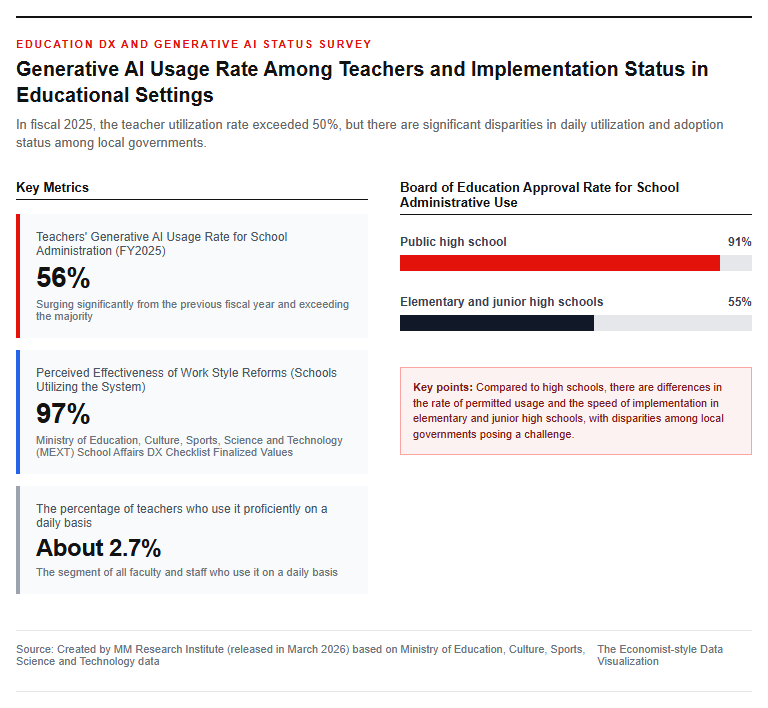
Long working hours and excessive workloads among teachers in Japanese elementary and junior high schools are serious issues, and the Ministry of Education, Culture, Sports, Science and Technology (MEXT) along with local governments are rapidly promoting work style reforms through school administrative DX. According to a survey released in March 2026 by the private research firm MM Research Institute (as of December 2025), the adoption rate of generative AI by teachers for school administration surged significantly in fiscal 2025, exceeding a majority at 56%. Boards of education allowing teachers to use generative AI for administrative tasks account for 91% in public high schools and 55% in elementary and junior high schools. Furthermore, finalized data from the school administrative DX checklist published by MEXT shows that 97% of schools utilizing generative AI for administrative work reported experiencing the benefits of work style improvements. However, at the same time, schools where all teaching and administrative staff routinely use generative AI remain at only about 2.7% of the total, and the reality is that a divide is emerging between local governments making headway with implementation and those that have yet to introduce it. The following graph shows the trends in the generative AI adoption rate among teachers.
The High Hurdle of Protecting Confidential Information and Ensuring Security
While the practical use of generative AI is advancing in school settings, security and the establishment of rules are emerging as major operational challenges. According to a survey by MMD Research Institute, 81% of boards of education reported facing challenges in utilizing AI. Specifically, security measures account for 42%, avoiding the risk of copyright infringement accounts for 41%, the establishment of usage rules accounts for 39%, and the risk of hallucinations—outputting misinformation—accounts for 37%. Guidelines established by the Ministry of Education, Culture, Sports, Science and Technology (MEXT) also urge strict caution regarding the handling of personal information and unreleased grade data. Many local governments are strictly restricting the use of personal, free versions of ChatGPT and other tools with inadequate protective measures, establishing operational policies utilizing secure educational clouds and closed environments. This initiative by Ibaraki City can truly be called a pioneering demonstration designed to directly resolve the security concerns faced by local governments.
The Outcomes Aimed for by School Administration AI Pilot Projects and the Future of Educational DX
Reducing Paperwork and Creating Time for Teachers to Focus on Students
The fundamental objective of the joint verification experiment by Ibaraki City and NTT West is to reduce administrative working hours for school staff and secure more time for educational activities that directly involve students. In conventional school administration, past meeting minutes, educational guidelines, and various application forms were scattered across multiple folders on servers, requiring significant effort to locate desired materials and complete update procedures. By introducing natural language-based bulk search and summary generation powered by generative AI, the time required for information retrieval is dramatically reduced. In preceding cases at pilot schools, results showed that the time required to analyze and summarize free-text fields in various surveys was drastically cut from about two hours down to roughly 20 to 30 minutes. Building an environment where teachers can focus on the educational activities they should truly prioritize—such as developing teaching materials, providing individualized instruction, and counseling students—directly translates to an enhancement in the quality of education.
Evaluation Metrics for Demonstration Results and Key Points for Expansion to Other Municipalities
In this demonstration experiment, running until the end of March 2027, the scope goes beyond the mere introduction of AI tools, establishing a wide range of multifaceted evaluation metrics. Through regular surveys and direct interviews with faculty and staff, comprehensive assessments will be made regarding time saved on information retrieval and document creation, the usefulness of generated responses, usability, and future intent to continue using the tools. The “Education DX Roadmap,” formulated by the Digital Agency and the Ministry of Education, Culture, Sports, Science and Technology (MEXT), sets the goal of introducing next-generation school administrative DX environments across all local governments nationwide by fiscal 2029. Insights gained from this pilot are expected to serve as a crucial reference model for horizontal deployment to other municipalities. The key focal point for the future nationwide adoption of school administrative AI will be how to generalize school-specific document management methods and permission-setting formats, thereby reducing the operational burden during initial implementation.
Reference Page
- 【Ibaraki City, Osaka Prefecture Launches Japan’s First School Administration AI Proof-of-Concept for Elementary and Junior High Schools Using a Purely Domestic LLM】[suspicious link removed]
- [NTT’s Large Language Model tsuzumi] https://www.rd.ntt/research/LLM_tsuzumi.html
- [Ministry of Education, Culture, Sports, Science and Technology (MEXT): Utilization of Generative AI in School Settings] https://www.mext.go.jp/b_menu/shingi/chousa/shotou/175/mext_01385.html
【#IbarakiCity #NTTWest #SchoolAffairsAI #GenerativeAI #EducationDX #LLM】
コメント