
On October 9, 2026, the Ministry of Land, Infrastructure, Transport and Tourism (MLIT) launched a trial of an “interactive AI questionnaire” to further promote i-Construction and infrastructure DX. The initiative aims to delve into on-site challenges and perceptions—roughly 10 years after the efforts began—through dialogue with AI, and to reflect these insights into future policymaking and improvement measures.
- Key points of the event and the basic trial scheme
- Traditional Single-Response Surveys and the Deep-Dive Mechanism Using Conversational AI
- 10 Years Since the Formulation of i-Construction and the Achievement Targets of i-Construction 2.0
- Alignment of AI Implementation Policies and Physical AI Strategy in the Infrastructure Sector
- Identifying On-Site Bottlenecks and the Ripple Effect on Small and Medium-Sized Construction Companies
- Future Outlook and Key Points of Infrastructure DX Initiatives
Key points of the event and the basic trial scheme
On October 9, 2026, the Ministry of Land, Infrastructure, Transport and Tourism announced that it has begun trialing a questionnaire survey utilizing conversational AI, with the aim of further promoting i-Construction, infrastructure DX, and the utilization of AI. The implementation period is approximately two months, from October to the end of November 2026, and the target participants are member companies and related organizations of the i-Construction and Infrastructure DX Consortium. Responses will be conducted on a dedicated website for members, featuring an interface where the conversational AI presents additional questions in real time based on the respondent’s selections and written input.
The main research themes include the following:
- Changes and results on-site brought about by i-Construction, approximately 10 years after the initiative began
- challenges that still remain on-site and business processes that have not changed sufficiently
- Measures and support initiatives to be prioritized moving forward, including the utilization of AI technology
Unlike traditional mass-distribution surveys, it is characterized by using dialogue to delve deeper into respondents’ specific experiences and awareness of issues. The Ministry of Land, Infrastructure, Transport and Tourism plans to reflect the multifaceted opinions obtained through this trial in future policy deliberations and the enhancement of consortium activities, while also proceeding to verify the effectiveness and accuracy of the opinion-gathering method using generative AI itself.
Traditional Single-Response Surveys and the Deep-Dive Mechanism Using Conversational AI
When identifying operational challenges at construction sites, conventional multiple-choice and open-ended questionnaires have had the limitation of making it difficult to grasp the essence of the problems. For instance, even if feedback from the site indicates that “work is busy” or “paperwork takes time,” it has been difficult to determine whether the underlying cause is the hassle of data entry work, waiting for confirmation from stakeholders, or the search cost of failing to find necessary information.
In the newly introduced conversational AI survey, generative AI instantly analyzes responses and dynamically generates follow-up questions such as “At what stage of the work did you get stuck?” and “Is the person you are checking with the client or someone internal?” This allows respondents to articulate the specific bottlenecks in their work. As shown in the image below, the interface is structured to alternately present options and free-form dialogue on the screen.
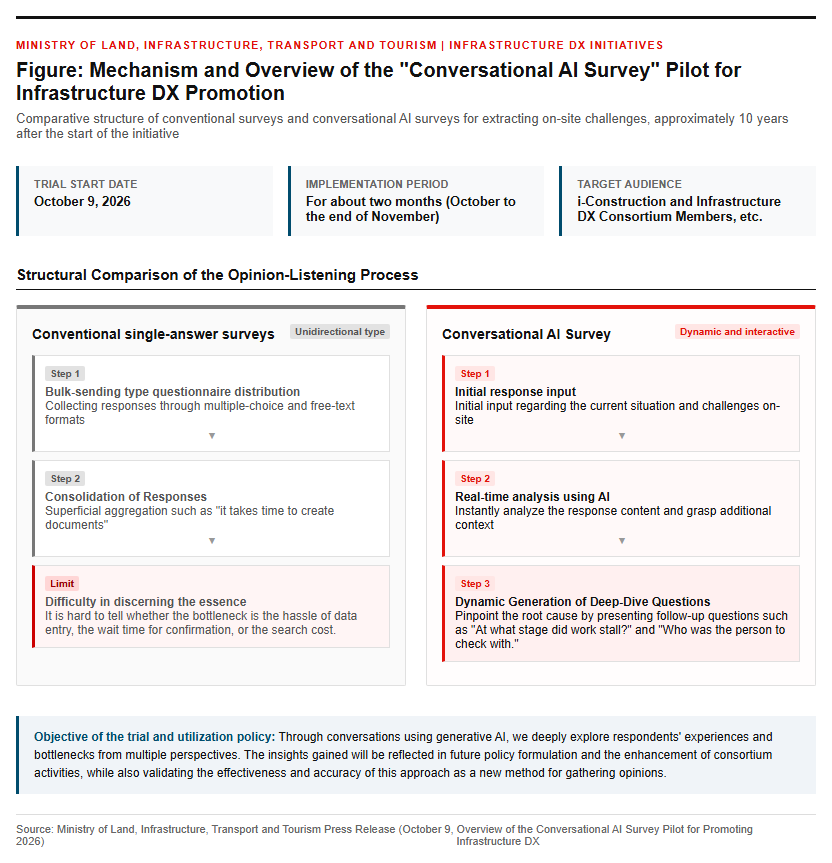
This interactive approach raises expectations that respondents’ superficial statements and the root causes of issues can be organized and converted into data. However, regarding final decisions on measures and the prioritization of issues, an operational rule is strictly enforced where these are not delegated to AI, and humans objectively verify them in accordance with actual conditions on the ground.
Background of the Trial and AI Implementation Policy in the Infrastructure Sector
10 Years Since the Formulation of i-Construction and the Achievement Targets of i-Construction 2.0
About 10 years have passed since the Ministry of Land, Infrastructure, Transport and Tourism launched i-Construction with the aim of improving productivity at construction sites. During this period, although some progress has been made—such as the introduction of ICT construction machinery, the utilization of 3D data, and the digitalization of construction management—structural challenges such as an aging workforce on-site, a severe labor shortage, and the difficulty of passing down technical skills continue to weigh heavily.
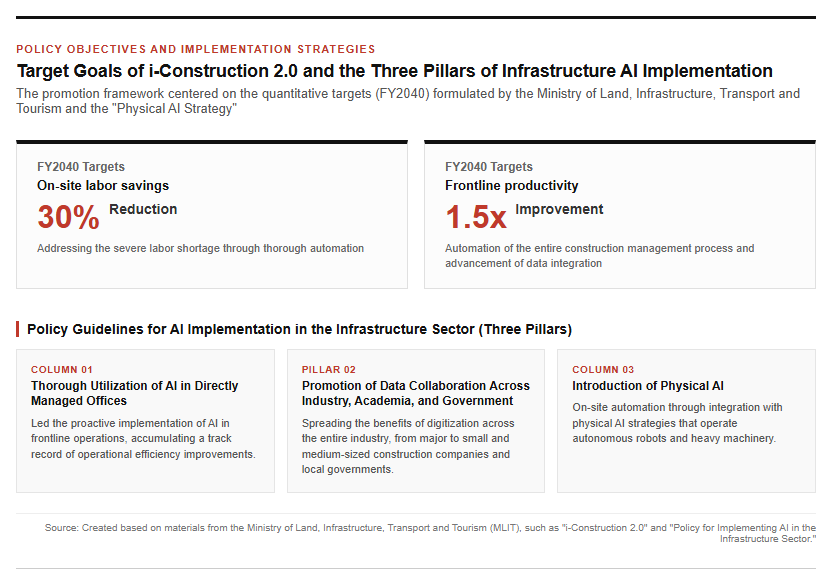
Against this backdrop, the Ministry of Land, Infrastructure, Transport and Tourism formulated “i-Construction 2.0” in April 2024 to promote the automation of construction sites. Under i-Construction 2.0, clear quantitative targets have been established to achieve a 30% reduction in on-site labor requirements and a 1.5-fold increase in productivity by fiscal 2040. To achieve these goals, it is deemed essential to go beyond the mere introduction of tools and instead advance the automation of the entire construction management process and enhance data integration.
However, the construction sector is characterized by one-off production, where weather and geological conditions vary by construction site, as well as a multi-layered business structure ranging from project owners to general contractors, subcontractors, and specialized construction companies. Therefore, penetrating the effects of digitalization not only to major general contractors handling large-scale projects, but also to small and medium-sized construction companies and local government work sites that make up the majority of the industry, is the biggest theme for the next decade.
Alignment of AI Implementation Policies and Physical AI Strategy in the Infrastructure Sector
In light of the revised Basic Plan for Artificial Intelligence approved by the Cabinet on July 14, 2026, the Ministry of Land, Infrastructure, Transport and Tourism (MLIT) released the “Policy Guidelines for AI Implementation in the Infrastructure Field” and the “Physical AI Strategy in the Construction Field (Interim Summary)” at the 13th DX Promotion Headquarters Meeting in the Infrastructure Field on August 26, 2026. The strategy positions AI as “a foundation that expands the capabilities of on-site workers and accelerates productivity improvement,” aiming for infrastructure management achieved through human-AI collaboration.
As specific developments, three main pillars have been set forth: thorough utilization of AI in direct control offices, promotion of data collaboration among industry, academia, and government, and the introduction of physical AI to operate autonomous robots and heavy machinery. As shown in the system conceptual diagram below, the creation of an environment where AI can efficiently read data is currently underway.
As measures of particular importance, the following initiatives can be cited.
- Facilitating communication by integrating conversational AI features into the information-sharing system (ASP) between buyers and suppliers
- Structuring technical standards such as common specifications for civil engineering works into HTML or JSON-LD formats that are easily interpreted by AI
- Data Integration Using MCP (Model Context Protocol) on the MLIT Data Platform (Kokudo DPF)
Under the Physical AI Strategy, eight priority fields have been established, including mechanical construction, structure inspection, weed and snow removal, and disaster recovery, with plans to digitize the decision-making rationale of skilled workers and connect it to on-site implementation.
Identifying Challenges at Construction Sites, Future Outlook, and Key Focus Areas
Identifying On-Site Bottlenecks and the Ripple Effect on Small and Medium-Sized Construction Companies
This trial of the interactive AI questionnaire is not merely for conducting policy evaluations, but also plays a role in uncovering the “true challenges” on the front lines. According to a questionnaire survey by the National Association of General Contractors (2,750 responding companies), the utilization rate of ASPs is the highest at 53.6% as a measure to reduce the burden on on-site engineers. While the reduction of paperwork and the introduction of remote site inspections are progressing, it has also highlighted realities such as complaints that work does not become any easier despite introducing tools, and discrepancies in operational understanding between clients and contractors.
In specialized construction companies and small to medium-sized construction enterprises, cases are sometimes observed where the parallel introduction of multiple DX tools leads to “in-house getting lost” (employees getting lost within the system) and data fragmentation, resulting in stagnation in construction management and estimation work. In this questionnaire, by having AI delve into examples of on-site failures and operational barriers, it will serve as an opportunity to deliver opinions directly toward the improvement of systems and specifications.
Even for SMEs that are not members of the consortium, it is crucial to understand what kind of questions the government is using to visualize operational challenges. Taking stock of where work halts in their own paper-, phone-, and Excel-dependent workflows is the key to preventing wasteful tool investments and making DX truly effective.
Future Outlook and Key Points of Infrastructure DX Initiatives
The trial results of the interactive AI questionnaire, to be conducted from October to the end of November 2026, will be tabulated and analyzed, and are planned to be incorporated into future infrastructure DX measures and consortium action plans. After verifying the dialogue accuracy and the effectiveness of intent extraction of the questionnaire itself, the Ministry of Land, Infrastructure, Transport and Tourism is also considering the potential future use of AI in administrative procedures and public comment procedures.
The greatest focus in future infrastructure DX will be the extent to which AI-driven “task automation” and “data integration” genuinely alleviate the burden on on-site engineers. To achieve i-Construction 2.0 by fiscal year 2040, an ecosystem that horizontally rolls out advanced case studies from large enterprises to local governments and small- and medium-sized construction companies nationwide is indispensable.
Here are the developments to watch in the future:
- Compilation of Next Fiscal Year’s Measures Based on Questionnaire Response Analysis up to the End of November 2026
- Demonstration of Automating Document Creation and Verification Work Between Clients and Contractors via Conversational AI Integration in an ASP System
- Establishment of an industry-academia-government consortium and development of field trial environments for physical AI
Instead of treating the adoption of digital technology as an end in itself, whether AI can be successfully integrated as a means to augment the capabilities of the “people” working on-site will determine the safety of Japan’s infrastructure and the sustainability of local construction industries.
Reference page
- 【Implementation of the “Conversational AI Survey” Regarding Infrastructure DX and AI Initiatives】https://www.mlit.go.jp/report/press/kanbo08_hh_001366.html
- 【Policy Guidelines for AI Implementation in the Infrastructure Field】https://www.mlit.go.jp/report/press/kanbo08_hh_001361.html
- 【i-Construction & Infrastructure DX Consortium Member Recruitment】[suspicious link removed]
【#MLIT #InfrastructureDX #iConstruction #ConversationalAI #ConstructionDX #PhysicalAI】


コメント