Nitori Holdings has migrated its core systems, which support in-store sales and delivery operations, to Oracle Cloud Infrastructure (OCI) and commenced live operations. This move was driven by severe operational challenges, including the expiration of maintenance for existing hardware, insufficient processing capacity during the spring peak demand period, and delays in daily batch processing.
- Overview of OCI Migration and Dramatic Improvements in Processing Performance
- The Impact of Shorter Daily Batch Processing Times on Business Operations
- Limitations of Conventional On-Premises Infrastructure and Motivations for Migration
- BCP Enhancement and DB Optimization through a Two-Region Configuration
- In-house Development and Talent Development Supporting the “Manufacturing, Logistics, IT, and Retail” Industries
- Core Cloud Migration in the Distribution and Retail Industry and Future Focus Areas
Overview of OCI Migration and Dramatic Improvements in Processing Performance
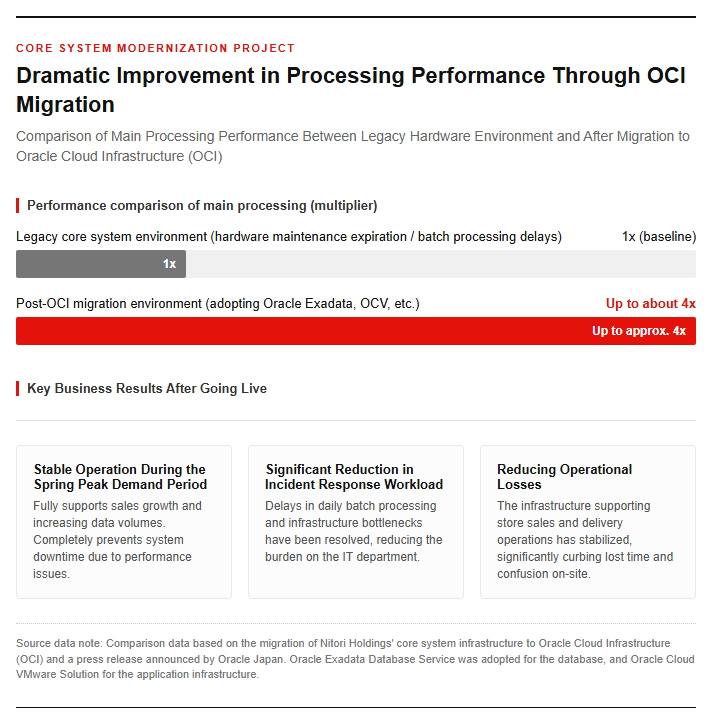
On September 15, 2026, Oracle Japan announced that Nitori Holdings has migrated its core system infrastructure—which handles operations such as in-store sales and delivery-related tasks—to Oracle Cloud Infrastructure (OCI) and commenced full-scale operations. Oracle Exadata Database Service was adopted for the database infrastructure, and Oracle Cloud VMware Solution is utilized for the application infrastructure. SCSK supported the project execution and infrastructure construction, while Assist was responsible for database evaluation and migration. Compared to the legacy environment, the performance of key processes improved by up to approximately 4 times. Even during the peak demand period in the spring of 2026 following the go-live, the system has continued to operate with extreme stability while accommodating increases in sales and data volume. By avoiding system outages caused by performance shortages during the peak season, not only was the IT department’s burden in responding to failures significantly reduced, but operational losses occurring at business sites such as stores and logistics were also substantially curbed. Please refer to the figure below.
The Impact of Shorter Daily Batch Processing Times on Business Operations
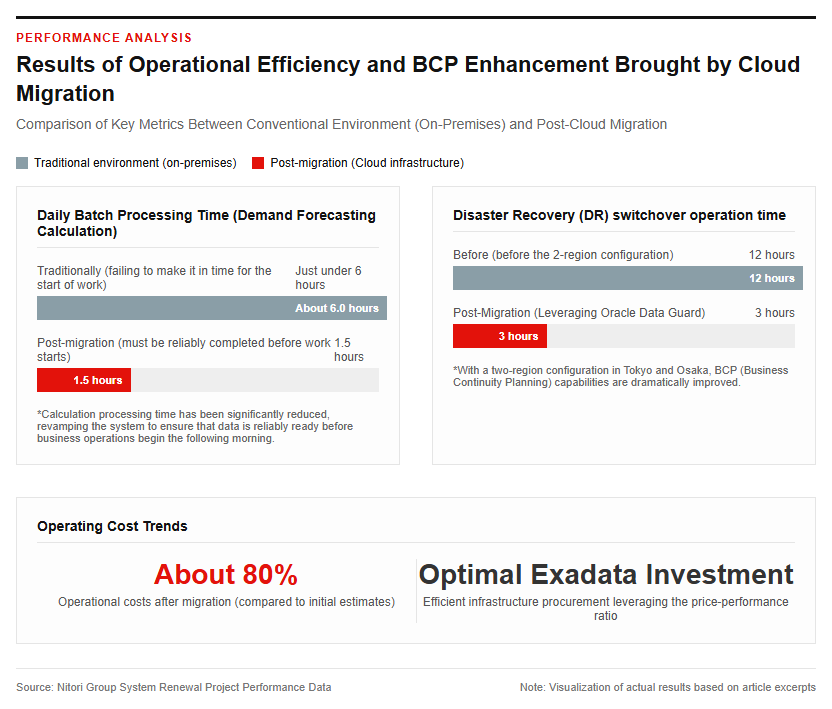
One of the most notable achievements of this cloud migration is the dramatic acceleration of the in-house daily demand forecasting calculation process. In the legacy environment, it took nearly six hours from the start of the process to the completion of calculations, presenting a major operational challenge as the processing failed to finish by the start of the next morning’s business hours. Following the migration, this calculation time was drastically reduced to an hour and a half, making it possible to advance the time when operations can begin the next day. With the calculation results for demand forecasting and automated ordering reliably available before business hours, product ordering decisions and shipping preparations at stores and logistics facilities nationwide have been streamlined, eliminating bottlenecks in the overall business process. Furthermore, a remarkable decrease in database wait events has established an environment where the entire system operates stably even during timeframes when large-scale data processing is concentrated. As a result, on-site workers can begin their operations first thing in the morning based on accurate demand forecasting data, making a significant contribution to preventing stockouts at stores and optimizing logistics allocation.
The Background of System Renewal and the Full Picture of the Technical Architecture
Limitations of Conventional On-Premises Infrastructure and Motivations for Migration
The Nitori Group is actively pursuing store expansion both domestically and internationally, global business development, and the promotion of new ventures. Along with this, the number of stores and the volume of data handled have increased significantly, and the processing limits of the traditional on-premises infrastructure were beginning to show. Previously, applications were run on an on-premises virtualization platform, with the on-premises Oracle AI Database used for the database layer. However, in addition to the approaching end-of-life for existing hardware maintenance, the surging system load during the busy spring season—when demand for furniture and interior goods peaks—had reached its breaking point. Furthermore, the execution times for in-house demand forecasting and automated ordering processes have been lengthening year by year, making it an urgent priority to secure processing headroom capable of withstanding future increases in data volume. Solving these multifaceted challenges and upgrading to an advanced IT infrastructure capable of flexibly accommodating business growth was required. Especially since the risk of system downtime during peak seasons directly translates to lost business opportunities, a complete migration to a cloud platform combining a dramatic boost in processing performance and high scalability became an indispensable decision.
BCP Enhancement and DB Optimization through a Two-Region Configuration
To enhance core system reliability and business continuity planning (BCP), an advanced disaster recovery (DR) environment utilizing Oracle Data Guard has been established. Specifically, it employs a two-region configuration that constantly and continuously synchronizes data between the Oracle Cloud Tokyo Region and the Oracle Cloud Osaka Region. The operational time required to switch to the DR environment in the event of an unforeseen disaster has been significantly reduced from the conventional 12 hours to 3 hours, dramatically enhancing the company’s recovery capabilities. In terms of system architecture, by migrating the application platform to the cloud while keeping the VMware environment intact, the scope of modifications was minimized while making focused investments in Exadata for the database, which was a processing bottleneck. Furthermore, by leveraging the high price-performance ratio at the time of selection, they also succeeded in keeping post-migration operating costs to approximately 80% of the initially projected amount, even though cost reduction itself was not the primary objective. Please refer to the figure below.
Nitori’s DX Strategy and Future Outlook
In-house Development and Talent Development Supporting the “Manufacturing, Logistics, IT, and Retail” Industries
Nitori Holdings has set a high target of 3 trillion yen in net sales by 2032. With consolidated net sales for the fiscal year ending March 2025 expected to reach the scale of 928.9 billion yen, the importance of promoting digital transformation (DX) has deeply permeated the organization from top management down to the frontline. The company’s strength lies in its IT insourcing system, which it has advanced for over 30 years. By building and controlling its systems in-house, Nitori has established a unique “manufacturing, logistics, IT, and retail” model that seamlessly handles everything from manufacturing and logistics to IT development and retailing. Under the leadership of Chief Information Officer (CIO) Nao Takei, who serves as the commander of DX, the company is focusing on cultivating and securing digital talent well-versed in both IT and frontline operations, centered around Nitori Digital Base. While leveraging existing application assets, this recent bold decision to migrate only the database infrastructure to a cutting-edge cloud can be called a rational approach unique to a company that deeply understands its own system structure and has led development in-house.
Core Cloud Migration in the Distribution and Retail Industry and Future Focus Areas
In recent years, the domestic distribution and retail industry has faced a common challenge with the aging and black-box nature of legacy core systems that have been operated for many years, leading to a rapid expansion in demand for cloud migration toward modernization. Amid the growing adoption of the “Fit to Standard” approach—aligning business processes with standard functions—and the introduction of AI-powered demand forecasting and automated ordering, Nitori’s recent migration to OCI is attracting significant attention as a pioneering industry case study. Defining outcomes not just in terms of improved processing performance and shortened batch processing times, but by reliably meeting the operational deadline of the morning start time, serves as an important guideline for evaluating corporate IT investments moving forward. Based on this newly constructed flexible infrastructure, the modernization of point systems, the expansion of e-commerce malls, and multi-platform deployments including overseas bases are expected to accelerate further, making their continued evolution one to watch closely.
Reference page
【#Nitori #OCI #CloudMigration #CoreSystem #DX #Oracle #Database】
コメント