SolarWinds announced the autonomous IT operations system “Avior” on October 14, 2026. This is driven by the goal of achieving automation that eliminates operational risks in increasingly complex hybrid IT environments by combining traditional probabilistic AI models with a deterministic execution framework.
- Announcement of Agentic AI “Avior” and Key Points of the Events
- The Mechanism of Deterministic Execution That Ensures Certainty
- AI by Design Philosophy and Risk-Tiered Access Control
- Model Context Protocol and Specific Tasks That Work in Practice
- Verification Challenges of Operational Automation Brought by a Deployment Base of 300,000 Companies
- Expanding Agent Capabilities and Autonomous IT Operations: Future Developments and Key Points to Watch
Announcement of Agentic AI “Avior” and Key Points of the Events
On October 14, 2026, IT infrastructure management giant SolarWinds officially announced “Avior,” an agentic artificial intelligence system designed for enterprise IT operations. Avior is designed not merely as an interactive virtual assistant, but as a standalone application that autonomously understands operational objectives and completes advanced incident analysis and system configuration tasks. Aimed at the company’s enterprise customer base of over 300,000 organizations worldwide, the system has begun rolling out through guided deployment programs in both SaaS and self-hosted environments. As the expansion of IT infrastructure makes alert fatigue and labor shortages leading to delayed incident response severe challenges, the system aims to shift operations from passive reactions to notifications to proactively stabilizing systems based on goals. While the uncertainty of suggestions presented by conventional generative AI tools has been a barrier to enterprise adoption, this system incorporates 25 years of the company’s operational expertise into its algorithms, providing a mechanism that allows organizations to confidently delegate autonomous operations even in mission-critical environments.
The Mechanism of Deterministic Execution That Ensures Certainty
The most defining feature of Avior is its combination of large language models that perform probabilistic reasoning and a strict control framework called deterministic execution. Conventional large language models output answers that are probabilistically deemed optimal for a given prompt, which carries the risk of producing different results with every execution. This has made direct automated execution difficult in IT infrastructure settings where system downtime or security breaches are unacceptable. In contrast, with Avior, while the large language model is responsible for analyzing solutions and planning “what should be done,” actual system operations and change procedures are processed in accordance with a deterministic framework and rules with pre-defined safety. As shown in the block diagram below, the probabilistic model and the deterministic execution framework are integrated.
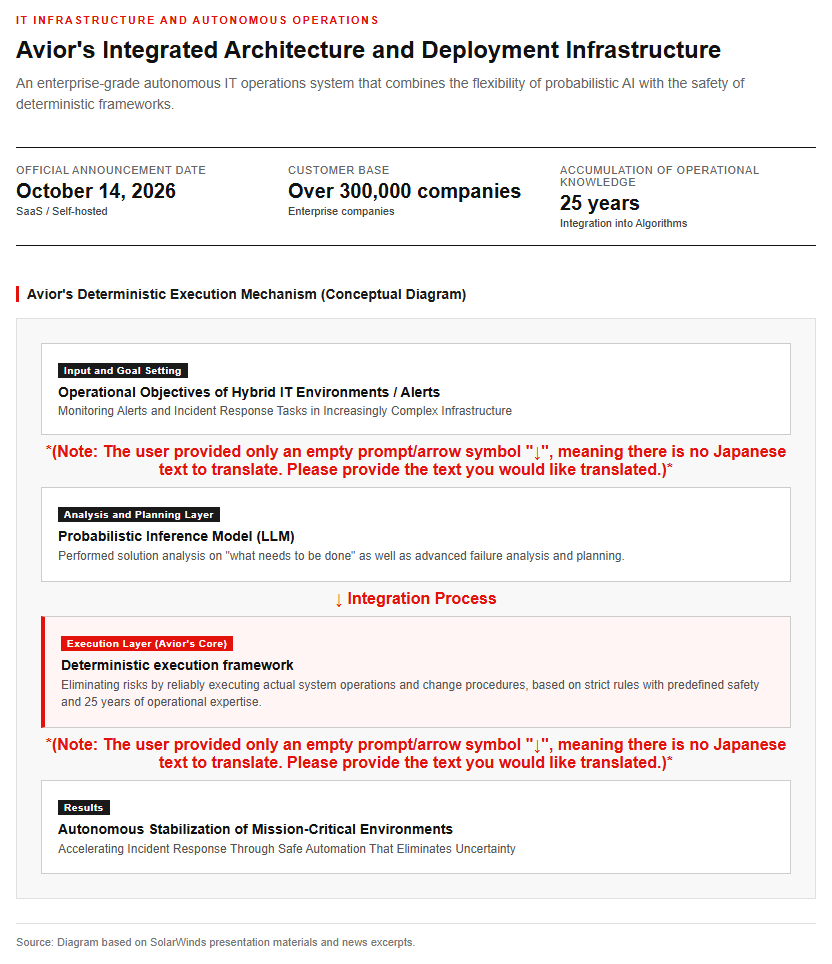
This makes it possible to maintain reproducibility and predictability of execution results close to 100 percent while leveraging AI’s flexible decision-making capabilities. All operational procedures are recorded as verifiable logs, and a safety design is implemented in which an automatic rollback function immediately activates in the unlikely event that unexpected behavior occurs.
Avior’s Technical Architecture and Phased Autonomous Control
AI by Design Philosophy and Risk-Tiered Access Control
Avior is built upon “AI by Design,” a responsible AI development framework advocated by SolarWinds. This framework consists of three pillars: purpose, transparency, and control, and is meticulously designed to strictly adhere to enterprise security and privacy protection. Operational autonomy is managed through a risk-tiered approach; routine tasks that do not impact system safety, such as log cleanup and information gathering, are executed automatically, while high-risk operations—such as modifying network device configurations or rebooting servers—are built with a mechanism that always requires explicit human approval. As illustrated in the management model image below, a human-led approval flow corresponding to the risk level is applied.
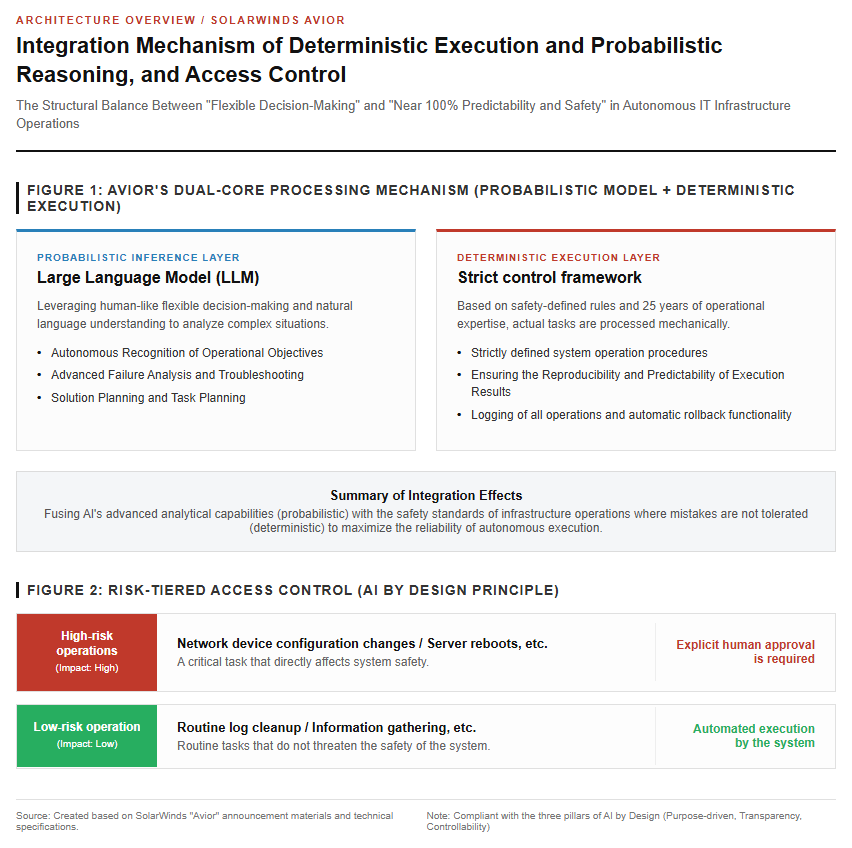
Three operational modes are available: an assistive mode that only provides suggestions, a human-in-the-loop mode where humans perform approvals, and a fully autonomous mode that operates within predefined guardrails. Additionally, customer operational data is never used to retrain models, and access control based on the principle of least privilege along with data masking are applied at all times.
Model Context Protocol and Specific Tasks That Work in Practice
Avior not only operates on the SolarWinds Platform, but by supporting the Model Context Protocol—an industry standard—it also integrates seamlessly with third-party external systems and heterogeneous environments. Specific features supported at the initial release include a noise-reduction function that automatically consolidates a large volume of related monitoring alerts into a single incident, and a function that detects unauthorized configuration changes and automatically restores systems to the last known good configuration. Furthermore, agents handle high-load daily operations such as verifying scheduled configuration backups, automatically cleaning up unresponsive “ghost” devices, and managing firmware versions and tracking vulnerability exposure. This significantly reduces the time infrastructure personnel spend processing monitoring queues, creating an environment where they can focus on more strategic infrastructure design and value-creation tasks. It is also equipped with advanced root-cause analysis capabilities that cross-diagnose logs and metrics spanning multiple products to track down the root cause of issues.
Impact on Enterprise IT Operations and Future Outlook
Verification Challenges of Operational Automation Brought by a Deployment Base of 300,000 Companies
Providing agent capabilities directly to SolarWinds’ existing customer base of over 300,000 companies has the potential to dramatically accelerate the adoption of AI agents in enterprise IT. The ability to test agent features simply by flipping a configuration flag on their existing operations platform—without the costs and learning curves associated with introducing new monitoring tools—significantly lowers the implementation hurdles for enterprises. Meanwhile, amid a flurry of announcements regarding such agentic AI within the industry, critics have also pointed out the challenge that the publication of quantitative outcome data, such as actual reductions in mean time to recovery and cost savings, is not keeping pace. Driven by concerns over security risks and system failures, many business leaders remain cautious about adopting autonomous operations tools. Consequently, the concrete numerical results demonstrated by early adopters regarding incident reduction rates and operational workload savings will hold the decisive key to full-scale market adoption moving forward.
Expanding Agent Capabilities and Autonomous IT Operations: Future Developments and Key Points to Watch
SolarWinds has clearly outlined the feature expansion roadmap for Avior and plans to introduce additional specialized agents moving forward. Following the currently available network engineering agent, a dedicated database management agent is planned for release in the fourth quarter of 2026. Furthermore, agents tailored for IT administrators, site reliability engineers (SREs), and security analysts are scheduled to be rolled out sequentially from the end of the fourth quarter of 2026 into early 2027. An evolution is anticipated from a single monitoring tool to a distributed multi-agent ecosystem where multiple domain-specific agents work in coordination. IT operations are undergoing a major paradigm shift—moving away from the traditional “race against response time to react quickly after an incident occurs” toward “proactive orchestration that prevents and controls incidents beforehand based on clear goals and safety guardrails.”
Reference page
- [SolarWinds Avior Official Product Page] https://www.solarwinds.com/avior
- [SolarWinds AI by Design Framework] [suspicious link removed]
- 【The Evolution of Agentic AI in Cybersecurity (arXiv)】[suspicious link removed]
[#SolarWinds #Avior #AgenticAI #ITOperationsAutomation #Cybersecurity #DeterministicExecution #AIOps]

コメント