In the demonstration experiments for the social implementation of automated logistics roads for fiscal 2026 conducted by the Ministry of Land, Infrastructure, Transport and Tourism, a driving verification project to be carried out by a three-company group consisting of Taisei Corporation, TIER IV, and Taisei Rotec has been selected. Behind this lies a national strategy to develop unmanned and automated transport infrastructure utilizing road space, aimed at addressing the severe driver shortage caused by the 2024 logistics problem and the approximately 25% transport capacity shortfall projected for the 2030s.
- Selection Results of Demonstration Experiments and Preliminary Project Overview
- The roles and technical strengths of the three selected companies
- The Impact of the “2024 Logistics Problem” and a 25% Transport Capacity Shortage
- How the Unmanned 24-Hour Expressway Transportation System Works
- Verification of Multi-Vehicle Operation and Infrastructure Simplification in Tunnel Environments
- Future Roadmap and Challenges Toward Practical Application in the Mid-2030s
Selection Results of Demonstration Experiments and Preliminary Project Overview
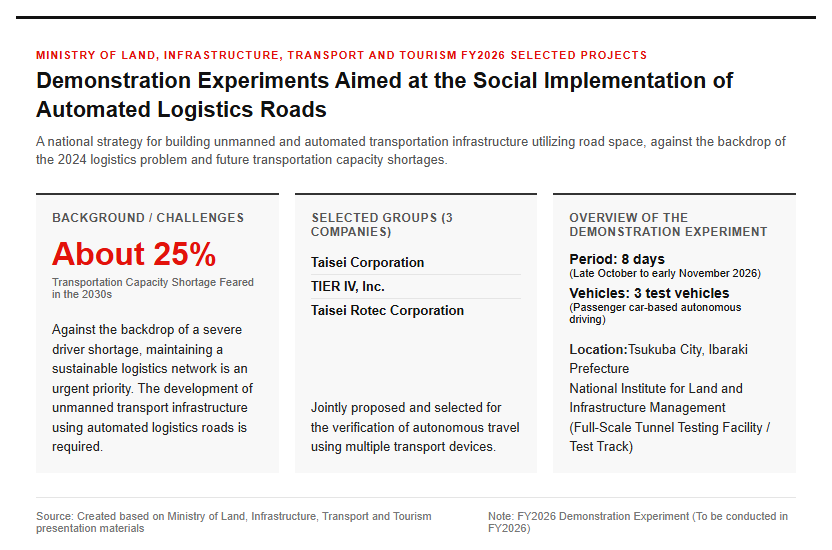
In October 2026, the Road Bureau of the Ministry of Land, Infrastructure, Transport and Tourism announced the selected operators for the “FY2026 Demonstration Experiment Aiming for Social Implementation of Automated Logistics Roads.” This demonstration experiment, for which public applications were accepted from July 22 to August 21, 2026, is positioned as part of a national project aimed at overcoming the logistics crisis and achieving carbon neutrality. This time, a joint group consisting of three companies—Taisei Corporation, TIER IV, Inc., and Taisei Rotec Corporation—was officially selected for their proposal on the “Verification of Autonomous Driving of Multiple Transport Devices.” The demonstration experiment will be conducted for eight days from late October to early November 2026 at the Full-Scale Tunnel Experiment Facility and test tracks (East Straight, South Loop) of the National Institute for Land and Infrastructure Management of the Ministry of Land, Infrastructure, Transport and Tourism, located in Tsukuba City, Ibaraki Prefecture. In the experiment, three passenger car-based experimental autonomous vehicles will be used to verify driving performance, such as platooning and passing each other in a tunnel environment. By utilizing tunnel facilities that closely resemble actual operational environments, the aim is to enhance practicality for future dedicated logistics roads. Please refer to the figure below.
The roles and technical strengths of the three selected companies
In this demonstration experiment, the three selected companies will advance verification with clear roles based on their respective areas of expertise. Taisei Corporation will formulate and execute the overall plan, conduct data analysis and evaluation, and verify the effectiveness of “T-Localizer®”, a self-position estimation support technology independently developed by the company. TIER IV will provide its proprietary system “Pilot.Auto”, which is based on the open-source autonomous driving software “Autoware”, along with three experimental vehicles, and will be responsible for driving settings, demonstration support, and driving data analysis. Taisei Rotec will be responsible for the planning, construction, and measurement of reflectors using special paint so that in-vehicle LiDAR can recognize road surfaces and walls with high precision. These three companies also collaborated in the FY2025 demonstration experiments, achieving successful results in verifying the dynamic wireless power transfer technology “T-iPower® Road” and autonomous driving support. In FY2026, they will take a step further, aiming to build a rational system optimized for dedicated spaces by integrating the autonomous driving system on the vehicle side with the equipment on the road infrastructure side.
The Full Picture of the Automated Logistics Road Initiative Amid the Logistics Crisis
The Impact of the “2024 Logistics Problem” and a 25% Transport Capacity Shortage
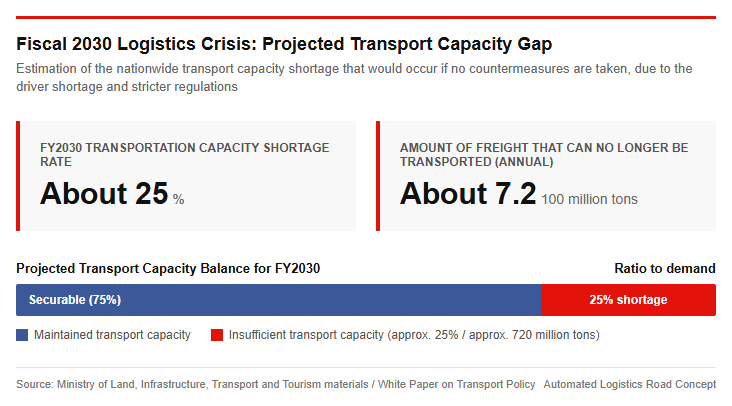
The Japanese logistics industry is facing a severe crisis due to a sharp decline in the number of drivers accompanying the declining birthrate and aging population, and the “2024 Logistics Problem” caused by regulations on the upper limit of overtime work. Furthermore, it is estimated that if no countermeasures are taken, a supply-demand gap known as the “2030 Problem” will occur by fiscal 2030, meaning that approximately 720 million tons of freight—equivalent to about 25% of the total domestic transport capacity—will not be able to be transported. To overcome this structural transport capacity shortage, the government has set forth a policy to automate and make road spaces themselves intelligent in the “2026 Traffic Policy White Paper” approved by the Cabinet in May 2026, among other measures. Breaking away from the conventional system dependent on long-hour truck transportation by drivers, creating dedicated infrastructure capable of unmanned operation 24 hours a day, 365 days a year without breaks has become an urgent issue. Automated logistics roads are strongly expected to serve as a groundbreaking solution to secure a stable transport volume without being affected by truck drivers’ working hour regulations. Please refer to the figure below.
How the Unmanned 24-Hour Expressway Transportation System Works
The “Auto-Flow Road,” promoted by the Ministry of Land, Infrastructure, Transport and Tourism, is a new initiative that utilizes existing infrastructure such as highway medians, underground spaces, and elevated structures to construct spaces dedicated exclusively to logistics. Within these dedicated spaces, unmanned, automated transport vehicles powered by clean energy will operate, transporting cargo without human intervention 24/7, 365 days a year. By creating a dedicated space that completely bars entry to regular vehicles and pedestrians, the system achieves high punctuality and safety, unaffected by weather or traffic congestion. Furthermore, the initiative incorporates not only transport functions but also automated cargo storage and labor-saving loading and unloading operations at hub facilities, aiming to automate the entire supply chain. The government aims to put the system into practical use on the Tokyo-Osaka arterial route by the mid-2030s, with development moving forward as a massive national project to fundamentally transform Japan’s logistics infrastructure.
Specific Verification Details and Future Prospects for the FY2026 Demonstration Experiment
Verification of Multi-Vehicle Operation and Infrastructure Simplification in Tunnel Environments
In the demonstration experiment scheduled to start in late October 2026, advanced driving tests using three autonomous vehicles will be conducted in a tunnel facility where GPS signals cannot reach. The verification items include following and stopping behind a lead vehicle, face-to-face and parallel driving, lane changes, diverging and merging, as well as avoidance and overtaking assuming roadside fallen objects, and millimeter-level stop position accuracy. A particularly important verification theme is balancing the “reduction of in-vehicle sensors” and “simplification of roadside infrastructure” required for autonomous driving. By leveraging the characteristics of a logistics-exclusive space—unlike public roads—and utilizing Taisei Corporation’s “T-Localizer®” and Taisei Rotec’s reflector paint, the project will explore methods to ensure high safety while reducing reliance on expensive in-vehicle sensors. By clarifying the optimal division of roles between the vehicles and the infrastructure, the policy aims to significantly reduce future construction and maintenance costs.
Future Roadmap and Challenges Toward Practical Application in the Mid-2030s
The roadmap for implementing automated logistics roads outlines plans to complete verification of the end-to-end operation processes and multi-vehicle control through demonstrations by fiscal 2026. From fiscal 2027 onward, the project will transition to Phase 2, with plans to conduct large-scale real-world testing utilizing actual infrastructure, using uncompleted sections of the currently under-construction Shin-Tomei Expressway (such as the Shin-Hadano to Shin-Gotemba section) as a testbed. Future challenges toward societal implementation include international standardization under JIS and ISO for automated driving systems and transport equipment, as well as the establishment of safety standards and legal frameworks. Additionally, site selection for dedicated terminals (nodes) connecting automated logistics roads and public roads, the reorganization of surrounding logistics warehouses, and the standardization of cargo sizes and packaging (palletization) will be essential. Alongside the establishment of a technological foundation, the development of operational frameworks through public-private partnerships is moving forward.
Reference page
- [Ministry of Land, Infrastructure, Transport and Tourism: Demonstration Experiments Aimed at the Social Implementation of Automated Logistics Roads in FY2026] https://www.mlit.go.jp/report/press/road01_hh_002120.html
- [Ministry of Land, Infrastructure, Transport and Tourism: Automated Logistics Road (Autoflow Road)] https://www.mlit.go.jp/road/autoflow_road/
- [Tier IV Pilot.Auto] https://pilot.auto/
【#AutomatedLogisticsRoad #AutonomousDriving #MLIT #TIERIV #TaiseiCorporation #Logistics2024Problem #LogisticsDX】


コメント