According to the financial and economic report for October 2026 released by the Bank of Japan’s Naha Branch, Okinawa Prefecture’s economy is maintaining an expansionary trend. Behind this are the steady expansion of private consumption and tourism, coupled with increases in capital investment and public investment, as well as a gradual improvement in employment and income conditions.
- The economy maintains its expansionary trend, and major indicators also show positive trends.
- Tourism demand and personal consumption drive the regional economy.
- Capital investment and public works remained solid, underpinning construction demand.
- The Impact of Employment and Income Environment Improvements and Price Trends on Consumption
- Interest Rate Trends in Financial Markets and Their Impact on Corporate Management and Lending Rates
- Outlook and Challenges for the Sustainable Growth of Okinawa’s Economy
The economy maintains its expansionary trend, and major indicators also show positive trends.
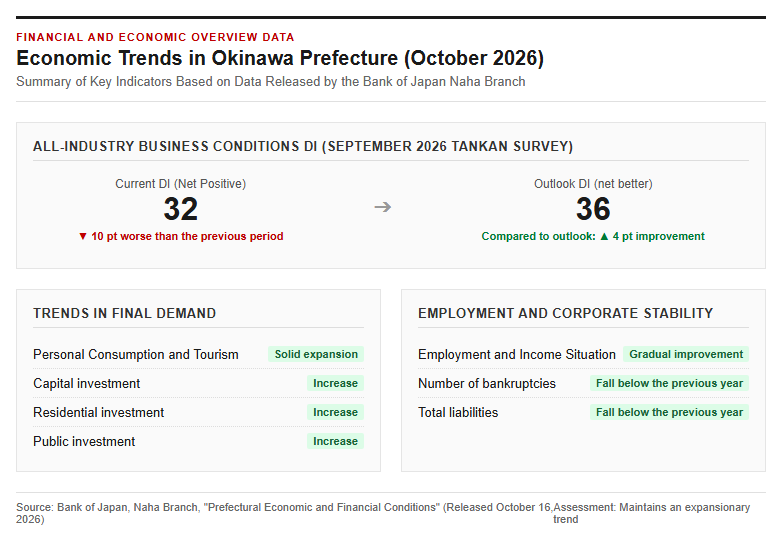
In the regional financial and economic overview released by the Bank of Japan’s Naha Branch on October 16, 2026, the economic assessment for Okinawa Prefecture was analyzed as being on an expansionary trend. Looking broadly at each component of final demand, private consumption, capital investment, housing investment, and public investment all show increases or moderate increases, confirming the multifaceted strength ofalu the regional economy. The all-industry business sentiment Diffusion Index (DI) in the September 2026 Tankan survey deteriorated by 10 points compared to the previous survey, but maintained a high level with an excess of “favorable” responses at 32. Furthermore, the outlook is projected to improve by 4 points to an excess of “favorable” responses at 36, showing that corporate sentiment remains positive. The number of corporate bankruptcies and total liabilities are also trending below the previous year, and the stability of corporate management is supporting the overall expansionary trend. Please refer to the figure below.
Thus, the Okinawan economy is charting an ideal growth pattern in which demand components are expanding in a well-balanced manner, without relying on a single driving force.
Tourism demand and personal consumption drive the regional economy.
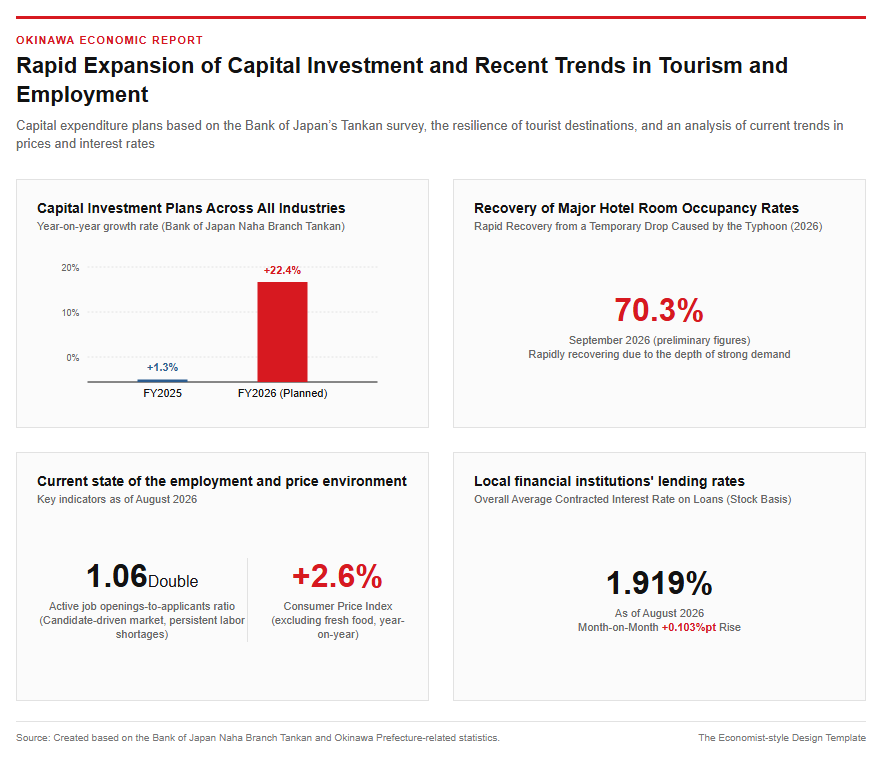
Personal consumption and tourism, the pillars of the regional economy, demonstrate that the primary drivers of economic expansion remain intact. In terms of personal consumption, department store and supermarket sales, convenience store sales, and home appliance sales all exceeded their previous year’s figures in August 2026, indicating underlying strength in consumer purchasing intent. On the other hand, in the tourism sector, the impact of a typhoon that occurred in August led to a temporary phase where the number of incoming tourists and the occupancy rates of major hotels fell below the previous year’s levels. However, the preliminary occupancy rate for major hotels in September rebounded rapidly to 70.3%, showing that the strong underlying trend in tourism demand remains unchanged. This has once again proven the strength of the Okinawa tourism market, possessing a depth of demand capable of swiftly absorbing slumps caused by temporary inclement weather such as typhoons. The increase in foreign tourists visiting Japan and the progress of infrastructure development are also contributing factors, and the virtuous cycle between personal consumption and tourism has become a major driving force boosting the economic sentiment of the prefecture’s economy.
Current Status Analysis of Demand Components and Major Industries Supporting the Okinawa Economy
Capital investment and public works remained solid, underpinning construction demand.
Capital investment by local companies and infrastructure-related public investment serve as a crucial foundation supporting medium- to long-term economic expansion. According to Tankan data from the Bank of Japan’s Naha Branch, capital investment across all industries is planned to expand significantly, rising from a 1.3% increase year-on-year in fiscal 2025 to a 22.4% increase in fiscal 2026. The floor area of non-residential building starts and the number of newly built housing starts are also trending above previous year’s levels, with active construction demand for the value enhancement of tourism-related facilities, commercial buildings, and housing. Public investment also remains at a solid level, and the construction industry as a whole is maintaining high operating rates. Although uncertainties regarding costs such as soaring labor costs and material prices remain, robust development demand is absorbing these risks. Active investment behavior by both the private and public sectors is accelerating the circulation of funds within the region, generating employment opportunities and ripple effects on related industries.
The Impact of Employment and Income Environment Improvements and Price Trends on Consumption
Against the backdrop of expanding economic activity, the employment and income situation in Okinawa Prefecture is following a gradual improvement trend. Total cash earnings in July 2026 exceeded those of the previous year, confirming that workers’ incomes are being lifted. The active job openings-to-applicants ratio for August 2026 stood at 1.06 on a seasonally adjusted basis, indicating that a job-seeker-favorable market and a sense of labor shortage continue to persist. This improved employment environment is underpinning household purchasing power, leading to a modest increase in private consumption. On the other hand, looking at price trends, the consumer price index (excluding fresh foods) for August 2026 rose 2.6% year-on-year, continuing to hover in the mid-2% range. Since rising energy prices and raw material costs are factors pushing up the cost of living, whether the growth in real wages can keep pace with inflation will be a crucial point influencing future consumption trends.
Economic Outlook and Its Impact on Regional Businesses: Key Points to Watch
Interest Rate Trends in Financial Markets and Their Impact on Corporate Management and Lending Rates
In terms of finance, along with changes in nationwide monetary policy, the transition to a “world with interest rates” is steadily spreading to regional financial markets. Both actual deposits and the balance of loans within the prefecture for August 2026 continued to trend above the previous year, underlying robust demand for funds. Amid this, the comprehensive average contracted interest rate on loans (on a stock basis) of the three local banks reached 1.919% in August 2026, rising by +0.103 percentage points from the previous month. While rising interest rates lead to expanded interest income for financial institutions, they pose the challenge of increased financial costs for local companies carrying borrowings. Please refer to the figure below.
Companies are required to strengthen their earning power through the enhancement of business added value and productivity reforms, while regional financial institutions are expected more than ever to provide consulting functions that go beyond mere financing, such as management improvement, business succession, and DX support.
Outlook and Challenges for the Sustainable Growth of Okinawa’s Economy
The short-term economy in Okinawa Prefecture is expected to continue its expansionary trend, with business forecasts for the future also pointing to a bright outlook. However, overcoming several structural challenges is necessary to achieve sustainable growth. First is the prolonged labor shortage, which is causing rising labor costs and opportunity losses across various fields such as tourism, construction, and the service industry. Significantly improving productivity through labor-saving investments and the introduction of digital technology is considered an urgent task. Second is uncertainty caused by external factors. Close attention must be paid to the impact that global inflation, fluctuations in resource prices, and trends in the exchange market have on local prices and tourist movements. While responding to these risks, advancing initiatives for sustainable community development that balance the preservation of the rich natural environment with economic growth will be the key to enhancing the long-term competitiveness of the Okinawan economy.
Reference Page
- Bank of Japan Naha Branch: “Prefectural Financial and Economic Overview”
- [Okinawa Prefecture: “Outlook for the Prefectural Economy”][suspicious link removed]
【#OkinawaEconomy #BankOfJapan #EconomicTrends #ConsumerSpending #RegionalFinance #TourismIndustry #CapitalInvestment】


コメント