
In the foreign exchange market conditions for October 16 published by the Bank of Japan, the dollar-yen exchange rate experienced volatile fluctuations, moving in a range from 157.70 to 158.34 yen. This was driven by a decline in expectations for additional rate hikes following the release of U.S. inflation indicators and remarks by the Fed Chair, alongside the rise in U.S. long-term interest rates prompted by high crude oil prices.
- Key Points of Events in the Foreign Exchange Market on October 16
- The Ripple Effects of US Monetary Policy and Long-Term Interest Rates
- Daily Interest Rate Differentials and Bank of Japan Rate Hike Expectations
- The Impact of Rising Crude Oil Prices and Geopolitical Risks on the Trade Balance
- Historical Perspective on Currency Intervention and Cooperative Frameworks
- The Interdependence of Stock and Foreign Exchange Markets
- Future Outlook and Key Points for Exchange Rates
Key Points of Events in the Foreign Exchange Market on October 16
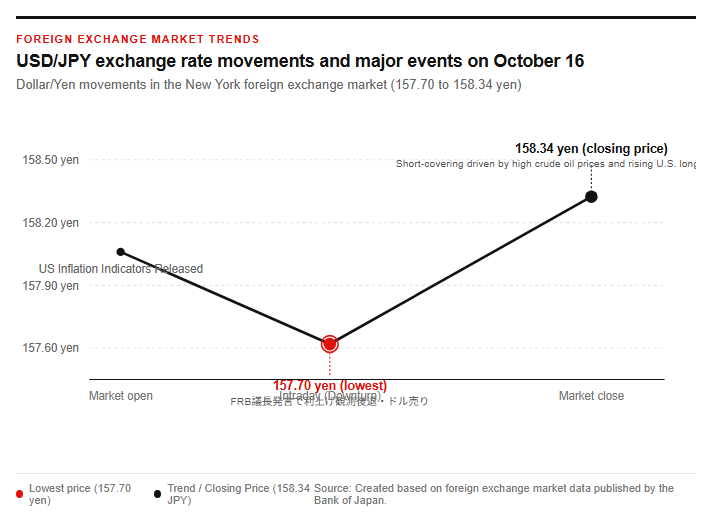
On October 16, 2026, the New York foreign exchange market marked a day of high volatility, with the dollar-yen exchange rate dropping to 157.70 yen before rising to 158.34 yen to close the session. Immediately after the market opened, released U.S. inflation-related indicators exceeded market expectations, intensifying caution regarding the entrenchment of high prices. However, Federal Reserve (FRB) Chair Warsh emphasized a stance of not pre-committing to specific policy decisions during speeches and other occasions, causing market expectations for an additional rate hike at the October Federal Open Market Committee (FOMC)—which had been simmering—to rapidly recede. In response, temporary dollar-selling and yen-buying movements became dominant in the foreign exchange market, pushing the dollar-yen down to the mid-157 yen range. Afterwards, against the backdrop of rising international crude oil prices, U.S. long-term interest rates narrowed their decline, prompting a spread of dollar-buying back into the market and ultimately resulting in the pair closing in the upper 158 yen range. Please refer to the figure below.
The Ripple Effects of US Monetary Policy and Long-Term Interest Rates
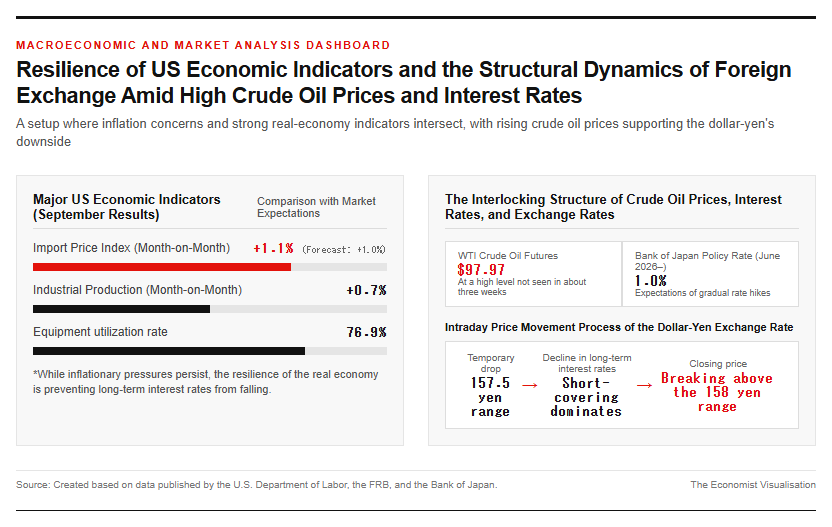
U.S. macroeconomic data and speculation surrounding monetary policy continue to play a central role in price formation in the foreign exchange market. The U.S. import price index for September, released on the same day, rose 1.1% from the previous month, exceeding the market expectation of a 1.0% increase. In addition, figures supporting the resilience of the real economy emerged successively, such as September industrial production improving by 0.7% month-on-month and the capacity utilization rate rising to 76.9%. Normally, such strong economic indicators would easily and directly trigger rising interest rates and dollar buying, but strong cautious views persist regarding the central bank’s continued rapid tightening, causing long-term interest rates to fluctuate back and forth. In particular, concerns over rising funding costs in the credit market driven by AI-related infrastructure investment and the flight to safety in the bond market intertwined in a complex manner. Ultimately, awareness of the risk of re-igniting inflation due to the surge in crude oil futures prices caused long-term yields, such as the 10-year U.S. Treasury yield, to stop falling, which strongly supported the downside of the dollar-yen exchange rate.
Daily Interest Rate Differentials and Bank of Japan Rate Hike Expectations
Japan’s monetary policy stance is also emerging as a crucial factor determining exchange rate trends. Bank of Japan (BOJ) Governor Kazuo Ueda’s remark that “we cannot tolerate the underlying inflation rate exceeding the 2% target” and his suggestion of continued additional rate hikes at an appropriate timing were received by market participants as a factor driving yen buying. Since raising the policy rate to 1.0% in June 2026, the BOJ has been progressing toward the normalization of its monetary policy. While expectations are spreading in the market that the BOJ is likely to forgo a rate hike at the October Monetary Policy Meeting, persistent expectations remain for an additional rate hike at the December meeting and gradual rate increases heading toward 2027. Although the policy interest rate gap between Japan and the US remains wide, the growing awareness of a potential narrowing of the interest rate differential in the future is creating a structure that puts a certain brake on one-sided yen selling.
Macroeconomic Factors and Structural Analysis Shaking the Foreign Exchange Market
The Impact of Rising Crude Oil Prices and Geopolitical Risks on the Trade Balance
Behind the foreign exchange market, the influences of commodity markets and geopolitical risks, extending beyond mere interest rate differentials, are strongly reflected. In the mid-October commodity market, WTI crude oil futures prices surged to $97.97 per barrel, reaching a high level not seen in about three weeks. Heightened tensions in the Middle East, concerns over attacks on energy infrastructure, and declining U.S. oil inventories are fueling the rise in crude oil prices. For resource-importing Japan, soaring crude oil prices mean a deterioration in the trade balance, constantly generating demand from real-demand players to buy dollars and sell yen for energy import settlements. This structural selling pressure on the yen, combined with the dollar-strengthening effect through rising U.S. long-term interest rates, is a major driving force pushing up the floors of the dollar-yen exchange rate. Please refer to the figure below.
Historical Perspective on Currency Intervention and Cooperative Frameworks
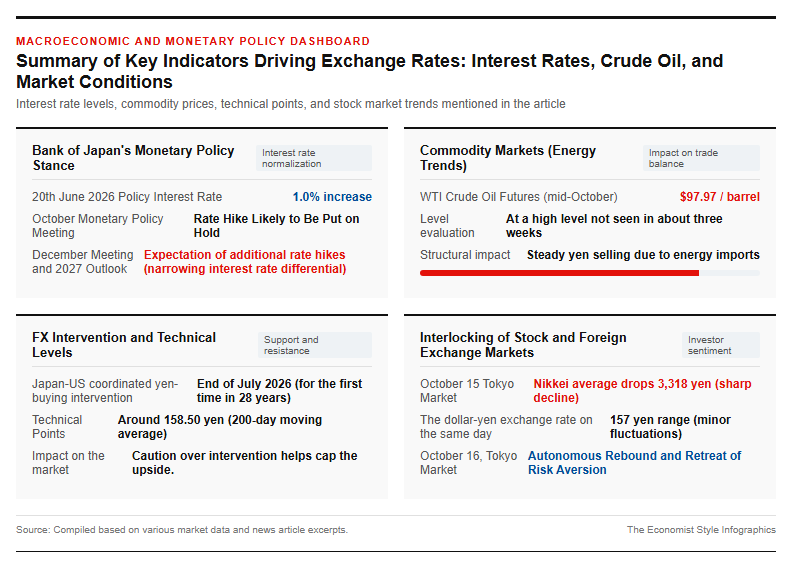
As the trend of a weak yen persists for a prolonged period, there is intense interest in the possibility of foreign exchange market intervention by authorities and its potential impact. At the end of July 2026, the Japanese and U.S. governments conducted a joint yen-buying intervention for the first time in 28 years, sending a strong warning message to the market. Historically, compared to unilateral intervention, coordinated intervention with major economies has a powerful effect in prompting market participants to adjust their positions. While the funding for yen-buying intervention is provided by drawing on foreign exchange reserves, the execution of such intervention not only causes a temporary surge in volatility but also plays a role in clearly defining the upside resistance level watched by the market. Currently, the level around 158.50 yen—corresponding to the 200-day moving average—is acting as a crucial technical point, which, combined with growing vigilance against intervention, is contributing to the market’s sluggish upside momentum.
Outlook and Market Participants’ Strategies
The Interdependence of Stock and Foreign Exchange Markets
The Tokyo stock market and the foreign exchange market are closely linked through the capital flows of international investors. In the Tokyo market on October 15, the Nikkei Stock Average recorded a historic plunge of 3,318 yen from the previous day, but the US dollar-yen exchange rate remained within a narrow range in the upper 157 yen range during this phase. This movement indicates that the decline in stock prices was not caused by factors specific to the Japanese economy or a sudden yen appreciation shock, but rather by credit concerns regarding U.S. AI-related companies and algorithmic selling in the derivatives market. In the Tokyo market the following day, October 16, an autonomous rebound was observed against the backdrop of high prices in night-session futures, and as firmness in stock prices was confirmed, excessive risk-averse yen-buying pressure receded. The stabilization of the stock market has led to an improvement in investor sentiment in the foreign exchange market, enabling trading based on clearer fundamentals. Please refer to the figure below.
Future Outlook and Key Points for Exchange Rates
The key point of focus in forecasting future foreign exchange market trends is the schedule and statements of the monetary policy meetings held by the central banks of both Japan and the United States. On the U.S. side, as the blackout period ahead of the FOMC begins, attention is focused on how Fed officials will assess the balance between inflation control and economic growth. On the Japanese side, meanwhile, the focus will be on the contents of the Outlook Report at the late-October policy meeting and the evaluation of the underlying inflation rate. In the short term, the US dollar-yen exchange rate is likely to continue moving primarily within a range of 157.50 to 158.50 yen, but depending on crude oil price trends and upside surprises in various U.S. inflation indicators, a scenario where it breaks above the 200-day moving average to test higher levels is also conceivable. Market participants are required to carefully evaluate primary statistical data from each country and messages from the central banks while establishing appropriate risk management and entry strategies.
Reference page
- 【Foreign Exchange Market (Daily) : Bank of Japan】[suspicious link removed]
【#ForeignExchangeMarket #BankOfJapan #DollarYen #ExchangeRates #MonetaryPolicy】


コメント