The domestic B2C-EC market size in 2025 expanded by 5.5% year-on-year to 27.6 trillion yen. This growth is driven by the entrenchment of demand for food and home appliances in the product sales sector, as well as the steady recovery of service sectors such as travel and dining.
- The Current State of the BtoC-EC Market, Which Has Reached a Scale of 27.6 Trillion Yen
- Rapid Digital Transition in Business-to-Business (B2B) E-Commerce
- Growing demand for food and home appliances driving the merchandise sales sector
- Recovery and Growth Trends in Service and Digital Sectors
- Overcoming Logistics Challenges and Deepening OMO and Cross-Sell Strategies
- Key Trends and Growth Drivers in the E-commerce Market from 2026 Onward
The Current State of the BtoC-EC Market, Which Has Reached a Scale of 27.6 Trillion Yen
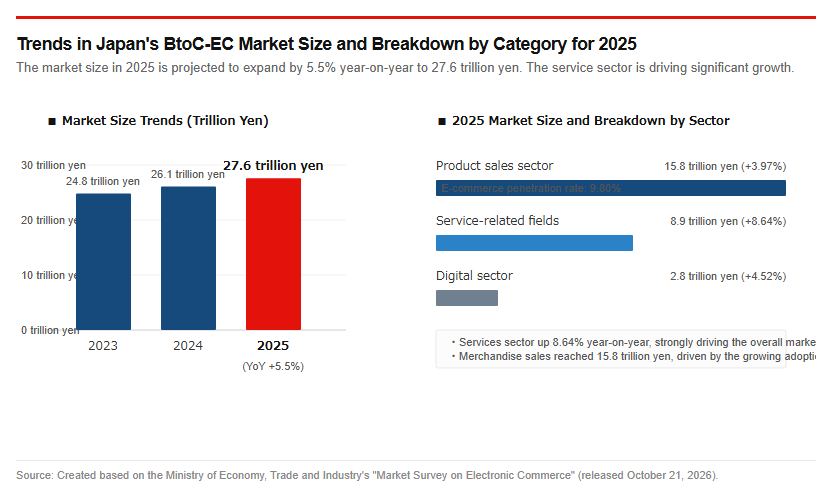
According to the market survey on e-commerce released by the Ministry of Economy, Trade and Industry on October 21, 2026, the domestic B2C-EC market size in 2025 reached 27.558 trillion yen, a 5.5% increase year-on-year. The expansion trend continues from 24.8 trillion yen in 2023 and 26.1 trillion yen in 2024, clearly showing the entrenchment of online transactions in consumer purchasing behavior. When the overall market structure is classified into three major categories, it consists of the following.
- Product sales sector: 15.8233 trillion yen (3.97% increase year-on-year)
- Service sector: 8.9362 trillion yen (up 8.64% year-on-year)
- Digital sector: 2.7985 trillion yen (up 4.52% year-on-year)
The e-commerce ratio for the merchandise sales sector stood at 9.80%, an increase of 0.02 points from the previous year. Everyday purchases via smartphones and the widespread adoption of subscription services are supporting the overall market. In addition, the expansion of delivery infrastructure and the penetration of fast-delivery services are contributing to an increase in purchase frequency. The composition ratio by sector for the entire market is visually summarized in the figure below.
As such, everyday shopping that combines brick-and-mortar stores and online retail is expanding, and the e-commerce market is entering a steady growth stage.
Rapid Digital Transition in Business-to-Business (B2B) E-Commerce
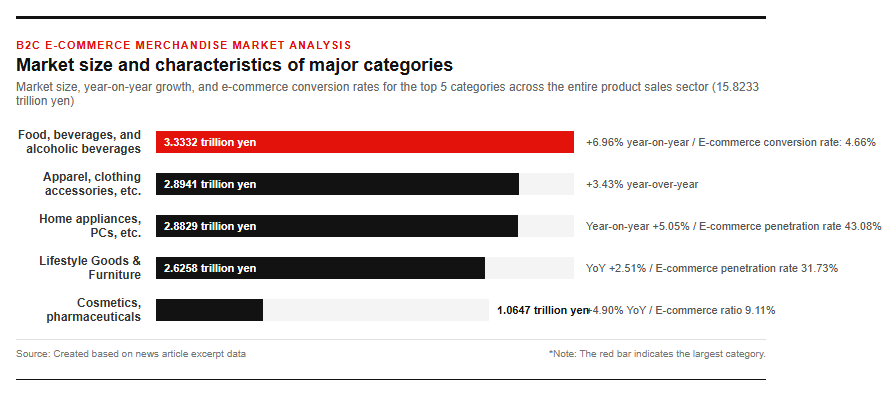
Not only the consumer market, but the market size of business-to-business e-commerce (B2B-EC) has also recorded significant growth. The B2B-EC market size in 2025 increased by 8.9% year-on-year to 560.1 trillion yen, expanding significantly from 514.4 trillion yen the previous year. The e-commerce ratio in the B2B sector reached 45.9%, an increase of 2.8 points from the previous year. Behind this lies the promotion of digital transformation across industries as described below.
- Going paperless in order-to-delivery operations and expanding the adoption of cloud-based order-to-delivery systems
- The adoption of electronic invoices and digital payment platforms in B2B payments
- Streamlining operations and visualizing procurement processes to address labor shortages
The shift from traditional manual transactions using telephone and fax to automated transactions utilizing Web API integration and EDI (Electronic Data Interchange) is accelerating. Furthermore, as the barriers to adopting cloud EDI have lowered even for medium and small-sized enterprises (SMEs), the adoption of B2B e-commerce has progressed across a wide range of industries. The results of operational efficiency, such as improved transaction accuracy, shortened delivery times, and inventory optimization through data integration, are serving as a strong driving force for market expansion.
Growth Drivers by Sector and Changes by Category
Growing demand for food and home appliances driving the merchandise sales sector
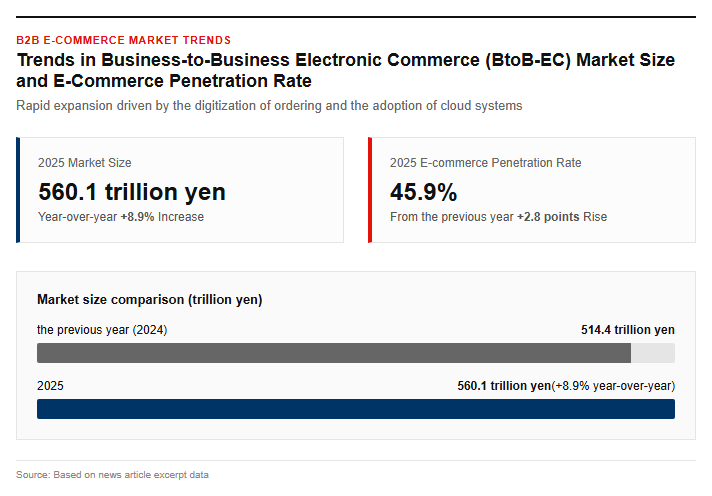
Within the merchandise sales sector (15.8233 trillion yen), which accounts for approximately 57% of the B2C-EC market, categories closely tied to daily life are driving the market. The market sizes and characteristics of the major categories are as follows.
- Food, beverages, and alcohol: 3.3332 trillion yen (up 6.96% year-on-year, e-commerce penetration rate of 4.66%)
- Apparel, clothing accessories, etc.: 2.8941 trillion yen (up 3.43% year-on-year)
- Home appliances, AV equipment, PCs and peripherals, etc.: 2.8829 trillion yen (5.05% increase year-on-year, e-commerce ratio of 43.08%)
- Household goods, furniture, and interior: 2.6258 trillion yen (up 2.51% year-on-year, e-commerce ratio: 31.73%)
- Cosmetics and Pharmaceuticals: 1.0647 trillion yen (up 4.90% year-on-year, e-commerce ratio 9.11%)
In the food and beverages sector, which boasts the largest scale, bulk purchases of heavy items, subscription services, and the improved convenience of online supermarkets have driven growth. In the consumer electronics sector, a high e-commerce penetration rate is maintained due to the clear specifications and ease of comparative shopping. Furthermore, in daily sundries and furniture, showrooming—where consumers check products in physical stores before purchasing online—and OMO (Online Merging Offline) strategies have become widespread. Please refer to the graph below for the breakdown and composition ratio by category.
Recovery and Growth Trends in Service and Digital Sectors
The BtoC-EC market in the service sector reached 8.9362 trillion yen, showing a strong growth of 8.64% year-on-year. Major factors behind this include the ongoing recovery in travel demand and the widespread adoption of online reservations in the restaurant industry. Specifically, the following services are driving this expansion.
- Travel services: 3.7603 trillion yen (up 6.68% year-on-year)
- Food and beverage services: 1.0984 trillion yen (up 13.34% year-on-year)
- Hair and beauty services: 799.5 billion yen (up 9.49% year-on-year)
- Food delivery services: 562.8 billion yen (up 3.43% year-on-year)
In the travel services sector, both domestic travel and inbound demand have performed strongly, with the online booking of flights and accommodations becoming firmly established. In dining services and beauty salon reservations, the convenience of last-minute booking and cashless payments through dedicated apps is highly appreciated. Meanwhile, the market size for the digital sector reached 2.7985 trillion yen (a 4.52% increase year-over-year), with online games, e-books, and paid video streaming services continuing to maintain a stable member base. The use of digital content subscriptions is expanding, forming a continuous revenue foundation.
Future Outlook and Strategies Required for E-commerce Businesses
Overcoming Logistics Challenges and Deepening OMO and Cross-Sell Strategies
While the e-commerce market continues to expand steadily, the challenges facing businesses are also becoming clearer. In particular, the shortage of truck drivers, rising labor costs, and increasing delivery costs—sparked by the “2024 Logistics Problem”—are having a direct impact on the profit margins of e-commerce operations. To address this, leading companies are implementing the following measures:
- Utilization of community-based distributed delivery hubs (dark stores) and the introduction of autonomous delivery robots
- Expansion of delivery and pickup options to reduce redeliveries, such as in-store pickup services (BOPIS) and designated drop-off delivery.
- Integration of multi-channel customer acquisition and purchasing data combining proprietary e-commerce and marketplace stores
For businesses with physical stores, providing an OMO (Online Merging with Offline) experience that eliminates the boundaries between stores and online is essential. The design of customer pathways—such as experiencing products in-store and making repeat purchases via e-commerce—and improving the precision of cross-selling strategies to suggest related items are viewed as crucial. The integration structure between logistics hubs and purchasing data is summarized in the configuration diagram below.
Balancing optimized delivery efficiency with a high-quality customer experience has become the key to sustainable e-commerce operations.
Key Trends and Growth Drivers in the E-commerce Market from 2026 Onward
In the domestic e-commerce market from 2026 onward, the industry is projected to shift from mere scale expansion to a phase focused on competing for high quality. The adoption of AI technologies and the widespread use of social commerce are expected to have a major impact on future market trends. Key focal points for future growth are as follows:
- Advanced personalized customer service and search experiences leveraging Generative AI
- Real-time product sales through SNS videos and live streaming (live commerce)
- Expansion of cross-border e-commerce transactions delivering high-quality Japanese products to overseas consumers
By leveraging generative AI, it becomes possible to offer highly accurate product recommendations tailored to individual consumer preferences and past browsing history. Furthermore, cross-border e-commerce targeting international users is drawing attention as a new revenue stream, driven by the weak yen and growing recognition of Japanese brands. However, given concerns over rising customer acquisition costs (CPA) due to intensifying competition, businesses must focus on strategies to improve LTV (Lifetime Value) by enhancing the loyalty of existing customers. We have entered an era where businesses that clearly define their strengths and deliver unique value will be the ones to reap growth.
Reference page
- 【Ministry of Economy, Trade and Industry: Market Survey on Electronic Commerce】[suspicious link removed]
[#ECmarket #Ecommerce #MinistryOfEconomyTradeAndIndustry #OnlineShopping #DigitalTransformation #BtoC #BtoB]


コメント