Chicago Nikkei 225 futures for October 23, 2026, ended their night session at 62,640 yen, down 270 yen from the Osaka Exchange (OSE) settlement price. The background includes concerns over AI overinvestment in the U.S. market and rising geopolitical risks.
- Key takeaway: Chicago futures settled 270 yen lower at 62,640 yen
- Reasons Behind the Divergence Between Night-Time Trading and Spot Stock Prices
- Earnings Announcements by Major US Tech Companies and Resurgent Cash Flow Concerns
- Rising Geopolitical Risks and the Chain Reaction of Oil Prices, Interest Rates, and Foreign Exchange
- Technical Points and Identifying Support Levels
- Future Outlook and Key Points: Monetary Policy Events in Japan, the US, and Europe, and Major Corporate Earnings
Key takeaway: Chicago futures settled 270 yen lower at 62,640 yen
In the night session on October 23, 2026, the front-month December 2026 Nikkei 225 futures contract on the Osaka Exchange finished trading down 270 yen from the previous day at 62,640 yen. The yen-denominated settlement price for Chicago Nikkei 225 futures also ended 270 yen lower compared to the Osaka Exchange closing price at 62,640 yen, while the U.S. dollar-denominated price finished 220 yen lower at 62,690 yen. The cash Nikkei Stock Average closed the same day at 62,693.16 yen, placing the futures price at a level 53.16 yen lower than the cash closing price. Trading volume for front-month Nikkei 225 futures stood at 12,369 contracts, while Nikkei 225 mini recorded a volume of 280,215 contracts, ending down 290 yen at 62,620 yen. Meanwhile, front-month TOPIX futures remained unchanged from the previous day at 3,970 points, finishing 4.19 points higher than the TOPIX cash closing price. The divergence among major indices in the futures market clearly indicates that the current selling pressure is concentrated on specific groups of stocks rather than the broader market. Nighttime futures trends serve as a leading indicator that influences opening prices and investor sentiment in the stock market on the next business day. Please refer to the figure below regarding the positional relationships that market participants are closely watching.
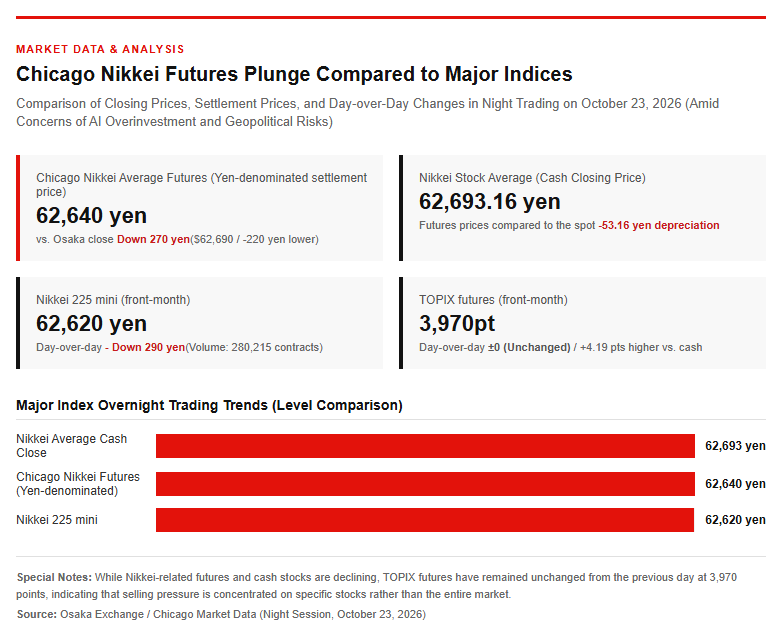
The price levels quoted in overnight trading strongly suggest that the Tokyo market will open with selling pressure the following morning.
Reasons Behind the Divergence Between Night-Time Trading and Spot Stock Prices
Chicago Japanese stock futures are Nikkei 225 futures traded on exchanges such as the U.S. CME (Chicago Mercantile Exchange), and are characterized by their ability to reflect overseas trends in real time outside of Japanese market trading hours. Because they are directly affected by U.S. economic indicators, major corporate earnings, and currency fluctuations announced during the nighttime when the Japanese stock market is closed, they are positioned as an important indicator for gauging the direction of Japanese stocks the following day. Behind the decline in Nikkei average futures during the nighttime trading session on October 23, 2026, was a risk-off movement that progressed in European and U.S. markets after the closing of the Tokyo market. Due to a bias in its index composition, the Nikkei Stock Average is structurally prone to being significantly affected by price fluctuations in semiconductor-related and high-priced stocks. As selling spread primarily to high-tech stocks in the U.S. market after the cash market closed, selling of futures took precedence in the nighttime futures market. The fact that futures settled at 62,640 yen—below the cash market closing price of 62,693.16 yen—indicates that investors are strengthening their cautious stance heading into the opening of the following morning. Even in past cases, futures declines that priced in negative news in overseas markets have been a factor causing gap-downs at the next day’s market open.
Concerns Over AI Overinvestment and Global Market Contagion
Earnings Announcements by Major US Tech Companies and Resurgent Cash Flow Concerns
The primary factor that triggered the recent sharp drop in futures is excessive caution regarding artificial intelligence-related investments in the U.S. market and the resurgence of credit concerns. Following the earnings announcements of major U.S. tech companies Meta Platforms and Tesla, concerns in the market rapidly escalated regarding the profitability of AI-related capital investments and the deterioration of free cash flow. In particular, credit anxieties resurfaced over the U.S. AI cloud service provider CoreWeave, with the company’s corporate bond yields exceeding 15 percent, while Meta’s CDS spreads also surged to record-high levels. This has spread the view that rising funding costs will become a heavy burden for companies that are carrying massive debt and driving AI investments. This impact led to sharp declines in the U.S. Nasdaq market and the Philadelphia Semiconductor Index (SOX index), and also spread to semiconductor manufacturing equipment and related stocks in the Tokyo market, such as Tokyo Electron, Advantest, SCREEN Holdings, and Lasertec. Please refer to the figure below for the structure of the AI investment cycle and cash flow concerns that market participants are on guard against.
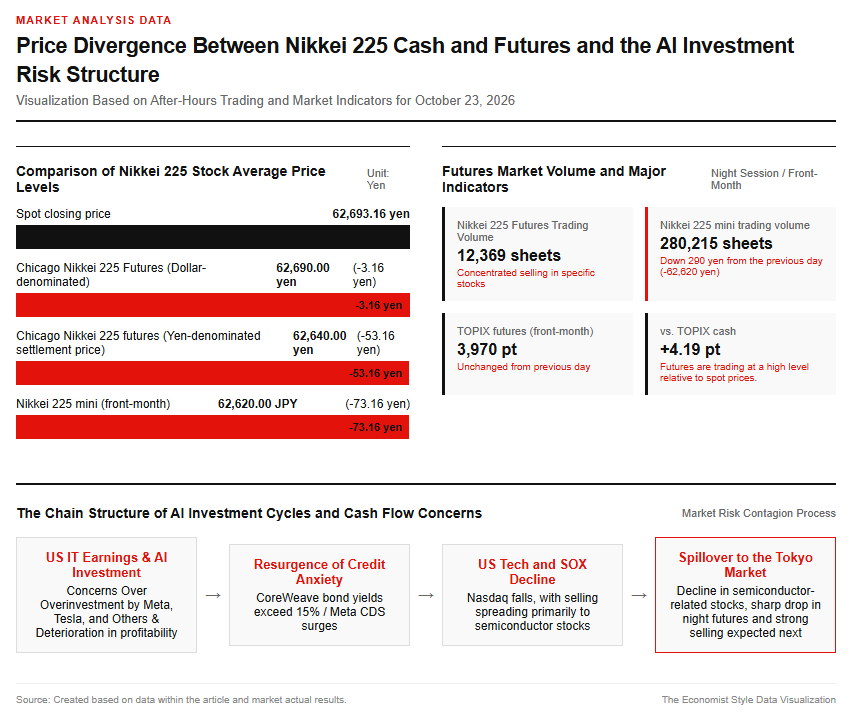
While the growth potential of AI demand itself is acknowledged, doubts regarding short-term profitability and financial sustainability to justify the investments are weighing on stock prices.
Rising Geopolitical Risks and the Chain Reaction of Oil Prices, Interest Rates, and Foreign Exchange
In addition to credit anxieties surrounding AI, rising geopolitical risks and the resulting changes in the macroeconomic environment are increasing market volatility. In the Middle East, attacks by Iran and pro-Iranian Houthi militants have intensified, reigniting concerns over energy supply disruptions. U.S. WTI crude oil futures rose to $101.41 per barrel, breaking through the $100 milestone for the first time in about a month. While concerns over the re-acceleration of inflation driven by high crude oil prices are intensifying, there is also a trend of capital fleeing to safe-haven assets due to growing uncertainty. The U.S. 10-year Treasury yield fell below 5 percent, and Japan’s long-term interest rates also showed a downward trend. Normally, falling interest rates are often a tailwind for high-valuation tech stocks, but this time, the market-wide risk-off stance is prevailing, resulting in an unusual scenario where stock prices and interest rates are declining simultaneously. In the foreign exchange market, the US dollar-yen exchange rate has been trading in the upper 156 yen to 158 yen range, with risk-off yen-buying pressure intersecting with dollar buying driven by the interest rate differential between the US and Japan. A complex web of anxieties is weighing on investor sentiment to the extent that interest rate levels and currency trends alone are no longer enough to support stock prices.
Market Technical Analysis and Future Outlook
Technical Points and Identifying Support Levels
As of the close of the night session on October 24, 2026, the technical indicators for Nikkei 225 futures clearly indicate that a market adjustment phase is intensifying. The night session settlement price of 62,640 yen on the 24th is positioned significantly below both the 25-day moving average of 66,406.80 yen and the 75-day moving average of 66,091.87 yen. In the Ichimoku Kinko Hyo as well, the base line stands at 66,570.00 yen, the leading span 2 (upper cloud limit) at 65,805.00 yen, and the conversion line at 65,100.00 yen, trading below major technical threshold levels. Furthermore, the Bollinger Bands show a breakout below the -1σ level of 63,977.95 yen, forming a pattern where downward trend pressure is easily perceived. As for future downside milestones, the -2σ Bollinger Band located at 61,549.10 yen, the 200-day moving average at 61,588.00 yen, and the psychological milestones around 62,000 to 61,500 yen are being closely watched as important support lines. Please refer to the figure below for the positional relationship regarding major technical support lines and trading milestones.
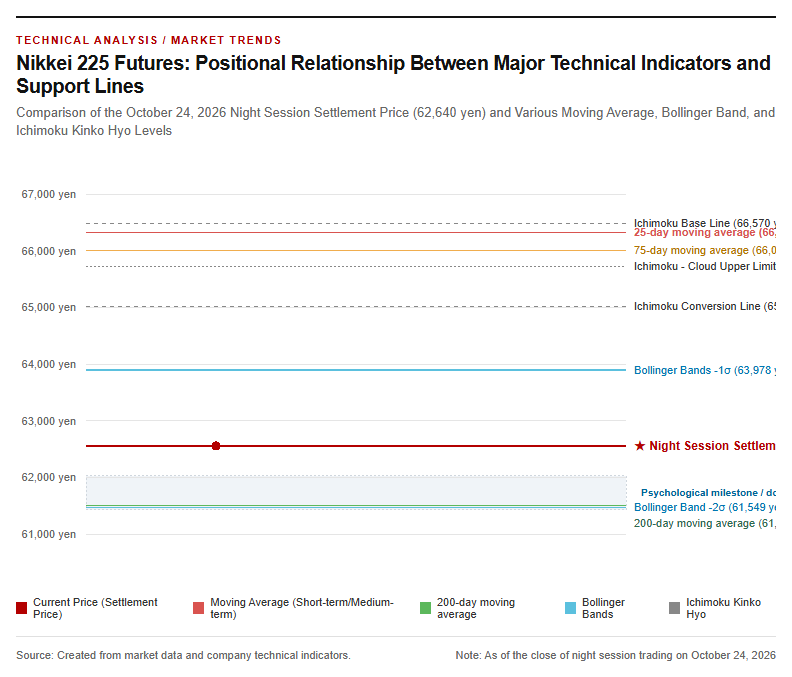
While a technical rebound from oversold conditions is expected in the short term, a cluster of moving averages is increasingly likely to act as resistance on the upside.
Future Outlook and Key Points: Monetary Policy Events in Japan, the US, and Europe, and Major Corporate Earnings
Whether the stock market will turn toward a rebound or prolong its correction depends on the monetary policy events in the US, Europe, and Japan, as well as the results of major domestic and overseas corporate earnings scheduled for later this week. On the monetary policy front, the US Federal Open Market Committee (FOMC), the European Central Bank (ECB) Governing Council, and the Bank of Japan (BOJ) Monetary Policy Meeting will be held in quick succession. While major central banks are widely expected to keep their policy rates unchanged, attention will focus on whether the FOMC hints at an additional rate hike in December and whether the BOJ upwardly revises its price assessment in the “Outlook for Economic Activity and Prices” (Outlook Report), along with the impact these factors will have on exchange rates and interest rates. In terms of corporate earnings, US tech giants such as Alphabet, Microsoft, and Amazon.com will release their financial results. Whether these companies can show prospects for monetizing AI investments and dispel financing concerns will serve as a touchstone for improving overall market sentiment. Domestically, major semiconductor stocks such as Shin-Etsu Chemical, Advantest, and Tokyo Electron will also release their earnings consecutively. Since investors must also gauge the outlook for the upcoming US midterm elections the following week and the situation in the Middle East, they are required to exercise cautious risk management while carefully evaluating individual performance.
Reference Page
- [Chicago Nikkei Average Futures Down 270 Yen from Osaka Closing Price (October 23) – Kabutan] https://kabutan.jp/news/marketnews/?b=n202610240098
【#ChicagoNikkeiFutures #NikkeiStockAverage #SemiconductorStocks #AIInvestment #StockMarket #MonetaryPolicy #JapaneseStocks】

コメント