Anthropic has integrated conversational capabilities and the agent feature “Cowork” into its enterprise plan, “Claude Enterprise,” and launched it for general availability. Behind this move is the aim to address the increase in token consumption associated with business automation and corporate administrators’ concerns over ballooning costs.
- Seamless Integration of Dialogue and Task Execution and Multi-Device Collaboration
- Features of Dashboards and Motion that Expand Visual Output
- Enterprise Security via Session-Isolated VMs
- Token Consumption Issues and Efficiency Modes in Agent Operations
- Spending Limits and Shared Budget Management by Organization and Group
- Platform Competition with Competitors and Its Spillover into the SaaS Industry
- The Future of Corporate Organizations and AI Governance Driven by Autonomous Business Processes
Seamless Integration of Dialogue and Task Execution and Multi-Device Collaboration
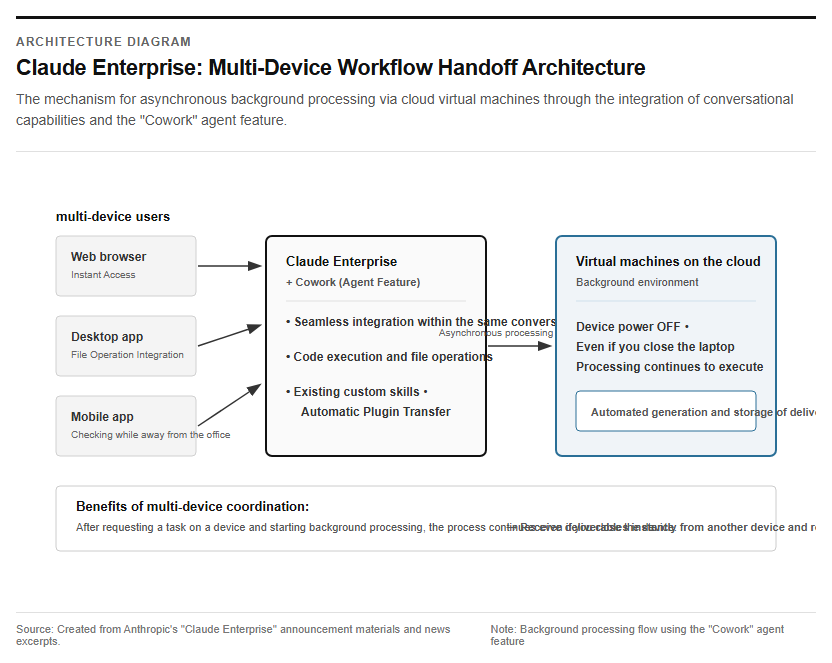
On October 23, 2026, Anthropic announced the general availability of “Claude Enterprise,” integrating its traditional chat functionality with the advanced AI agent feature “Cowork” for enterprise customers. This allows users to seamlessly handle everything from routine Q&A to complex, project-based task requests within the same conversation interface, regardless of the operating environment such as Web, desktop, or mobile apps. When code execution or file operations become necessary during a conversation, Claude automatically takes over and initiates background work on a virtual machine in the cloud. Even if the device is powered off or the laptop is closed while the work is in progress, the background processing does not stop, making it possible to resume work from another smartphone or PC and receive the completed deliverables. Because existing projects, connectors, custom skills, and external plugins are automatically carried over, it achieves a high degree of task automation while minimizing the effort required for migration within enterprises. The following diagram illustrates the multi-device work handoff structure.
Features of Dashboards and Motion that Expand Visual Output
Along with this feature integration, Anthropic has added new output capabilities to improve enterprises’ data analysis and presentation creation capabilities. The real-time updating dashboard feature “Dashboards” is offered in beta and integrates directly with major data platforms such as BigQuery, Snowflake, and Databricks. By simply giving instructions in natural language, users can have Claude generate appropriate SQL queries to extract data and automatically visualize it in charts and tables. Data transparency is ensured as users can click on any number to check the underlying query and view the last updated timestamp. Furthermore, a code-driven animation creation feature called “Motion” has also been introduced for paid plans. Because motion is controlled via programming code rather than using a video generation model, modifications to numbers are instantly reflected without having to regenerate the entire video. It is expected to see use in a wide variety of business settings, such as creating animated summaries for quarterly reports and animating graphs for board meeting materials.
Enterprise Security via Session-Isolated VMs
Maintaining security and governance is a top priority when deploying AI agents in an enterprise environment. The agent capabilities integrated into Claude Enterprise run securely on fully independent and isolated virtual machines (VMs) for each session. To prevent unrestricted access to corporate external networks, outbound connections are disabled by default, and credentials for various integration tools are designed to be securely stored and isolated outside of the VM sandbox. Additionally, it is fully integrated with existing Single Sign-On (SSO) and Compliance APIs for log auditing, allowing for implementation without compromising IT monitoring structures. Furthermore, when integrating with over 6,000 external system connectors—such as Gmail, Slack, and Stripe—the system is designed to always require explicit user pre-approval before executing critical actions like sending messages, making payments, or signing documents. High-risk operations such as securities trading and fund transfers are prohibited even if approved, reflecting a thoroughly secure design.
4 Control Mechanisms to Prevent Increases in Pay-As-You-Go Costs
Token Consumption Issues and Efficiency Modes in Agent Operations
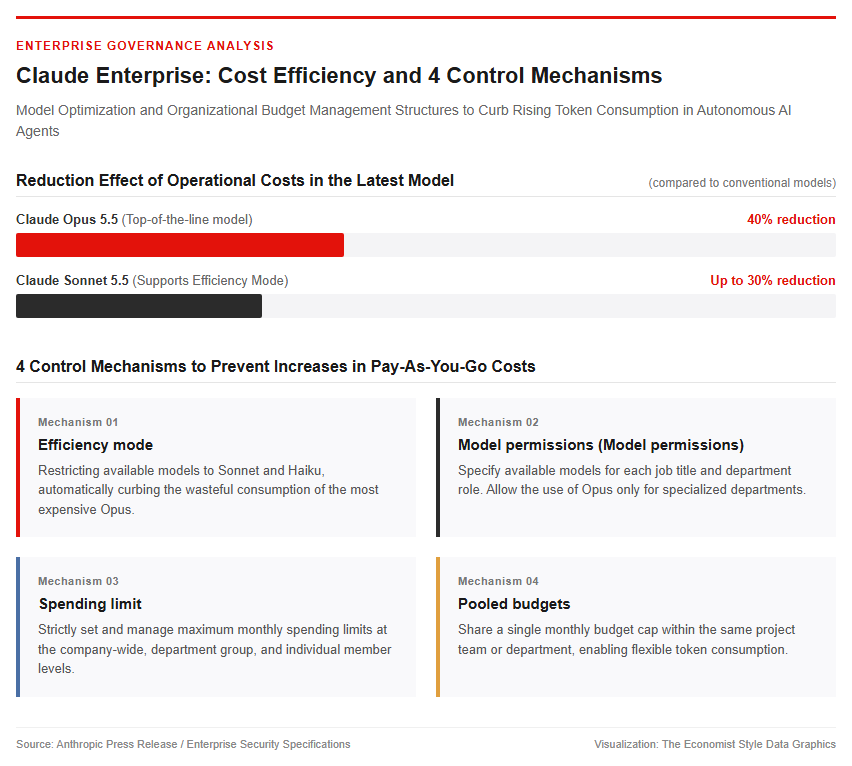
As the corporate adoption of generative AI expands, a transition is underway from traditional per-seat monthly subscription pricing to consumption-based models. However, because autonomous AI agents perform advanced reasoning, code execution, and file scanning, they pose a challenge: token consumption per task tends to increase significantly compared to simple chat responses. As a result, unexpected billing inflation caused by unrestricted usage has become a major concern for corporate IT administrators. To address this concern, Anthropic has announced four new control features. Foremost among them is the “Efficient mode” setting. When this mode is enabled, the underlying models available to users are restricted to Sonnet and Haiku, curbing the wasteful consumption of the highest-tier, most costly model (Opus). While the latest Claude Opus 5.5 reduces operational costs by 40% compared to the conventional Opus 5, and Claude Sonnet 5.5 also reduces costs by up to 30%, combining this model-restriction feature further enhances the certainty of cost control.
Spending Limits and Shared Budget Management by Organization and Group
The remaining three control mechanisms introduced alongside efficiency mode enable granular, organization-level budget management. First, “Model permissions” allow administrators to specify which models can be used by each corporate role or department, making it possible to restrict the use of Opus exclusively to specialized departments that require high-precision analysis. Next, the “Spending caps” feature allows you to set maximum monthly spending limits at the company-wide level, for departmental groups, and even for individual members. Finally, the “Pooled group budgets” feature enables a single monthly budget to be shared within the same project team or department, allowing team members to flexibly distribute token consumption among themselves. Because administrators can monitor each department’s usage from a real-time management dashboard, they can drive business efficiency while eliminating the opacity of costs. The diagram below illustrates the corporate budget management screen and the hierarchical structure of access permissions.
Market Trends and Future Outlook Driven by the Expansion of AI Agents
Platform Competition with Competitors and Its Spillover into the SaaS Industry
Market competition surrounding AI agent capabilities is rapidly intensifying. At the DevDay event hosted by OpenAI, “ChatGPT Space”—which allows users to collaborate with agents while managing dynamic charts and documents—was announced, and Microsoft is also revising the billing structure for “Copilot Cowork,” marking the full-scale onset of a scramble by major tech companies for the business gateway. This evolution of AI agents is also forcing major structural changes on the traditional software industry (SaaS companies). Until now, SaaS companies such as Salesforce, Workday, Intuit, and Snowflake have provided specific business processes and analytical functions as separate software applications, collecting subscription fees. However, as AI agents become capable of completing data extraction, report generation, and business automation on-demand from a single interface, the value and pricing power of existing software are being called into question, acting as a factor capping the stock prices of related companies.
The Future of Corporate Organizations and AI Governance Driven by Autonomous Business Processes
In highly specialized fields such as financial institutions and consulting firms, the replacement of business processes by AI agents is already becoming a reality. For example, major investment funds and large insurance companies have introduced Claude for financial statement analysis, risk assessment, and underwriting operations, achieving tens of thousands of hours in work reduction, a fivefold increase in review speed, and dramatic improvements in accuracy. On the other hand, as the delegation of operations to AI agents progresses, compliance with domestic and international laws, regulations, and governance is also indispensable. Specialized institutions such as Deloitte Tohmatsu have independently developed AI agents that autonomously investigate AI regulations, supporting companies in adapting to rapidly evolving regulations such as the EU AI Act and Japan’s new AI legislation. Going beyond mere task-assistance tools, AI agents are transforming into practical engines that actively shoulder a company’s core operations. Moving forward, it is believed that companies capable of balancing cost management with advanced governance systems will be the ones to establish a competitive advantage through increased productivity and the utilization of autonomous AI.
Reference Page
- [Claude Duet Official Product Page] https://claude.com/product/claude-duet
- [Anthropic Official Announcement] https://www.anthropic.com/news/anthropic-raises-30-billion-series-g-funding-380-billion-post-money-valuation
[#AIAgents #Anthropic #ClaudeEnterprise #GenerativeAI #ITCostManagement #DX]

コメント