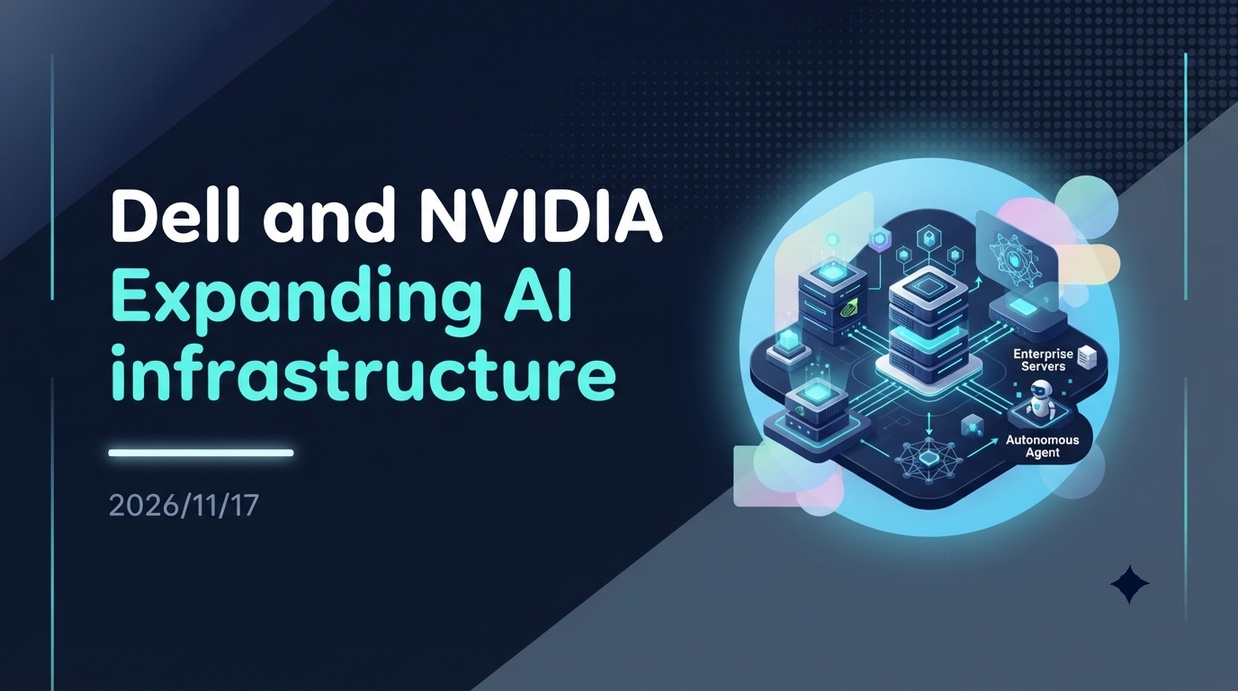
Dell Technologies and NVIDIA have announced functional enhancements to “Dell AI Factory with NVIDIA,” which allows AI agents to be operated securely in-house. This is driven by a rapid surge in token consumption and growing corporate demand for security and data sovereignty.
- Key Takeaways: The Complete Overview of the Dell AI Factory with NVIDIA Expansion
- The Foundation for Autonomous AI Agents Deployed from the Desk-side
- Infrastructure for Optimizing Data Preparation and Orchestration
- Innovations in Data Center and Infrastructure Management Software
- Changes in the GPU Oligopoly Structure in the Market and Competing Accelerators
- Future Outlook and Key Points: Multipolarization of AI Infrastructure Toward 2030
Key Takeaways: The Complete Overview of the Dell AI Factory with NVIDIA Expansion
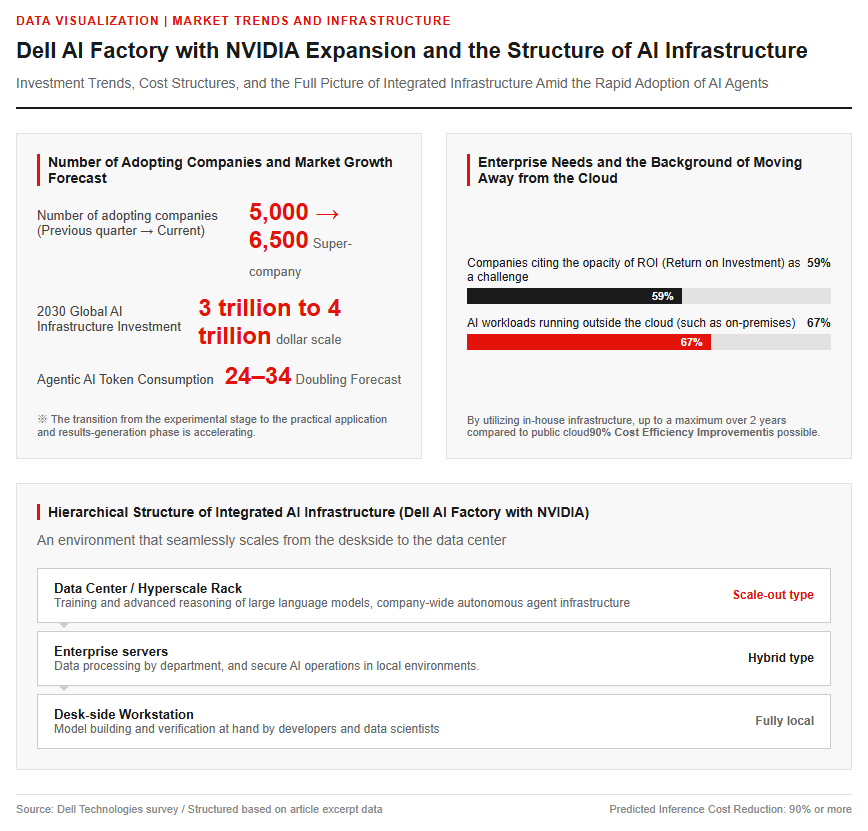
In 2026, Dell Technologies and NVIDIA announced a massive feature expansion of their enterprise AI infrastructure platform, “Dell AI Factory with NVIDIA.” This platform covers everything from desk-side workstations to ultra-large data center racks, and is designed to enable enterprises to safely and efficiently build and operate autonomous AI agents in their local environments or on-premises. The number of adopting companies has rapidly expanded from 5,000 in the previous quarter to over 6,500, proving that interest in AI adoption is shifting from the experimental stage to practical application and value creation.
Behind this is a historic surge in investment and usage related to AI infrastructure. By 2030, global AI infrastructure investments are projected to reach between $3 trillion and $4 trillion. While inference costs are expected to drop by over 90%, token consumption by agentic AI is forecasted to skyrocket by 24 to 34 times. However, 59% of enterprises cite uncertainty regarding ROI (Return on Investment) as a challenge, and a growing trend is emerging to break away from dependence on public clouds. According to Dell Technologies research, 67% of AI workloads are executed outside the cloud, and utilizing on-premises infrastructure is said to improve cost efficiency by up to 90% compared to public clouds over a two-year period.
The following figure illustrates an overview of the integrated AI infrastructure that seamlessly scales from the desktop to the data center.
The Foundation for Autonomous AI Agents Deployed from the Desk-side
One of the major features of this expansion is the establishment of an environment where individual developers and on-site teams can develop and run advanced AI agents right at their desks. With the new “Dell Deskside Agentic AI” solution, hardware such as the “Dell Pro Precision with GB10” and “Dell Pro Precision with GB300” featuring the NVIDIA Grace Blackwell architecture has been introduced. The GB10 model is equipped with 64GB of unified memory, enabling even small teams to easily run frontier-class open-weight models locally. Furthermore, by clustering multiple units, the system can flexibly scale up to large-scale agent workflows.
Additionally, the Windows-compatible “Dell Pro Precision with GB300” delivers up to 748GB of coherent memory and 20 petaflops of FP4 compute performance on the desktop. At the software layer, it integrates “NVIDIA NeMoClaw” for agent orchestration and “NVIDIA OpenShell,” an open-source runtime providing security and privacy controls. This enables developers to control agents with a consistent architecture—from a single-developer environment to large-scale deployments exceeding 1,000 units enterprise-wide—while adhering to security policies.
- Deskside hardware: Dell Pro Precision with GB10 (64GB unified memory), GB300 (up to 748GB memory, 20 PFLOPS)
- Orchestration and Security: Native Integration of NVIDIA NeMoClaw, NVIDIA OpenShell, and NVIDIA Nemotron Models
- Applicable Use Cases: Agentic Coding, VSS, AI Lab Infrastructure for Higher Education
Technological Innovations in Data Optimization and Next-Generation Infrastructure Management
Infrastructure for Optimizing Data Preparation and Orchestration
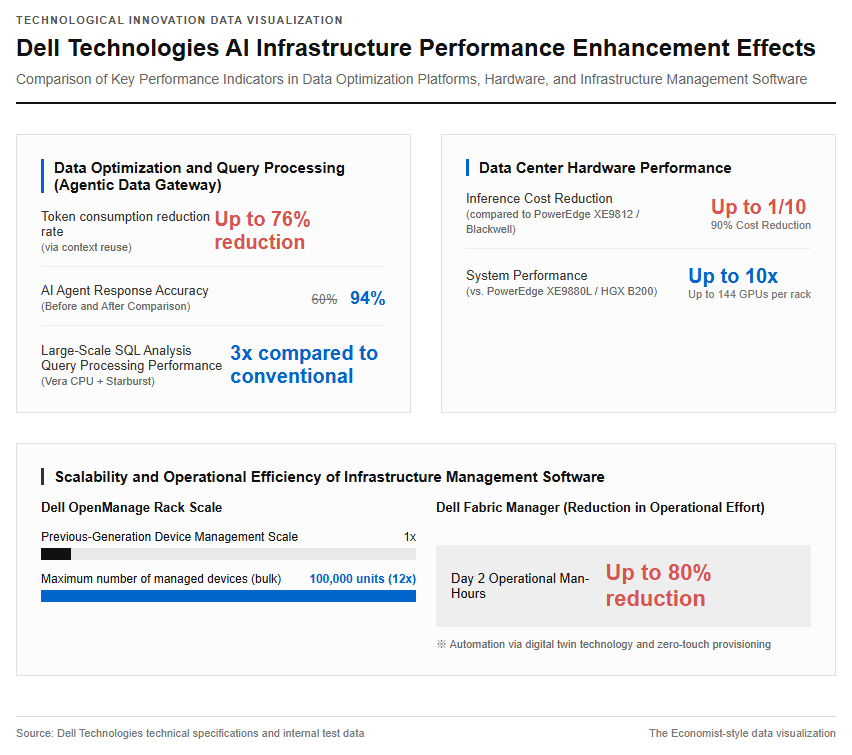
For AI agents to perform advanced reasoning and task execution, a data infrastructure that converts a company’s diverse data into a reliable context and provides it is essential. In this feature enhancement, Dell Technologies has evolved the “Dell AI Data Platform” and introduced the “Agentic Data Gateway,” which centrally processes distributed internal data. This gateway provides a controlled access path for all AI agents, and in internal tests, the reuse of context reduced token consumption by up to 76% and significantly improved response accuracy from 60% to 94%.
Furthermore, it features hybrid data pipelines that process unstructured data scattered across on-premises and public clouds without moving it, as well as “Storage Intelligence,” which visualizes data quality and lineage on a scale of billions of files. For the CPU infrastructure, it incorporates the “NVIDIA Vera CPU” with a high-bandwidth memory of 1.2TB/s, and by combining it with the data analytics engine “Starburst,” it has tripled query processing performance in large-scale SQL analysis compared to conventional levels. This drastically reduces latency for agent-based workloads that send massive numbers of requests to databases.
Innovations in Data Center and Infrastructure Management Software
For data center infrastructure, advanced air and liquid cooling hardware as well as powerful management software have been introduced to cope with increasingly dense computational demands. The rack-based systems “Dell PowerRack” and “PowerEdge XE9812” feature the NVIDIA Vera Rubin NVL72, reducing inference costs per token by up to one-tenth compared to Blackwell. In addition, products such as the “PowerEdge XE9880L,” which supports 100% direct liquid cooling (DLC), support up to 144 GPUs per rack and deliver up to 10 times the performance of the conventional HGX B200. Furthermore, the containerized AI factory “Dell Modular Data Center with NVIDIA DSX POD” significantly reduces the burden of on-site deployment.
In terms of infrastructure management software, “Dell OpenManage Rack Scale” has been introduced, capable of centrally managing and monitoring up to 100,000 devices. It supports 12 times the scale of the previous generation and enables system status investigation and troubleshooting using natural language. Additionally, the network automation platform “Dell Fabric Manager” leverages digital twin technology and zero-touch provisioning to reduce Day 2 operational man-hours by up to 80%.
The following diagram illustrates the internal structure of data center infrastructure featuring direct liquid cooling technology and high-density rack configurations.
Structural Changes in the GPU Market and Future Outlook
Changes in the GPU Oligopoly Structure in the Market and Competing Accelerators
Amid the explosive growth in demand for AI infrastructure, efforts to break away from single-vendor dependence in the accelerator market are accelerating. According to research and analysis by Kearney, NVIDIA’s current market share of approximately 90% in the AI accelerator market is projected to drop to about 70% by 2030. This trend is driven by factors such as rising infrastructure costs associated with the highly profitable structure of data center GPUs (a gross margin of around 75%), declining profit margins for server OEMs (shrinking from 10–12% to 3–4%), supply constraints, and efficiency challenges in specific workloads.
To adapt to this change, competing semiconductor manufacturers, hyperscalers, and startups are rising. AMD is offering high cost-effectiveness by leveraging HBM3E memory with its Instinct MI300X, MI350X, and MI450X, leading to large-scale deployments on Oracle and Microsoft Azure. In addition, custom silicon such as Google’s TPU v7, AWS’s Trainium2/Inferentia2, Microsoft’s Maia, and Meta’s MTIA is expanding, achieving up to an 80% reduction in inference costs. Furthermore, application-specific architectures are increasing their presence, such as Groq’s LPU, which achieves ultra-low-latency inference, and Cerebras, known for its massive wafer-scale chips.
- Market Share Forecast: NVIDIA’s share to change from current ~90% to ~70% by 2030
- Competitor GPUs and custom chips: AMD Instinct series (expected to capture 5-10% of the market), hyperscaler custom silicon (projected to account for 15-20%)
- Next-generation architectures: Groq LPU (ultra-low-latency inference), Cerebras WSE-3 (single-wafer ultra-large-scale training), SambaNova (dataflow-based)
Future Outlook and Key Points: Multipolarization of AI Infrastructure Toward 2030
The future enterprise AI market is making a full-fledged transition from an era of “NVIDIA’s sole dominance” to an era of “multipolar coexistence,” where the optimal infrastructure is combined according to use case and cost requirements. The continuous expansion of “Dell AI Factory with NVIDIA” by Dell and NVIDIA highlights the importance of integrated solutions that encompass not only hardware performance competition, but also validated blueprints, security architectures, data management, and consulting services. As companies advance from PoCs (Proof of Concepts) to production deployment, the value of local on-premises infrastructure that ensures data sovereignty while balancing security and cost efficiency will become even greater.
What is noteworthy is that the application of AI is deepening—moving beyond chatbots and search assistants to AI agents that autonomously make decisions and execute tasks, and further into “Physical AI,” which merges with robotics and digital twins. For corporations and public institutions, choosing an open and highly scalable AI ecosystem that is not tied to specific hardware and can adapt to future technological innovations will be the key to determining long-term competitiveness and productivity improvement.
Reference page
- [Dell Technologies Press Release (Expansion of Dell AI Factory with NVIDIA)] https://www.dell.com/ja-jp/newsroom/announcements/dell-nvidia-gtc-20261022
- [NVIDIA Japan Blog (Dell Technologies World Infrastructure Expansion Announcement)] https://blogs.nvidia.co.jp/blog/dell-technologies-agent-enterprise-ai/
- 【GitHub – Dell Deskside Agentic AI】https://github.com/dell/deskside-agentic-ai
【#Dell #NVIDIA #AIInfrastructure #AIAgents #DataCenters #GPU #OnPremises #DigitalTransformation】
コメント