
UK-based Nothing has decided to announce a new screenless AI-native device on December 8, 2026. This shift in business strategy is driven by rising component costs and intensifying competition in the traditional smartphone market, as well as the goal to eliminate the “context gap” where AI fails to fully capture real-world contexts.
- Full Picture of the Official December 8 Announcement and Intentional Device Leak
- Hardware Design Without a Display and Its Texture
- Eliminating the Context Gap and the Product’s Role
- Rejection of the “AI iPhone” Pursuit and Differences from Existing AI Devices
- Transformation of the Smartphone Market and Nothing’s Business Strategy Shift
- Possibility of Japanese Market Entry and Expectations for a New Era of Devices
Full Picture of the Official December 8 Announcement and Intentional Device Leak
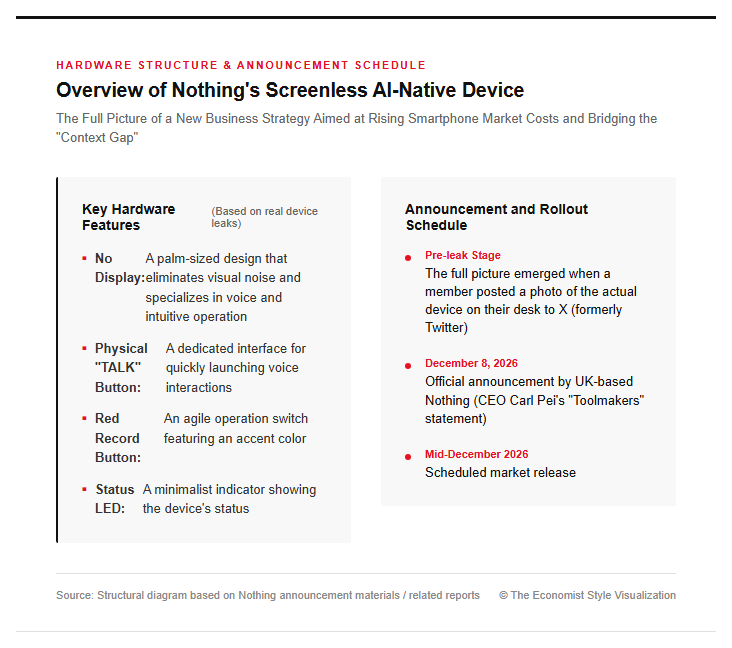
UK consumer technology company Nothing has announced that it will officially unveil its first display-free AI-native hardware on December 8, 2026. The development was previously teased by CEO Carl Pei in a statement titled “Toolmakers,” and a release is scheduled for sometime in December. Prior to the announcement, Sebastian Ingrosso of the Swedish music group Swedish House Mafia, who is also an investor in the company, posted a photo of the actual device on a desk on X. This post revealed the full design of the palm-sized casing, equipped with a physical “TALK” button, a red recording button, and a status LED indicating operational states. As shown in the image below, it adopts a compact design that fits neatly in the palm of the hand.
Hardware Design Without a Display and Its Texture
This product is designed as an independent productivity tool rather than an extension of a smartphone app. Externally, it features a gray-black hairline-finished metal chassis, structured as a binocular-style box divided in half by a central parting line. A polished circular part is embedded in the front, which is speculated to serve as a camera lens for visual intelligence or a control sensor. The bottom is equipped with Pogo Pin metal terminals for connecting to a dedicated dock or accessories. Bearing the catchphrase “Be present. It’s noted.,” it aims to be a zero-interference device that eliminates the hassle of operating a screen and does not disrupt everyday experiences.
Development Philosophy Put Forward by CEO Carl Pei and Competitor Comparison
Eliminating the Context Gap and the Product’s Role
CEO Carl Pei points out two major challenges facing modern AI models: “true context does not exist inside a chat box” and the “context gap.” Ideas that pop up during cafe conversations or meetings are lost unless the user consciously inputs them into a screen. This device is designed to listen to the context of conversations and dialogues in the background—without the user having to stare at a screen—and perform transcription and summarization. The processed results and converted information are seamlessly synchronized to the screens of the user’s smartphone (such as Nothing OS’s Essential Space) or personal computer. It is positioned as a companion device that bridges the gap between everyday real spaces and AI knowledge bases.
Rejection of the “AI iPhone” Pursuit and Differences from Existing AI Devices
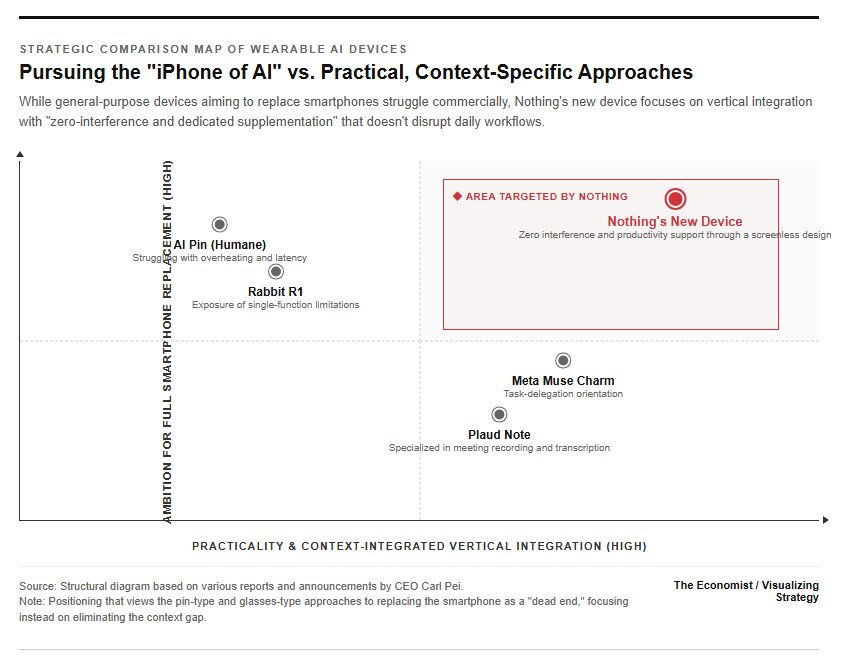
In the wearable AI market, Humane’s “AI Pin” and “Rabbit R1,” which appeared in 2024, struggled commercially due to slow response times, thermal issues, and single-function limitations. In response, CEO Carl Pei has criticized pin-style and glasses-style approaches that seek to completely replace the smartphone with an “AI iPhone” as a dead end. This device is not an all-purpose smartphone replacement; rather, it aims to differentiate itself as a tool that directly supports work productivity—distinct from Plaud Note, which specializes in meeting recordings and verbatim transcripts, and Meta Muse Charm, which targets task execution. As the comparison chart below indicates, it aims for vertical integration of practicality through the absence of a screen.
Underlying Market Environment and Future Outlook
Transformation of the Smartphone Market and Nothing’s Business Strategy Shift
Behind Nothing’s focus on AI-native devices are structural changes in the smartphone market. In recent years, sharp price surges, such as memory costs jumping up to fourfold, have heavily squeezed profit margins in device manufacturing. The company has implemented organizational restructuring, establishing a dedicated AI-native business division while shifting resource priorities toward AI-enabled hardware and wearable products. The company raised $200 million in a Series C round from backers including Tiger Global and Qualcomm Ventures, bringing its valuation to $1.3 billion. On the OS front, “Nothing OS 5.0” is advancing support for the Model Context Protocol (MCP) and expanding voice transcription features, solidifying the foundation for integration with AI hardware.
Possibility of Japanese Market Entry and Expectations for a New Era of Devices
Regarding the new AI device to be announced on December 8, the launch timing for the Japanese market and the status of obtaining Technical Standards Conformity Certification (Giteki) have not been disclosed at this time. However, Nothing has a track record of rolling out smartphones and audio products in Japan, having pursued Giteki certification and FeliCa support through its Japanese subsidiary. Screenless AI hardware aligns with the development of edge AI, which enables continuous sensing while suppressing battery consumption, and is gathering expectations as a new growth category in the tech industry. Great attention is gathering toward the full picture of this product—which achieves both liberation from screens and task assistance via AI—and its Japanese rollout ahead of the official announcement in December.
Reference Page
- [Nothing Official Website] https://jp.nothing.tech/
[#Nothing #AIDevice #Gadgets #EdgeAI #Hardware]


コメント