The US Cybersecurity and Infrastructure Security Agency has added a critical vulnerability in the LiteLLM large language model relay server to its Known Exploited Vulnerabilities catalog and issued an alert. Amid escalating damage from high-cost fraudulent AI usage claims and API key leaks, applying appropriate patches and establishing multi-layered access controls have become an urgent necessity.
- Key Takeaways and Background on CISA’s KEV Addition
- Technical Mechanism of the Vulnerability and Sandbox Escape Techniques
- API Key Theft and Financial Damage via LLMjacking
- Authentication Path Flaws and Attack Observations in CVE-2026-42208
- Emergency Response Procedures and Updating to Patched Versions
- Future Outlook and Key Points in Generative AI Infrastructure Security
Key Takeaways and Background on CISA’s KEV Addition
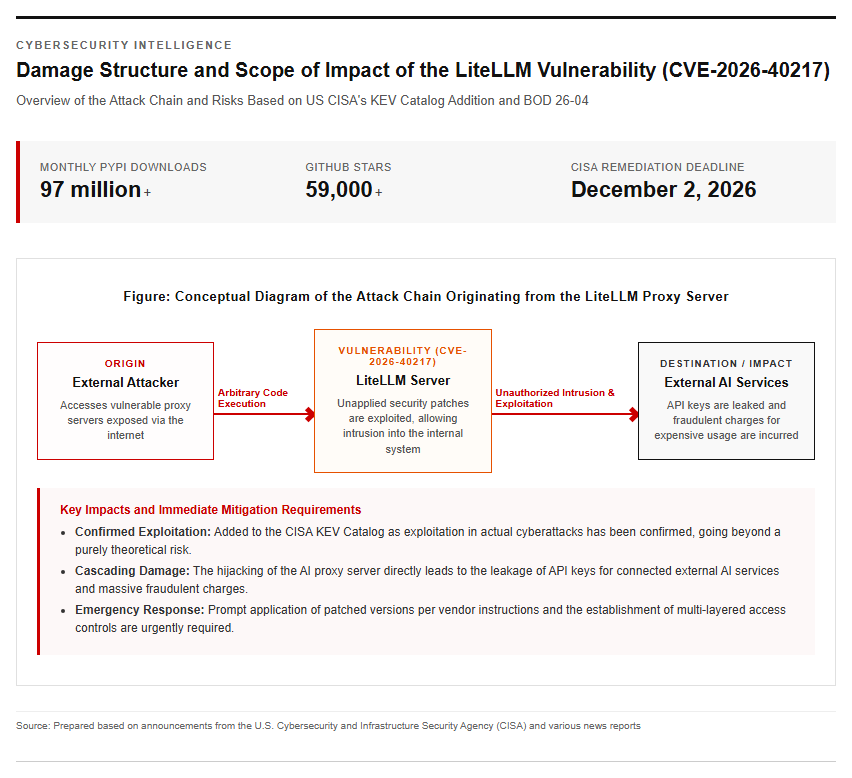
On November 18, 2026, the U.S. Cybersecurity and Infrastructure Security Agency (CISA) added an arbitrary code execution vulnerability (CVE-2026-40217) affecting the open-source LLM gateway software “LiteLLM” to its Known Exploited Vulnerabilities (KEV) catalog. LiteLLM is a widely used AI relay server that exceeds 97 million monthly downloads on PyPI and has garnered over 59,000 stars on GitHub. Inclusion in the KEV catalog indicates that exploitation of this vulnerability has been confirmed in actual cyberattacks, rather than remaining a purely theoretical risk. CISA mandated that U.S. federal agencies comply with Binding Operational Directive (BOD 26-04), setting a remediation deadline of December 2, 2026, and requiring them to promptly apply vendor-provided security patches and conduct risk assessments. Although lacking legal binding force for organizations in Japan, this situation strongly indicates an extremely high risk that relay servers exposed to the internet will immediately become targets. The conceptual diagram below illustrates the damage structure wherein an attacker uses a LiteLLM relay server as a starting point to infiltrate external AI services.
Technical Mechanism of the Vulnerability and Sandbox Escape Techniques
LiteLLM functions as a proxy server for centrally managing and utilizing diverse AI models—such as OpenAI, Anthropic, and Google Gemini—through a single interface. Operators issue virtual keys for internal use and centrally store genuine AI API keys on the LiteLLM side. However, the vulnerability CVE-2026-40217 (CWE-420) resided in the “/guardrails/test_custom_code” guardrail test endpoint, which performs response validation using custom code. Python code was originally designed to run safely in a sandbox environment without affecting the external system. Yet, the implemented protection mechanism was merely a rudimentary string-searching system that checked for prohibited keywords, making it easily possible to escape the sandbox via character splitting or bytecode rewriting. Furthermore, by combining this with privilege escalation flaws identified around the same time (CVE-2026-47101 and CVE-2026-47102), attackers could escalate privileges from a standard user’s virtual key to administrator privileges (proxy_admin), creating a severe threat where arbitrary code could be executed with root privileges in standard Docker container environments.
API Key Theft and Financial Damage via LLMjacking
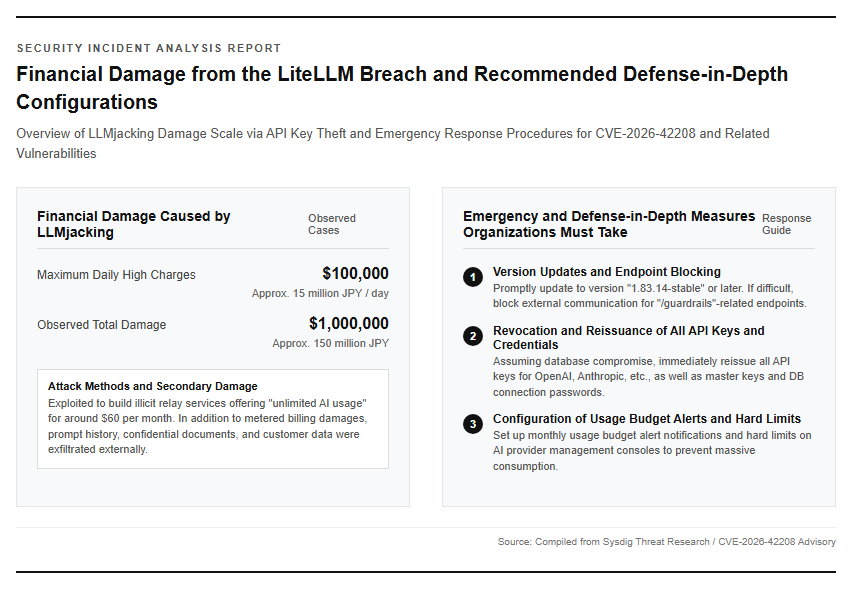
The greatest threat posed by a compromise of LiteLLM is the simultaneous theft of all stored AI provider API keys. Attackers exploit the stolen API keys to execute massive amounts of AI inference at another’s expense and resell the capacity, a practice known as “LLMjacking.” In fact, cases have been reported where attackers escalated a pre-obtained virtual key to administrator privileges, extracted the API keys, and set up unauthorized relay services offering “unlimited AI usage” for around $60 a month. Among victimized organizations, cases of exorbitant billing exceeding $100,000 (approx. 15 million yen) per day, as well as total damages reaching $1 million (approx. 150 million yen), have been observed. Moreover, the damage extends beyond metered-billing charges from AI providers; secondary damages—such as the exfiltration of confidential information sent by internal users, including prompt histories, sensitive documents, customer data, and database connection details—are also intensifying.
Pre-Authentication SQL Injection and Multi-Layered Defense Measures Organizations Must Take
Authentication Path Flaws and Attack Observations in CVE-2026-42208
Regarding LiteLLM, in addition to CVE-2026-40217, a pre-authentication SQL injection vulnerability (CVE-2026-42208) has also become a major threat. This vulnerability stems from the fact that token strings included in the HTTP Authorization: Bearer header were directly concatenated into PostgreSQL database verification queries without being parameterized. Because the SQL statements are executed before authentication decisions are made, any attacker who can reach the proxy port can issue arbitrary SELECT statements without authentication credentials. According to observations by Sysdig Threat Research, the first active attacks were observed just 36 hours and 7 minutes after the advisory was published to the global database on April 24, 2026. The attackers were already familiar with the table structure specific to Prisma ORM, pinpointing and enumerating the three most critical tables: LiteLLM_VerificationToken, which holds master keys; litellm_credentials, which holds upstream keys; and litellm_config, which holds environment variables.
Emergency Response Procedures and Updating to Patched Versions
Organizations operating LiteLLM must implement security measures immediately. First, the highest priority is to promptly complete updates to version “1.83.14-stable” or later, in which all privilege escalation and SQL injection flaws have been resolved. As a temporary measure if immediate updating is difficult, completely block external communication to endpoints related to /guardrails/test_custom_code and /guardrails at the reverse proxy or API gateway layer. Second, if the affected version was previously exposed to the internet, you must operate on the assumption that the database has been compromised, and immediately revoke and reissue all stored API keys for OpenAI, Anthropic, etc., as well as LiteLLM master keys and database connection passwords. Third, configure monthly usage budget alert notifications and hard limits in the management consoles of various AI providers to prevent unexpected mass consumption. The diagram below shows an image of the recommended defense-in-depth architecture.
Future Outlook and Key Points in Generative AI Infrastructure Security
This series of attacks targeting LiteLLM demonstrates that, with the expansion of enterprise generative AI adoption, relay infrastructure (AI gateways) has become firmly established as a high-value attack target, alongside the vulnerabilities of the models themselves. Gateways that centrally manage multiple cloud API keys and credentials become a Single Point of Failure, and their compromise can have a devastating impact on an enterprise’s entire cloud environment and finances. Moving forward, AI infrastructure will be required to adopt a Zero Trust architecture on par with identity management systems and core applications. Specifically, eliminating the direct exposure of relay servers to the internet and isolating them within private networks, transitioning from static long-lived API keys to short-lived session tokens, and thoroughly enforcing access control based on the principle of least privilege will become the new standards for generative AI security.


コメント